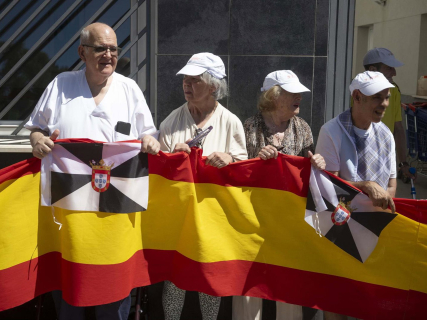

September 2, 2026, will not be just any day in Ceuta. It is City Day, an official holiday, but this year it coincides with the moment of greatest national mobilization in support of the autonomous city since the migration crisis began at the end of July.
The Spanish Federation of Municipalities and Provinces called on Spanish municipalities on August 25 to hold gatherings at 8:00 PM in front of their town halls. At the same time, a parallel citizen mobilization has been spreading events across hundreds of localities. A as of August 29, the map created by the platform Ceuta unites us records 317 confirmed gatherings in 46 provinces.
This does not mean that the 8,132 Spanish municipalities will concentrate. The FEMP has made a general call to all of them, but there is still no institutional record confirming the participation of each municipality. The figure of more than 300 comes from a citizen compilation that is updated as it receives and verifies new calls.
What is celebrated exactly on September 2 in Ceuta
September 2 is officially the Day of the Autonomous City of Ceuta.
The date was established by the Assembly of Ceuta through a plenary agreement on October 1, 1997. The proposal had the unanimity of the present groups and began to be part of the labor holiday calendar in 1998.
There is an important historical nuance. September 2 is not the anniversary of the Portuguese conquest of Ceuta.
John I of Portugal took the city on August 21, 1415. What happened on September 2 was another decisive episode: the monarch appointed Pedro de Meneses as the first governor of the square after deciding to keep it under Portuguese control. From that period come elements that continue to be part of Ceuta's institutional identity, including its coat of arms, its flag, and the tradition of the áleo or staff of command.
In 2026, Ceuta's Day will also again be listed as a labor holiday for the city. Both the official Ceuta calendar and the one published in the BOE list Wednesday, September 2, as a holiday in the Autonomous City, but not in the rest of Spain.
Why this year there will be gatherings throughout Spain
The date has acquired extraordinary significance due to the crisis that began on July 30 and 31.
The massive entry from Morocco overwhelmed the border device for hours and opened a crisis that has lasted throughout August. Interior estimated about 72,000 entries, while thousands of people subsequently remained in the city pending identification, protection requests, care for minors, or return procedures.
The pressure has been changing in nature. First, it was border-related. Then came the problem of reception, healthcare, and minors. In the last week of August, the focus shifted towards coexistence and public order, with successive demonstrations and episodes of violence.
It was in that scenario when the president of the FEMP, María José García-Pelayo, traveled to Ceuta on August 25 and announced the call to all local governments.
The institutional call establishes a common reference: Wednesday, September 2, at 8:00 PM, in front of the town halls. The FEMP presents it as a show of "solidarity and support for Ceuta" and has reiterated its request to the municipalities to join.
More than 300 gatherings, but not all are at 8:00 PM
The citizen map available as of August 29 raises the confirmed gatherings to 317 in 46 of the 52 provinces accounted for by the portal.
The vast majority are scheduled for 8:00 PM, although there are exceptions. LCeuta itself is listed at 7:00 PM; Seville, at 7:30 PM; Pontevedra, at 8:30 PM; Ciudad Real, at 7:30 PM; and other locations have announced different times.
Therefore, it is not advisable to automatically assume that any gathering starts at eight in the evening. The time, place, and organizer must be checked in each municipality before traveling.
Madrid, Barcelona, Zaragoza, Las Palmas de Gran Canaria, A Coruña, and numerous capitals and municipalities are already on the map. In provinces like Seville, a dozen calls are accumulating, and the list continues to change as the mobilizations approach.
There is no single organization behind September 2
Another element that can generate confusion is who is calling.
On one hand, there is the FEMP, which has officially called on the town halls to organize gatherings.
On the other hand, there is a citizen mobilization that is compiling and promoting calls in towns across Spain under the slogan "In favor of the people of Ceuta and for our Unity." Its own portal defines itself as a citizen call.
And in Ceuta there is a third dynamic. The protests that arose in the city during the last week of August have been temporarily halted due to some organizers' fear that they would be linked to violent episodes or ultra groups. The Provincial Federation of Neighborhood Associations and the Ceuta XXI Forum have moved their next major mobilization precisely to September 2.
The three currents coincide on the date, but they are not the same call nor do they necessarily have the same organizers or demands.
September 2 has also opened a political discussion
The call from the FEMP has not been born with political unanimity.
The Socialist Group and the groups of Izquierda Unida-Compromís-Comuns-Podemos, ERC, and Junts within the Federation have maintained that the president of the institution unilaterally made the decision to call for the concentrations and other measures related to Ceuta. The PP supports the initiative.
The discrepancy is important because it does not automatically equate to a rejection by all those parties to participate in acts of support for Ceuta.
The situation changes from municipality to municipality. There are corporations that have announced their adherence, others that have expressed reservations about the way the call was made, and some that have expressly decided to distance themselves.
That is why the map for the 2nd will continue to change until practically the start of the events.
Six provinces still without concentrations on the citizen map
The latest list from Ceuta unites us does not currently register concentrations in Álava, Lugo, Ourense, Palencia, Segovia, and Soria.
That a province does not yet appear on the map does not mean that its municipalities have rejected the initiative from the FEMP. It may simply mean that there is no call communicated to the compilation or that it has not yet been confirmed.