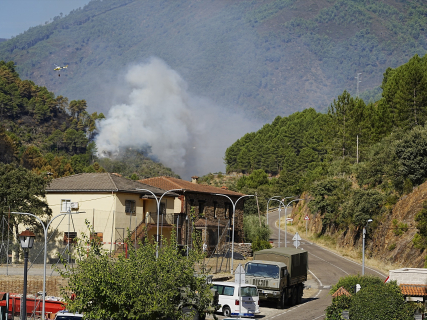
Fires in Spain today, August 24: Segorbe and Pinofranqueado improve after the large fires of August

The fire in Segorbe is stabilized after affecting about 630 hectares, while Pinofranqueado maintains surveillance work and other new hotspots evolve favorably.

3 minutes

incendios 24 agosto

incendios 24 agosto

Add DEMÓCRATA to Google

Ask FREN

Published

Last updated

3 minutes

Most read

The situation of the wildfires presents a more favorable evolution this Monday, August 24, after the main hotspots of the last few days have managed to be stabilized or controlled. The fire in Segorbe, in the Sierra Calderona, has left behind the most critical phase, while the fire in Pinofranqueado, in Las Hurdes, has also improved significantly.

Attention remains on the work of surveillance, refreshing, and consolidating the affected perimeters. Although the general situation has lowered the level of emergency compared to previous days, several fires have still not been declared extinguished and the operatives continue deployed to prevent possible re-ignitions.

Segorbe is stabilized after affecting about 630 hectares

The wildfire declared in Segorbe, in Castellón, has been stabilized after affecting about 630 hectares in the surroundings of the Sierra Calderona. The fire, caused by a lightning strike, became the main forest emergency in the country and forced the evacuation of nearly a thousand residents of Gátova.

The favorable evolution allowed the return of the evacuated population and the deactivation of the extraordinary emergency level. However, preventive measures remain in place in the municipality and teams continue working on the perimeter to consolidate the stabilization and prevent possible reactivations.

Pinofranqueado maintains firefighting efforts in Las Hurdes

The fire in Pinofranqueado, in the Cáceres region of Las Hurdes, has also left behind the most complicated moments of the emergency. The fire, which forced the evacuation of several hamlets and kept the town of Nuñomoral confined, evolved favorably during the last few days and allowed for the gradual lifting of restrictions.

The firefighting resources continue working in the area on the hot spots and the affected perimeter. The improvement of meteorological conditions and the decrease in the intensity of the fire have allowed for the reduction of the extraordinary device, although the fire still requires monitoring before it can be declared definitively extinguished.

Las Peñas de Riglos remains under surveillance after its stabilization

The fire of Las Peñas de Riglos, in Huesca, remains stabilized after being one of the major wildfires of August. The INFOAR operation continues the cooling work on smoke and hot spots located within the wide affected perimeter.

The stabilization allowed the return of the evacuated population and the progressive reduction of the device, but the fire has still not been declared extinguished. The work now focuses on preventing reproductions and definitively consolidating the affected areas.

New fires in Aragón are stabilized or controlled

During the day on Sunday, several wildfires were also recorded in Aragón. One of them was declared in Biscarrués, in the province of Huesca, and was stabilized shortly after its detection thanks to the deployment of aerial and ground resources.

A fire also occurred in Aliaga, in Teruel, which was reported as controlled during the afternoon. These new outbreaks forced the mobilization of resources from the Aragonese operation, although its rapid favorable evolution prevented them from reaching the scale of the major fires recorded in recent weeks.

Niebla remains in control phase after the large fire in Andalucía

The fire of Niebla, between the provinces of Huelva and Sevilla, remains controlled after being one of the largest fires of the summer. The device maintains surveillance over the enormous affected perimeter while the necessary tasks continue to advance towards its definitive extinction.

The situation of this fire contrasts with the emergency experienced during the first weeks of August, when the flames forced the deployment of a large operation and affected thousands of hectares. The current phase allows concentrating efforts on surveillance and monitoring of possible reproduction points.

More key points, information and questions with FREN

AI-GENERATED CONTENT

What is the legal and administrative procedure to declare a forest fire extinguished in Spain?

In Spain, the declaration of a forest fire as “extinguished” is supported by a basic state legal framework (Forestry Law, civil protection regulations, Directive and State Plan for forest fires) and the detailed development made by each autonomous community in their own special plans. Although specific procedures vary by territory, there is a common technical and administrative scheme: succession of fire phases, decision by the extinguishing chief, safety checks, drafting of reports, and integration of that decision into civil protection plans.

1. Basic regulatory framework and distribution of competences

The Law 43/2003, on Forests, as amended, establishes the general framework for the conservation and protection of forests and the need for administrative coordination against forest fires, as well as the declaration of high-risk zones and the obligation to restore burned lands. It is a basic state law that sets principles and leaves autonomous communities a wide margin to organize their prevention and extinguishing services.

From the civil protection perspective, the Law 17/2015, of July 9, on the National Civil Protection System, defines the civil protection plans (state, regional, and local) and requires special plans for specific risks, including forest fires. It regulates how intervention and assistance services are organized, including forest fire prevention and extinguishing services and regional coordination bodies.

On this basis, the Royal Decree 893/2013, of November 15, approves the Basic Directive for civil protection emergency planning for forest fires, which sets minimum requirements for state, regional, and local plans. And the State Civil Protection Plan for Forest Fire Emergencies (Council of Ministers Agreement of October 24, 2014, published by Resolution of October 31, 2014) specifies the organization and action of the General State Administration when there is a “national interest” or support is provided to autonomous communities.

Together, these regulations establish that:

  • The main competence for prevention and extinguishing of forest fires corresponds to the autonomous communities.
  • The State sets common bases and coordinates, especially in major emergencies or when state resources intervene (Military Emergency Unit, state aerial means, etc.).
  • Each autonomous community must approve a Special Civil Protection Plan against forest fires where, among other aspects, the criteria and procedures to declare a fire controlled, stabilized, or extinguished are regulated.

2. Fire phases: definition of “extinguished”

The 2013 Basic Directive, developed by the State Plan, incorporates operational definitions that serve as a common reference:

  • Controlled forest fire: one that has been isolated and stopped in its advance and spread within control lines.
  • Stabilized forest fire: without being controlled, it evolves within the planned control lines, according to extinguishing efforts aimed at its control.
  • Extinguished forest fire: “situation in which there are no longer any ignited materials in or within the fire perimeter nor is it possible for the fire to reproduce.”

This definition is key: extinction is not only the absence of visible flames but a reasonable guarantee that no hot spots capable of reactivating the fire remain within the perimeter.

3. Who decides and how the technical decision is made

Regional plans and the State Plan articulate a typical chain of command:

  • On the ground, there is a director or chief of extinguishing (usually a forestry technician or head of the regional device), who assumes operational direction of the fire.
  • As efforts evolve, that chief proposes phase changes (from active to stabilized, controlled, and finally extinguished), in coordination with the regional emergency coordination center.
  • The decision to declare a fire “extinguished” is based on technical criteria: absence of residual heat in the perimeter and critical points, meteorological and fuel conditions, and results of mop-up and surveillance tasks.

4. Technical criteria and usual checks

Although each regional plan details its protocols, common criteria derive from basic regulations and practice:

  • Perimeter reconnaissance: foot and vehicle patrols inspect the perimeter and the interior of the burned area, paying special attention to roots, stumps, embers in hollows, and areas of fine fuel accumulation.
  • Verification of hot spots: manual tools and increasingly thermal cameras or drones are used to identify possible latent foci.
  • Meteorological and fuel conditions: wind forecast, temperatures, relative humidity, and risk of new ignitions are assessed, as well as the presence of unaffected vegetation inside or near the perimeter.
  • Observation time: a surveillance period is maintained after fire control, during which inspections are made and it is verified that flames do not reactivate.

5. Reports, communication, and administrative closure

Once the extinguishing chief considers the criteria met, an administrative procedure is followed that regional plans specify but usually includes:

  • Drafting a report or extinguishing record, which includes essential data: start and extinguishing date and time, perimeter and affected area, resources used, relevant damages, and special circumstances.
  • Communication to the regional emergency coordination center (112) and, if applicable, to the civil protection structure that declared emergency levels; this, in turn, adjusts the emergency level and updates the status in the Special Plan.
  • If state resources intervened or it was an emergency of national interest, it is also communicated to the competent state body (for example, the National Emergency Monitoring and Coordination Center of Civil Protection) according to Law 17/2015 and the State Plan.
  • After extinction, other administrative phases open: damage assessment, possible declarations of catastrophe zones or areas severely affected by civil protection emergencies, and, from the forestry perspective, restoration obligation and application of land use change restrictions provided in the Forestry Law.

In summary, the declaration of a fire as extinguished is a fundamentally technical act, adopted within the framework of civil protection and forestry plans, but with relevant administrative effects in institutional coordination, statistics, damage assessment, and future management of the affected land.

What competences do the autonomous communities have in the management and extinguishing of forest fires?

The autonomous communities play a central role in the management and extinguishing of forest fires in Spain. The distribution of competences is structured based on the Constitution (arts. 148 and 149), basic state laws (forests, environment, civil protection), and the statutes of autonomy. In practice, almost all ordinary management (prevention, planning, and extinguishing in the territory) is an autonomous competence, while the State retains coordination, support, and basic regulatory functions.

General framework of competences

In general terms, autonomous communities assume competences in:

  • Environment and forests: planning, management, and protection of forests and forest areas, as well as fire prevention.
  • Civil protection and emergencies: organization of their own emergency services and plans against risks such as forest fires.
  • Organization of their public services: regional fire brigades, forest brigades, environmental agents, etc.

The State, for its part, maintains the power to enact basic legislation on environment, forests, and civil protection, and a specific competence in the general coordination of emergencies of national interest, in addition to the use of state resources (such as the Military Emergency Unit or aerial means).

Specific competences of the autonomous communities

1. Fire prevention

Autonomous communities are responsible for designing and applying prevention policies in their territory, which include, among others:

  • Forest planning: preparation of forest plans and specific defense plans against fires (regional forest fire plans, with their high-risk zones).
  • Management of vegetal fuel: silvicultural treatments, clearing, firebreaks, auxiliary strips around infrastructures and urban centers, use of grazing as a preventive tool, etc.
  • Regulation of uses and activities during high-risk periods: restrictions on agricultural burns, machinery use, recreational fires, or transit in certain forest masses.
  • Awareness and environmental education campaigns aimed at the population, forest owners, and professional sectors.
  • Inspection and sanctioning regime regarding forest fires, within the framework of basic state legislation.
2. Planning and organization of devices

It is also the responsibility of the communities to organize fire-fighting devices:

  • Develop their regional civil protection plans against forest fires and the special plans that develop them.
  • Create and equip extinguishing brigades and services (forest firefighters, helitranported crews, advanced command posts, etc.).
  • Determine the command and coordination structure within the device, as well as emergency levels and action protocols.
  • Establish operational coordination centers and emergency rooms (regional 112 numbers).
  • Regulate collaboration with provincial councils, island councils, municipalities, and other local entities in prevention and extinguishing.
3. Extinguishing forest fires

Direct intervention on the ground is fundamentally regional:

  • Direction of extinguishing operations in fires that develop entirely within their territory, unless a national interest emergency is declared.
  • Deployment and management of own or contracted ground and, if applicable, aerial resources.
  • Coordination with municipal fire services and other bodies acting in the fire.
  • Decision on the request for reinforcements from the state or other communities (state aerial means, Military Emergency Unit, interregional cooperation mechanisms).

Relationship with the State and coordination

Although ordinary competence is regional, the fight against forest fires is based on a cooperative system:

  • Basic state regulations establish common minimum standards for planning, prevention, and civil protection.
  • The State provides support resources (planes, helicopters, specialized units) that are mobilized at the request of the affected community or within state plans.
  • If a fire reaches a certain severity or affects several territories, the Government can declare it a national interest emergency, assuming strategic direction but through civil protection mechanisms, in coordination with the autonomous community.

In summary, autonomous communities are the main authorities in prevention, planning, and extinguishing of forest fires in their territorial scope, while the State sets common regulatory bases and provides coordination and reinforcement when the magnitude of the fire exceeds regional capacity or affects national interests.

Could you explain the role the State (including the Military Emergency Unit) plays when a fire exceeds the capacity of an autonomous community? What differences are there between the competences of an autonomous community and those of a municipality regarding forest fires? Can you detail which basic state laws regulate the prevention and extinguishing of forest fires and what aspects each covers?

What have been the largest forest fires in Spain in the last decade and what area have they affected?

In the last decade, the largest forest fires recorded in Spain have been concentrated especially in the most recent years (2022–2026), with several episodes breaking records of burned area. Below I summarize the main cases for which available sources provide clear data on hectares affected.

Main large fires and burned area

  • Burgohondo (Ávila, 2026) – According to the newspaper Demócrata, the forest fire declared in Burgohondo has already burned about 50,000 hectares, making it “the largest fire in the history of Spain since records exist.” It thus surpasses all previous major fires in the country and marks a before and after due to its scale and environmental and social impact over a large part of the province of Ávila (Demócrata news).
  • Molezuelas de la Carballeda–Palacios del Jamuz (Larouco–Quiroga–Oencia, 2025) – In 2025 a large fire affected the municipalities of Larouco, Quiroga, and Oencia, in Galicia and Castilla y León. Demócrata notes that until the appearance of the Burgohondo fire, this was the largest recorded fire in Spain in terms of recent area, with 37,765 hectares burned in August 2025 (same source). Greenpeace also identifies it as the large fire that devastated the surroundings of Palacios de Jamuz, leaving two volunteer fatalities and devastating areas near Las Médulas (Greenpeace note).
  • Losacio (Zamora, 2022) – The Losacio fire, caused by a dry thunderstorm in July 2022, burned more than 30,000 hectares, according to Demócrata, becoming one of the largest forest fires of the 21st century in Spain. Besides the enormous area, it caused four fatalities (a forest firefighter, a shepherd, and two residents), placing it among the most serious recent forest tragedies (Demócrata report).
  • Great wave of fires in Galicia (summer 2025) – This is not a single fire but a set of simultaneous fires of great intensity. The European system EFFIS (Copernicus program) estimated 209,281 hectares affected in Galicia in 2025, of which 171,218 hectares burned only in summer (analysis on Galicia). Within this episode, Ourense was the most affected province, with 177,285 hectares burned throughout the year.
  • Other large fires of 2025 – Greenpeace highlights that in 2025 there was “a historic wave of fires,” and that eight of the ten largest fires of this century took place precisely that year (Greenpeace, 2025; Greenpeace, 2026). Not all those fires are broken down by name and hectares in the consulted sources, but the data illustrates the concentration of large disasters in a single year.

Context: a decade of increasingly large fires

Beyond specific cases, official balances reveal that the problem has worsened in area and severity:

  • The Ministry of the Interior points out that 2025 was the worst year of the decade in number of incidents and hectares affected, with around 348,000–382,000 hectares burned according to different sources (official statistics and Copernicus data) (Interior, 2025; Demócrata).
  • 2026 is worsening even those records: the Ministry for Ecological Transition reported in mid-August more than 226,000 hectares affected and 43 large fires so far this year (Demócrata; MITECO note).
  • Organizations like WWF emphasize that, although the total number of fires tends to decrease, the proportion of Large Forest Fires (more than 500 hectares) grows, with fires “increasingly larger and with the potential to burn thousands of hectares” (WWF Spain).

In summary, the largest fires of the decade — Burgohondo (≈50,000 ha), Larouco–Quiroga–Oencia (37,765 ha), and Losacio (>30,000 ha) — are concentrated in recent years and fit into a trend of fewer fires but much larger and harder to control. The figures come from official sources (MITECO, Interior, Copernicus) and analyses by environmental organizations (Greenpeace, WWF) and media such as the newspaper Demócrata. Not all public statistics offer a closed and ordered list of “the N largest fires” with exact area, so the above overview includes those cases for which there are concrete and verified data on hectares burned.

Play

Test your knowledge with FREN!

How much do you know about this topic? Answer the following 3 questions.

What event caused the Segorbe forest fire?

Question 1 of 3

What measure was taken regarding the population of Gátova during the Segorbe fire?

Question 2 of 3

What is the current status of the Niebla fire between Huelva and Sevilla?

Question 3 of 3

Hola, soy Fren. ¿Cómo te ayudo?