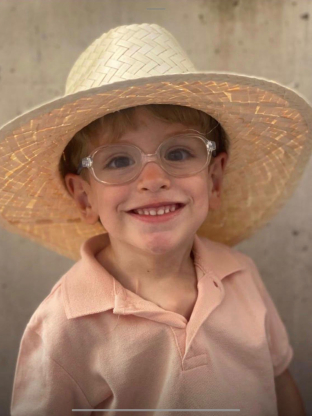

Gonzalo has just turned six years old. Since he was born, Patricia, his mother, noticed that his fingers had a strange shape. «They told me it wasn’t anything. Also when I saw that he had a malformation in his ribs. He also had an enormous amount of photosensitivity and, even though he wore sunglasses, he couldn’t go out into the street or even raise the blinds in his room», she recalls.
Then a journey through different doctors began which, as she tells it, «never told me that Gonzalo had anything. But they never gave me definitive clearance: they always told me to come back in a few months or that they were continuing to review his case».
Over time, Gonzalo began to develop pectus carinatum, a deformity in which the chest takes on a shape similar to a keel. «He kept hitting the development milestones, but it took him longer to reach them, especially in what had to do with motor skills. I kept worrying, but they told me it was normal. As soon as I could, I had him get an X-ray when he turned 18 months. I took him to the Hospital Infantil Universitario Niño Jesús de Madrid and, when the neurologist saw him, she told us that she suspected he might have Morquio syndrome. They started running tests and confirmed the diagnosis. It was a bucket of cold water; it overwhelmed us», Patricia recounts.
Morquio syndrome is a very rare genetic, metabolic and degenerative disease, affecting approximately one in 200,000 people. It is a type IV mucopolysaccharidosis, which can compromise the development of the skeleton and joints, as well as causing alterations in different organs and senses. Among its manifestations are vision problems, hearing loss, recurrent ear infections, cardiac complications, respiratory difficulties, and compression of the spinal cord. In Spain, according to the data that way Patricia, there are currently 42 diagnosed patients.
Patricia highlights the way in which the Hospital Niño Jesús de Madrid accompanied the family after learning the diagnosis. «They were telling us different aspects in a progressive way, so that we could assimilate them little by little. And they sent us right away with a social worker from the hospital, something to be grateful for: there are many bureaucratic procedures related to disability that aren’t easy to do, and even more so with the emotional impact», she emphasizes.
Looking for a treatment
Since the diagnosis, Patricia and her husband decided not to give up and began looking for possible treatments. «We read all kinds of medical articles and spoke with specialists from all over Europe, Japan and the United States. That’s how we came across a preclinical investigation that had shown very promising results in rats, but that had been stalled due to lack of funding. After insisting a great deal for three years, they have granted us the patent to a biotech company that we have created since our association. We already have a team, but we still must meet several milestones and obtain funding».
To move forward with that goal, Patricia drives different initiatives from the association with which she works, both to raise funds and to make the disease known. Among them is a collaboration with Ongiving, which helps to channel donations through a micro-funding campaign with tax deduction. Raising funds is essential in order to be able to continue developing research that, until now, has not gone beyond the preclinical phase.
Patricia explains that Morquio syndrome affects multiple organs, but not intelligence. «In simplified terms, during the process of renewal and destruction of the cells that takes place every day in all organs, substances are generated that must be eliminated by an enzyme. Gonzalo’s body, due to a genetic alteration, does not produce that enzyme. That’s why those substances accumulate and end up damaging the organs».
The consequences for her son are serious. «He has a much shorter life expectancy, numerous malformations and dysplasias, and he will need a wheelchair very soon because walking causes him a lot of pain. My son has all the bones of his body malformed. All of them. He is six years old and the height of a two-year-old child. He will also soon need oxygen because the disease affects the respiratory pathways a lot. And his heart, sight and hearing are affected. It’s devastating», she describes.
At present there is a enzyme replacement therapy that helps to partially compensate for the enzyme deficiency and can slow some of the consequences of the disease, although it does not reach all affected tissues. As Patricia explains, «It means, for example, that he still does not have accumulations in his heart. But it does not reach his sight, his hearing and, of course, his bones».
That is why the family places its hopes in a possible gene therapy, a strategy that seeks to introduce a functional copy of the affected gene or to correct the genetic defect responsible for the disease. The goal is to address the cause of the syndrome and expand treatment possibilities where current therapies have limitations.
“It is encouraging, but for now it has only been tested in rats. Our goal is for the first patient to be able to receive the treatment by the end of 2029 or at the beginning of 2030. I hope it reaches Gonzalo and everyone who comes after,” Patricia adds.
“I also want to highlight the kindness, the human quality, and the sensitivity of our healthcare institutions, which are demonstrated in the excellent reception this project has received. In this regard, I want to express our special thanks to César Hernández and to María Jesús Lamas for their receptiveness, closeness, and interest, as well as for the guidance and support they have provided us from the very first moment.”
“Their willingness to listen, to understand the scope of this initiative, and to offer their support constitutes a show of our institutions’ commitment to people, to the new proposals, and to those projects that seek to add value to society. Attitudes like yours reinforce our confidence and encourage us to keep moving forward, convinced that collaboration, sensitivity, and institutional involvement are essential to turn good ideas into realities,” concludes.
From Demócrata, we support Patricia’s campaign to find a treatment for Gonzalo. You can donate, with tax deduction, through the Ongiving platform, on this link