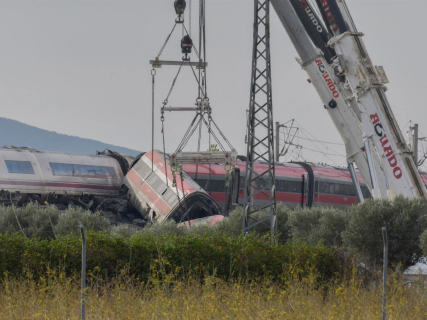

Renfe introduces new safety instructions for its drivers on the Madrid-Seville high-speed line after the Urda accident. The operator establishes that, when traffic resumes at sight speed after a partial blockage of the LZB system, the train may not exceed 40 kilometers per hour until it passes the signal indicated in the authorization.
The measure appears in an internal directive to which El País has had access. The new prescriptions will begin to apply this Sunday, November 1, and regulate how drivers must act in the event of a data transmission loss in the safety system.
The instruction comes after last Wednesday’s accident in Urda, which left a provisional toll of 69 dead. Its application affects specific situations of degraded LZB operation: it does not mean limiting the usual circulation of trains on the corridor to 40 kilometers per hour.
Stop the train and wait for a specific authorization
According to the document described by El País, in the event of a partial LZB blockage the driver must stop the train immediately. After that, they will have to wait to receive from the traffic controller a specific regulatory communication, called LZB3 telephone message, before setting off again.
Renfe identifies that telephone message as the valid authorization to restart circulation in this situation, always under the prescription of sight speed. The instruction seeks to prevent the route from being resumed at normal speed when the protection of the system has been lost.
The document differentiates this case from total blockage and sets out different procedures for each scenario. Therefore, the obligation to stop and wait for the LZB3 corresponds to the case of partial blockage described in the information.
The 40 km/h limit remains until the indicated signal
One of the main clarifications affects the stretch the train may travel after receiving permission to proceed. During the prescribed sight speed, the driver may not exceed 40 kilometers per hour until passing the signal indicated in the telephone message.
That limit must be maintained regardless of the aspect that a previous signal may show. In addition, the driver will have to communicate this prescription to the traffic controller after receiving the authorization, according to El País.
The difference is significant: a prior signal will not be enough to abandon that restriction. The instruction sets both the maximum speed and the point up to which it must be respected.
Check the occupation of the track before starting off
The directive incorporates another check before accepting the LZB3 telephone call. The driver must request from the control center confirmation that his train is the only one that is in the corresponding block section, according to the information from the newspaper.
A block section is a stretch of track used to organize traffic and maintain separation between trains. Checking its occupancy is especially important when the automatic protections stop functioning and traffic depends on alternative procedures.
This requirement affects one of the circumstances described in the reconstruction of the Urda accident: the AVE resumed its journey while an Iryo train remained stopped ahead.
What changes for travelers on the Madrid-Seville route
The new instructions reinforce the conditions for traveling when a specific incident occurs in the LZB. If that procedure is activated, the stop, the checks and the subsequent movement at reduced speed may prolong the journey while the incident is being managed.
The published information does not announce a general reduction in commercial speed or a permanent change in schedules. The change is concentrated in the response to the system failure: stopping when appropriate, receiving the planned authorization, checking the occupancy of the block section and respecting the established limit.
The adoption of these measures also does not by itself determine the responsibilities of the accident. Its scope is operational: to specify the conditions under which Renfe trains can resume circulation after losing the protection of the LZB.