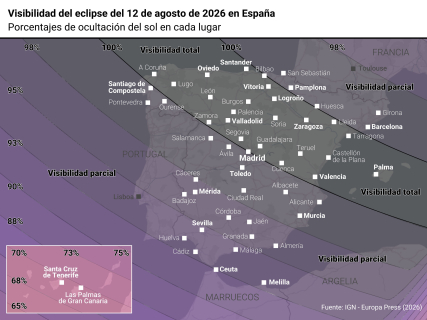
There is no need to be in the 'VIP' zone to see the eclipse: these are the areas of Spain where it can also be appreciated.

The total eclipse of August 12 will cross a specific strip of the country, but practically all of Spain will be able to observe the phenomenon partially.

4 minutes

EuropaPress 7709053 infografia visibilidad eclipse espana 12 agosto 2026 eclipse solar total 12

EuropaPress 7709053 infografia visibilidad eclipse espana 12 agosto 2026 eclipse solar total 12

Add DEMÓCRATA to Google

Ask FREN

Published

Last updated

4 minutes

Most read

The total solar eclipse of August 12, 2026 will have a privileged observation zone in Spain, but it will not be necessary to be within it to contemplate the phenomenon. The totality —the moment when the Moon completely covers the solar disk— can only be observed from a specific strip of territory, but the eclipse will be partially visible from practically all of Spain. The difference will be in the percentage of the Sun that remains hidden in each place and in the specific observation conditions.

The path of totality will cross part of the north and east of the Peninsula and will reach the Balearic Islands. The route will affect territories of Galicia, Asturias, Cantabria, Basque Country, Navarra, La Rioja, Castile and León, Madrid, Castile-La Mancha, Aragon, and the Valencian Community, in addition to the Balearic Islands. In those points, those who are within the path of totality will be able to observe for a few minutes how the Moon completely covers the Sun. Outside of that strip, the eclipse will be partial, but the obscuration will still be significant in large areas of the country.

Madrid, Castile-La Mancha...

One of the clearest examples is Madrid. The capital is located outside the path of totality, but very close to it, so the percentage of the Sun obscured will be very high. As one moves south and west in the Peninsula, the magnitude of the eclipse will decrease. Andalusia, Extremadura, and other areas of central and southern Spain will also be able to observe it, although the Moon will cover a smaller proportion of the solar disk. In the Canary Islands, the phenomenon will also be partially visible.

In Castile-La Mancha, the conditions will vary considerably depending on the locality. Part of the community will be within the path of totality, while other municipalities will be able to witness a partial eclipse. Alhambra, in Ciudad Real, will be outside of totality, but will be able to clearly appreciate the eclipse, with a significant obscuration of the Sun. This means that, although from there the moment of darkness typical of totality will not occur, the progression of the Moon over the solar disk and the consequent change in the illumination of the surroundings will be observable.

Awaiting the sunset

One of the peculiarities of the Spanish eclipse will precisely be its timing. The phenomenon will occur at the end of the afternoon, when the Sun will be very low on the western horizon. This makes the choice of observation location especially important. A point from which there is a clear view to the west will allow for a longer observation of the eclipse, while a mountain, a building, trees, or other obstacles may hide the Sun before the phenomenon ends. Cloudiness will be another determining factor.

For this reason, for those who are outside the path of totality, it will not always be necessary to travel hundreds of kilometers to enjoy the eclipse. If the percentage of obscuration is high in your locality and there is a clear western horizon, the experience can be very remarkable. In addition to the image of the partially covered Sun, the reduction of solar radiation can cause noticeable changes in ambient lighting and, depending on local conditions, also in temperature.

The fundamental difference is that outside the path of totality the solar disk will never completely disappear. In the totality zones, on the other hand, the Moon will completely cover the Sun for a few minutes and some of the characteristic effects of these phenomena will appear: a sudden drop in brightness, a decrease in temperature, and the appearance of the solar corona, among others. It is precisely that brief period that makes certain localities the most sought after to observe the eclipse.

Eye Protection

Safety is another element that does not change whether inside or outside the totality zone. During the partial phases, one should not look directly at the Sun with conventional sunglasses . To observe it, it is necessary to use appropriate and approved solar filters for solar observation. Normal sunglasses, even if they are dark or polarized, do not offer the necessary protection. It is also possible to follow the phenomenon through indirect methods, such as pinhole projection, without looking directly at the Sun.

The eclipse map thus leaves a clear difference between the 'VIP zone', where the totality can be contemplated, and the rest of Spain. The former will be the most sought after by those who want to experience the complete astronomical phenomenon, but the latter will be much more extensive. From Galicia to the Canary Islands, passing through Madrid, Castilla-La Mancha, Andalusia, Extremadura, and a good part of the rest of the territory, millions of people will be able to see how the Moon interposes between the Earth and the Sun.

On August 12, 2026, therefore, it will not be necessary to be in the totality strip to participate in the eclipse. The key for those who find themselves outside of it will be to know the percentage of obscuration of their locality, have a clear western horizon, and use the appropriate observation material. The totality will be the heritage of a specific strip; the partial eclipse, on the other hand, will be a phenomenon much more widespread across Spain.

More key points, information and questions with FREN

AI-GENERATED CONTENT

What phase is the planning of tourist infrastructures for the 2026 eclipse in Spain currently in?

The planning of tourist infrastructures for the August 12, 2026 eclipse is no longer in the design phase but in the operational deployment and final adjustments phase. At the state level, the Interministerial Commission of the Eclipse Trio has defined mobility, security, tourism, and public information plans, with a Specific Civil Protection Plan and a Security Plan already activated. Several autonomous communities (Catalonia, Galicia, Balearic Islands, Aragon…) have configured their own devices, with specific commissions, observation zone maps, and coordination with the tourism sector. At the municipal level, cities like Valencia and Madrid have concrete protocols, official observation points, reinforced transport and services, and are working with the Spanish Federation of Municipalities and Provinces (FEMP) to coordinate municipalities in receiving visitors.

State planning: from strategy to operation

The Government formally created the Interministerial Commission for the Eclipse Trio by royal decree, aiming to coordinate security, mobility, tourism promotion, and scientific dissemination for the 2026-2028 eclipses, including the August 12, 2026 eclipse, considered a “unique” phenomenon as it is the first total eclipse visible on the peninsula since 1905 and the only inhabited territory where it will be fully seen, according to the Ministry of Science (Commission creation).

In its first and second meetings, this Commission defined priorities such as tourism promotion, definition of observation points, and coordination among administrations, creating five working groups (mobility, prevention/civil protection, tourism and economic impact, public health, and scientific dissemination) and opening participation to 16 autonomous communities (first meeting, second meeting).

The Interior Ministry has already moved from the planning phase to operational command, with the establishment of the State Coordination and Direction Committee (CECOD) and a Specific Civil Protection Plan that foresees a Unified Command Post at CENEM, 33,600 deployed agents, more than 350 observation points, and 123 exclusion zones due to environmental risk, attending to an estimated 1.8–2.9 million displacements (Interior plan).

The DGT (Traffic General Directorate) considers the eclipse a “High Traffic Impact Event” and has activated a specific plan with continuous monitoring, reinforcement of the Traffic Group, and possible access restrictions to certain tourist sites, along with explicit recommendations to choose authorized points and avoid stopping on road shoulders (Traffic recommendations).

In parallel, the Transport Ministry has promoted digital tools to support observation planning and visitor distribution, key for astrotourism: a specific website for the “Iberian Trio” with viewers for more than 8,000 municipalities (Iberian Trio website) and a cartographic viewer and mobile app “IGN Eclipses” to plan the exact place to see the eclipse, including relief information, schedules, and conditions (Transport resources).

Autonomous communities: own commissions and tourist maps

Catalonia has created an Interdepartmental Commission for the eclipse, chaired by the president and involving 13 departments, working on an action plan regarding research, mobility, management of observation spaces, tourism promotion, and security; official observation points and a broad dissemination campaign are planned (Catalan commission, Catalonia action plan).

In the Balearic Islands, the Government has established a Commission for the Management of the 2026 Eclipse and developed a strategy based on anticipation and reduction of displacements, coordinating with the hotel sector so many visitors observe it from their own accommodations (Government planning). Additionally, it has launched the tool “Horizon Eclipse 2026” to check real visibility and minimize unnecessary travel, integrated into a plan with maps of Safe Observation Zones, multilingual campaigns, and joint work with the tourism agency AETIB (Horizon Eclipse 2026).

Galicia, for its part, presents the eclipse as an opportunity to consolidate itself as an astrotourism destination, working with the sector and other departments to make the event “safe and attractive” and extend stays, relying on its certified Starlight destinations (Galicia Tourism plan).

Municipalities and local network: official points and services for visitors

At the municipal level, Valencia has approved the “Solar Eclipse 2026” device, which includes the designation of an Official Observation Point on the Malvarrosa and Cabanyal beaches (about 850 meters of coastline) and coordination of Local Police, Firefighters, Civil Protection, EMT, rescue, reinforced bathing, cleaning, and a CECOPAL to manage the massive dispersion of the public after the phenomenon (Valencia protocol).

In Madrid, the City Council has focused part of its action on the Planetarium, with special programming, workshops, and distribution of certified glasses through cultural facilities and municipal libraries, integrating tourism, culture, and security in observation (Madrid City Council action).

In rural and inland areas, Aragon has detailed in its Parliament a strategic plan with large observation areas (Motorland, industrial parks, ski resorts, etc.) equipped with massive parking, health devices, tourist information, and screens to follow the phenomenon, explicitly designed to manage both the tourist pull and mobility and fire risks (information gathered by the newspaper Demócrata in Aragon and the eclipse).

Additionally, the Spanish Federation of Municipalities and Provinces is integrated into the Interadministrative Commission of the Eclipse Trio and working groups on mobility, tourism, civil protection, and environmental risks, conveying specific protocols and resources to municipalities through its network, as reported by Demócrata (FEMP-municipalities coordination).

Conclusion: current phase

In summary, as of August 11, 2026, the planning of tourist infrastructures and associated devices for the eclipse is in the execution phase: coordination frameworks and plans are already approved, observation points and linked services (mobility, emergencies, tourist information) are defined, and political and institutional effort focuses on managing the real influx of visitors, minimizing risks (especially traffic and fires), and capitalizing on the tourist impact without excessively straining the host territories.

What official estimates exist about the number of tourists and the economic impact of the 2026 eclipse in Spain? Which autonomous communities have created commissions or specific tourism and security plans for the eclipse? What role are small and rural municipalities within the path of totality playing in the tourist management of the eclipse?

What are the competencies of local authorities regarding citizen security during large astronomical events?

During large astronomical events (for example, eclipse observations in squares, beaches, or viewpoints), local authorities in Spain have clear but limited competencies regarding citizen security: they manage the use of public space, deploy local police and municipal civil protection, approve or condition the activity, and can sanction violations of their ordinances. Public security in the strict sense remains a state and autonomous community competence, requiring close coordination with the Government Delegation/Subdelegation and State Security Forces and Corps. These events are legally treated as outdoor gatherings, recreational activities, or shows, not as a special category, and are subject to the general regime of citizen security and civil protection.

General framework of competencies

The Organic Law 4/2015, on citizen security protection defines citizen security as the protection of people and property and maintenance of public tranquility, reserved to the State, but recognizes that local authorities exercise their powers “in accordance with Organic Law 2/1986 and local regime legislation, public shows, recreational activities, and classified activities” (initial articles; can be consulted in the Organic Law 4/2015). This referral is key: the municipality acts mainly through local police, ordinances, and public domain use regulations.

The Organic Law 2/1986, on Security Forces and Corps establishes the distribution of functions among State, autonomous communities, and local corporations, emphasizing that public security is a “shared” matter where cooperation and coordination among police forces prevail (Organic Law 2/1986).

At the local level, Law 7/1985, Regulating the Bases of Local Regime sets municipal own competencies, including security in public places, local traffic regulation, civil protection, and management of public domain (squares, streets, viewpoints, etc.), implemented through ordinances and authorizations (Law 7/1985).

Law 17/2015, of the National Civil Protection System, configures civil protection as a public service integrated by all administrations, with territorial and municipal plans, and foresees citizen participation and volunteering (Law 17/2015). Local plans are the basic instrument for preventive and emergency response devices in mass events.

Preventive planning and use of public space

In a massive astronomical event, the municipality can and should:

  • Integrate the event into its municipal civil protection plan or activate specific devices (traffic cuts, medical points, evacuation signage, lighting reinforcement or, conversely, lighting control if the city darkens for observation).
  • Regulate the use of local public domain: authorize or deny public road occupations (stages, stands, collective telescopes), set capacities for squares or viewpoints, and establish safety conditions (free aisles, emergency access, physical barriers).
  • Order traffic and mobility at accesses to beaches, ports, urban roads, or municipal parking to avoid bottlenecks and facilitate emergency actions.

These powers are supported by local regime legislation and autonomous community regulations on public shows and recreational activities, which usually require self-protection plans when certain capacities are exceeded.

Coordination with State and Security Forces and Corps

According to Organic Law 4/2015, the state authority (Government Delegation/Subdelegation, Ministry of Interior) directs the general citizen security policy, while local authorities “exercise the powers that correspond to them” in coordination and institutional loyalty. For large human gatherings, Organic Law 2/1986 contemplates concurrent functions: surveillance of public spaces, protection of demonstrations, and maintenance of order in large gatherings, with possible intervention of State Security Forces and Corps at the request of autonomous or local authorities, or by state decision.

In practice, local security boards and joint devices are used where local police handle urban order and traffic regulation, while the Civil Guard or National Police assume, as the case may be, crowd control, interurban access, and security in the strict sense.

Civil protection, emergencies, and sanctioning power

According to Law 17/2015, the municipality is a basic piece of the National Civil Protection System: it deploys municipal services and volunteers, coordinates with autonomous emergency services, and participates in preventive information to citizens (safe behaviors in elevated areas, fall prevention, attention to vulnerable groups, etc.).

Regarding sanctions, municipalities can apply their sanctioning power for violations of ordinances (unauthorized occupations, failure to meet safety conditions, dumping, noise, unauthorized street vending, etc.), while infractions typified in Organic Law 4/2015 (e.g., serious disorders, resistance to authority) are processed by the state administration, although local police can report the facts.

In summary, in large astronomical events the municipality does not assume full public security but controls the framework: where, how, and under what conditions it is held, how civil protection response is organized, and what is sanctioned administratively locally, always in coordination with other competent administrations.

Could you detail the specific functions of the local police during a mass astronomical event in my municipality? What types of authorizations and safety conditions does a municipality usually impose for a public eclipse observation? How is coordination articulated between the municipality, the autonomous community, and the Government Delegation in a security device for an event of this type?

What technical requirements must a solar filter meet to be considered approved according to Spanish regulations?

In Spanish and European regulations, there is no specific “approval” only for solar filters; rather, they are considered cosmetic products and must comply with the general regime of safety, manufacturing, control, and labeling provided in Regulation (EC) 1223/2009 and its national development, Royal Decree 85/2018 (Royal Decree 85/2018). With the information available in the consulted standards, the general framework of requirements (safety, good manufacturing practices, cosmetovigilance, labeling in Spanish, market control) can be described, but the minimum SPF values, UVA protection requirements, nor test methods that are usually set at the European level and in UNE standards do not appear in the specific text. Therefore, a sunscreen sold in Spain must at least comply with all requirements for any cosmetic and adhere to ingredient limits and safety obligations derived from that regulation.

General legal framework applicable to solar filters

The central piece of the system is the Cosmetics Regulation (EC) (expressly mentioned in the preamble of Royal Decree 85/2018), directly applicable throughout the EU. This regulation requires that all cosmetics be safe under normal or reasonably foreseeable conditions of use, respect composition and labeling rules, and have a responsible person in the EU and an information file with a safety report.

In Spain, Royal Decree 85/2018 develops this regulation, regulating, among other aspects:

  • Competent authorities (AEMPS, autonomous and local health authorities) and their inspection and control powers.
  • The obligation that only cosmetics complying with the European Regulation and the royal decree are marketed.
  • The Spanish Cosmetovigilance System, to collect and evaluate undesirable effects.
  • Health control at the border of imported cosmetics.

Previous cosmetics regulations (Royal Decree 1599/1997 and its amendments) are largely repealed or residual, as recognized by Law 10/2013 and Royal Decree 85/2018 itself, as well as various orders modifying annexes of that regime: Order SAS/642/2010, Order SAS/346/2010, Order SAS/1166/2010, Order SAS/2061/2010, Order SAS/2063/2010, Order SPI/3375/2011, Order SSI/2260/2012, or Order SCO/249/2003, among others.

Safety, manufacturing, and control requirements

Royal Decree 85/2018 emphasizes that cosmetics, including solar filters, must be manufactured according to good manufacturing practices, supervised by AEMPS and autonomous health authorities. Once compliance is verified, these authorities can issue a certificate of good practice compliance valid for up to three years.

Regarding market control and health protection, the royal decree foresees that when a cosmetic presents a serious health risk, authorities can take measures such as:

  • Limiting or prohibiting manufacturing, import, or marketing.
  • Quarantining, withdrawing from the market, and product recall.

These powers are also supported by general regulations on medical products and medicines, such as Royal Legislative Decree 1/2015, and Law 14/1986, General Health Law.

Labeling, language, and traceability

The corresponding article of Royal Decree 85/2018 requires that labeling information provided for in article 19 of the Cosmetics Regulation (name, content, precautions for use, minimum durability date, batch, etc.) appear in Spanish on products made available to the final user in Spain, as well as product file information kept in Spanish territory. This obligation also applies to products presented without prior packaging or packaged at the point of sale, which must be accompanied by labels or leaflets with mandatory mentions.

Likewise, product traceability is reinforced and the obligation to have an information file with the safety report, available to the competent authority, for each cosmetic introduced into the market.

Ingredients, limits, and analysis methods

Solar filters are subject to ingredient limits and toxicological and safety requirements defined in the European Regulation and previous Spanish regulations on cosmetic ingredients, developed through orders such as Order of September 28, 1989 (cosmetic analysis methods) and resolution on hexachlorophene. However, in the consulted texts, neither specific methods to measure SPF nor specific UVA/UVB protection ratios are detailed, which are usually set today by UNE standards and international standards whose mention appears only as general lists of standards (UNE resolution 2017, UNE 2014, UNE 2018, UNE 2020, UNE Sept. 2020, UNE Nov. 2022, UNE Oct. 2022, UNE Jul. 2025), but without breaking down their content.

Similarly, several European directives on cosmetic product analysis methods are cited, such as the Seventh Directive 96/45/EC, the Sixth Directive 95/32/EC, and the Fifth Directive 93/73/EEC, but they also do not specify, in the sources handled, the specific technical parameters of sunscreens.

Scope of available information

In summary, for a solar filter to be “approved” and marketable in Spain it must: be a safe cosmetic, manufactured under good practices, with a responsible person and safety file, comply with authorized ingredient limits, and meet labeling and traceability obligations established by the European Regulation and Royal Decree 85/2018. However, no further information is available in the consulted sources about numerical SPF requirements, minimum UVA protection proportion, or specific test methods, which presumably refer to technical regulations and UNE standards not developed in the texts accessible here.

What exactly does the European Cosmetics Regulation say about the minimum SPF and UVA protection of sunscreens? What role does AEMPS have in the market withdrawal of a sunscreen that does not comply with regulations? What specific UNE standards are currently applied in Spain for SPF and UVA test methods in solar filters?

Play

Test your knowledge with FREN!

How much do you know about this topic? Answer the following 3 questions.

On what date will the total solar eclipse visible in Spain occur?

Question 1 of 3

Which areas of Spain will be within the totality path of the eclipse?

Question 2 of 3

What safety measure is essential during the observation of the partial phases of the eclipse?

Question 3 of 3

Hola, soy Fren. ¿Cómo te ayudo?