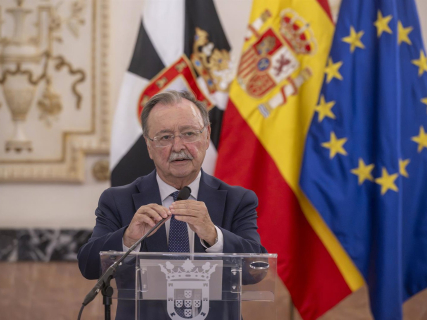

The president of the Autonomous City of Ceuta, Juan Jesús Vivas, has offered for the first time a detailed chronology of the hours leading up to the massive entry of migrants on July 30 and assures that he alerted Moncloa directly three days before the crisis began.
In an extensive interview published this Sunday by El Español, Vivas explains that on Monday, July 27, he decided to contact the Presidency of the Government because the strong increase in arrivals by swimming during the previous days made him think that Ceuta could be approaching an emergency situation.
According to his account to El Español, that call was answered by Diego Rubio, chief of staff of Pedro Sánchez, who would have conveyed calm and committed to contacting the various ministries to analyze the situation.
Monday 27: Vivas calls Moncloa directly
Vivas assures that the alert did not arise on the same day of the massive entry. By then, he explains, Ceuta had been registering an extraordinary increase in people reaching the city by swimming for several days.
The Ceuta president claims that approximately 1,500 people had arrived by the coast over about a week, while the number of minors attended had risen from around 180 to about 800. It was that growth, he explains to El Español, that led him to call Moncloa on Monday the 27th.
The call is particularly relevant in the current debate about what information the Government had before July 30, although the account of those conversations comes from Vivas himself and the internal communications that would allow for an independent reconstruction of their content have not been made public.
Tuesday 28: asks to study the state of alarm
Concern increased the next day. According to Vivas, on Tuesday the 28th he held a meeting with the head of Civil Protection and with the counselor of the Presidency of Ceuta. From that meeting, he called the Ministry of the Interior to propose the possibility of studying the declaration of state of alarm from the perspective of Civil Protection.
Vivas maintains that Minister Fernando Grande-Marlaska could not personally attend the call because he was busy with the crisis of the fires that were then affecting different parts of Spain.
From the Interior, the Ceuta president assures, they indicated that they would study the legal fit of the request.
It was not yet about formally requesting the activation of the state of alarm, but, according to his version, about asking the Government to analyze whether there was a legal basis to use that instrument in light of the deterioration of the situation.
Wednesday 29: the Government rules out the measure
The response would have arrived approximately 24 hours later. Vivas asserts in the interview that during the afternoon of Wednesday 29 he received a call from a Government spokesperson in which he was informed that there was not enough "legal foundation" to declare the state of alarm.
He was also informed that the operational direction of the situation corresponded to the Government delegate in Ceuta. The next morning, Thursday 30, the massive entry began.
The sequence that Vivas provides is, therefore, particularly significant from a political point of view: Monday, call to Moncloa; Tuesday, request to study the state of alarm; Wednesday, negative response; Thursday, massive entry.
A new piece in the debate on prior warnings
Until now, much of the political controversy had focused on knowing what the CNI, Interior, and the Government Delegation knew about the calls circulating on social networks before July 30.
The Minister of Defense, Margarita Robles, has publicly defended that the intelligence services did their job and conveyed information to the corresponding agencies. Interior, for its part, has maintained that it did not receive any report that would allow anticipating an entry of the magnitude that ultimately occurred.
Vivas's account now introduces another distinct issue: regardless of the existing intelligence information, the president of Ceuta himself asserts that the City conveyed its concern to the central Government several days earlier.
This does not prove that Moncloa could have known in advance that tens of thousands of people would try to reach Ceuta on the 30th. It does raise a new question about what level of risk the different administrations assigned to the signals accumulated during the previous days.
Sánchez called Vivas when the entry was already underway
According to the reconstruction that Vivas provides to El Español, the first direct conversation he had with Pedro Sánchez took place on Thursday 30, when the massive entry had already begun.
The president of the Government would have conveyed to him that the situation would be resolved. Vivas assures that he responded by asking him to travel to the city because he considered that the magnitude of what happened required the presence of the head of the Executive.
Sánchez finally traveled to Ceuta the next day accompanied by the Minister of the Interior, Fernando Grande-Marlaska.
During that visit, the president of the Government presented what happened as a matter that affected the territorial integrity of Spain and, as Vivas recalls in the interview, defended that relations with Morocco were good.
Vivas estimates that there could still be about 10,000 people. A month after the crisis, the interview also reflects differences between the Ceuta Government and the Ministry of the Interior regarding the number of migrants who still remain in the city.
Marlaska has placed that figure around 5,000 people, while Vivas believes it could be around 10,000.
The Ceuta president himself, however, introduces an important caution. He acknowledges that his estimate does not come from a statistical census, but from the estimates he receives from associations, neighbors, and the existing perception on the ground. Therefore, the two figures cannot be considered equivalent or definitive counts.
"Ceuta is not the same"
Vivas describes to El Español a city still marked by the consequences of July 30.
The president speaks of insecurity, social tension, pressure on public services, and deterioration of coexistence, and considers that the main priority must be to accelerate the returns of people who legally do not have the right to remain in Spain.
In recent weeks, there have been protests, incidents around reception spaces, and various violent episodes, while the Ceuta Assembly has repeatedly demanded that any mobilization take place peacefully.
Vivas questions why the single command took almost a month
Another of the criticisms raised by the Ceuta president relates to the coordination of the state response.
After the massive entry, the Assembly demanded extraordinary measures, including the activation of mechanisms contemplated in the National Security Law.
The Government ended up declaring the situation of interest for National Security and establishing a functional authority coordinated by Ángel Víctor Torres several weeks after the beginning of the crisis.
Vivas now claims that he does not understand why this type of mechanism was not activated earlier.
The central Executive, on the contrary, maintains that it managed to contain the entries during the first days, facilitate the return of a good part of the people who had crossed, and subsequently adapt the device to a second phase focused on identification, reception, and administrative procedures.
About Morocco: "I knew it," but without proof that it organized it
Vivas also addresses in the interview the role of Morocco and differentiates between two issues.
The president of Ceuta is convinced that the Moroccan authorities knew that a massive mobilization was taking place towards the border, because he considers it difficult for tens of thousands of people to move to the area without the authorities' knowledge.
However, he acknowledges that he does not have intelligence information that proves that Rabat organized or directed the operation.
The distinction is relevant: suspecting that Morocco knew about the mobilization does not equate to proving direct participation of the Moroccan state in its organization.
He also considers the resources for minors insufficient
The president of Ceuta also questions the 25 million euros allocated for the care of migrant minors.
As he explains to El Español, that amount was initially calculated based on a reception capacity much lower than what the city currently needs.
Vivas estimates around 1,500 the minors received and warns that there could still be others pending incorporation into the system. These numbers also cannot be considered definitive, as they have been changing during August as a result of the processes of identification, age determination, and elimination of duplicities.
The 72 hours prior return to the center of the debate
Vivas's statements once again place the political focus on the three days immediately prior to July 30.
His version does not confirm that the Government was aware in advance of the scale that the massive entry would reach. It also does not resolve the existing controversy between Defense and Interior regarding the intelligence warnings.
But it does add an element that has been less publicly detailed until now: the president of Ceuta assures El Español that he directly warned Moncloa on Monday the 27th and that on Tuesday the 28th he asked the Government to study the possibility of declaring a state of alarm.
Three days after that first call, Ceuta faced the largest migratory influx in its recent history. The question that Vivas's chronology leaves open is now what information each agency handled, what severity it attributed to the existing signals, and what decisions were made during the last 72 hours before the avalanche began.