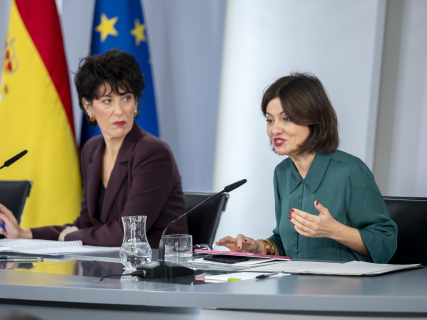

Can the Government of Spain shut down TikTok? The possibility has entered the debate after the Ministry of Youth and Childhood, led by Sira Rego, has requested the intervention of the Public Prosecutor’s Office of the State in response to the dissemination of child sexual abuse material on the social network. The department has even proposed to suspend TikTok’s services in Spanish territory if the competent authorities consider that there are sufficient grounds. However, although legislation includes mechanisms to restrict digital platforms, the Executive cannot order their closure based on a simple political decision.
The initiative by the ministry responds to an investigation by Maldita.es, published this Monday, November 9, which has identified more than 1,000 posts containing child sexual abuse material that accumulate approximately 48 million views. The organization has also detected deficiencies in TikTok’s moderation systems, after verifying that the platform removed only five of the 50 videos that were expressly reported. Based on these findings, Youth and Childhood believes that infringements of minors’ rights could exist and calls for an immediate response from national and European authorities.
The point is that the law distinguishes between removing illegal content and completely blocking a platform used by millions of people. The first measure can be directed at specific publications that violate legislation, while the second would also affect users who carry out legitimate activities. For this reason, any eventual shutdown of TikTok would have to meet especially strict requirements of necessity and proportionality, in addition to respecting fundamental rights and established procedures.
What Spanish law says about the possibility of shutting down TikTok
The main rule governing this possibility is the Law 34/2002 on Information Society Services and Electronic Commerce (LSSI). Its Article 8 allows competent bodies to adopt measures to interrupt the provision of digital services or remove content when these attack or may attack certain protected rights and interests.
Among the assumptions contemplated are the protection of children and young people, public order, public safety, criminal investigation, national defense, public health, and the dignity of persons. The law also includes the protection of consumers and users, the principle of non-discrimination, and intellectual property rights. Therefore, the dissemination of child sexual abuse material could constitute a basis for studying restrictive measures against a service such as TikTok.
However, Article 8 does not grant any ministry a general power to close social networks. The rule specifies that these decisions correspond to the competent bodies, within the functions that they have legally assigned. It also requires respect for the guarantees intended to protect privacy, personal data, freedom of expression, and the right to receive information.
In the cases that the Constitution and laws reserve to the courts, only the competent judicial authority may adopt the corresponding measures. This becomes especially important in the face of a general blocking of TikTok, which could prevent access to legal content and affect the exercise of fundamental rights. The authorities would have to justify why it would not be enough to remove the illicit videos, suspend the accounts responsible, or require improvements in moderation systems before restricting access to the entire social network.
Would a judge have to intervene to block TikTok in Spain?
Judicial intervention would depend on the legal channel used and on the rights affected, but it cannot be bypassed when the Constitution or legislation establishes it as mandatory. In a proceeding intended to completely restrict a platform, the proportionality control would be especially relevant due to the scope of the measure and its consequences for millions of users.
In addition, there is a circumstance that complicates any eventual unilateral action by Spain: TikTok provides its services in the European Union through a company established in Ireland. As it is a company located in another Member State, the cooperation mechanisms provided for in European and Spanish legislation must be respected.
Sections 3 and 4 of Article 8 of the LSSI establish that, as a general rule, Spain must first request the intervention of the State where the service provider is established. If its authorities do not adopt measures or these prove insufficient, the competent Spanish body must first communicate the restriction provided for both to that State and to the European Commission.
Legislation includes an exception for urgent situations. In those cases, the competent authority may adopt measures without first completing the entire cooperation procedure, but it must justify the urgency and communicate its decision to the European authorities as quickly as possible and, at the latest, within a period of 15 days from its adoption. This exception does not eliminate the judicial guarantees and the protection of fundamental rights that may apply.
Therefore, Sira Rego’s request to the Public Prosecutor’s Office does not constitute an order to shut down nor does it allow TikTok to be automatically suspended. The Public Prosecutor’s Office may examine the facts, promote the corresponding investigations, and request judicial measures when appropriate, but any eventual restriction must be processed through the legally empowered bodies.
The European Union also allows suspending platforms, but as a last resort
The second major legal avenue is found in the Regulation on Digital Services of the European Union (DSA), which sets obligations for digital platforms and grants the European Commission powers to investigate and sanction noncompliance.
TikTok is considered a very large online platform, which implies strengthened obligations to assess and reduce risks related to the dissemination of illegal content, the operation of its algorithms, and the protection of minors.
The article 82 of the regulation contemplates the possibility of requesting temporary access restrictions when the tools available to put an end to an infringement have been exhausted, this persists, and causes serious harm that cannot be avoided by other measures. In that scenario, the European Commission may request that the digital services coordinator of the State where the company is established act in accordance with the procedure provided for in article 51.
This last provision establishes especially demanding conditions. Among them, that the infringement persists despite prior measures, causes serious harm, and constitutes an offense that threatens the life or security of individuals. Limiting access must be requested before a competent judicial authority, which will have to assess its proportionality and the consequences for access to lawful information.
The regulations establish that the initial restriction will last for four weeks, although they provide for judicially authorized extensions if the circumstances that justified the measure persist. Before reaching that point, Brussels has other tools, such as requiring changes to recommendation systems, imposing corrective measures, or financially sanctioning the company.
If a breach of the regulation is proven, fines may reach up to 6% of the platform’s worldwide annual turnover. However, the existence of illegal content alone does not demonstrate that all the necessary requirements to impose a sanction or block the service have been met.
Can the Government use national security to shut down TikTok?
Another possibility that could be considered is to rely on national security or telecommunications legislation. However, these rules also do not allow the Government to block a social network at its discretion.
The 4.6 article of Law 11/2022, General of Telecommunications allows the Executive, on an exceptional and temporary basis, to directly manage certain networks or electronic communications services in order to guarantee public and national security. This is a power related to the infrastructures and services defined by that law, which does not constitute a general authorization to suspend content platforms such as TikTok.
The provision also states that these interventions may not violate fundamental rights and public freedoms. The agreements adopted must be communicated to the competent judicial body within 24 hours, so that it can check their suitability for those rights within the following 48 hours.
For its part, the Article 23.3 of Law 36/2015, on National Security determines that situations of interest for national security must be addressed through the ordinary powers of the administrations and that, in no case, may they involve the suspension of citizens’ fundamental rights and public freedoms.
Consequently, invoking reasons of national security would not automatically make it possible to avoid the procedures and checks required to restrict access to a digital platform.
What could happen now with TikTok after the Government’s request
The action by the Ministry of Youth and Childhood opens the door to new investigations and possible measures against TikTok, but it does not mean that there is a decision to suspend its operations in Spain. The Prosecutor’s Office must analyze the information received and determine whether it is appropriate to promote criminal actions or request measures to protect the affected minors.
Meanwhile, Sira Rego has requested an urgent meeting with the representatives of TikTok in Spain to learn the company’s explanations, the measures adopted to prevent the spread of the material, and the immediate actions it plans to apply.
European authorities may also examine whether the complaint, detection, and content removal mechanisms comply with the obligations established by the Digital Services Regulation. A potential investigation could result in requests, corrective measures, or sanctions if failures were proven.
The fundamental difference is that the removal of illegal content, the investigation of possible offenses, and the general blocking of a platform are different actions, subject to different legal requirements. To reach this latter measure, it would be necessary to prove that there is a sufficient legal basis, that the competent authority acts, and that there are no less restrictive alternatives capable of effectively protecting the affected rights.
For now, the Government can promote investigations and request actions against TikTok, but cannot shut down the platform through a simple political decision. Spanish and European legislation provides for the interruption of digital services in exceptional circumstances, always with the corresponding administrative, judicial, and international cooperation guarantees.