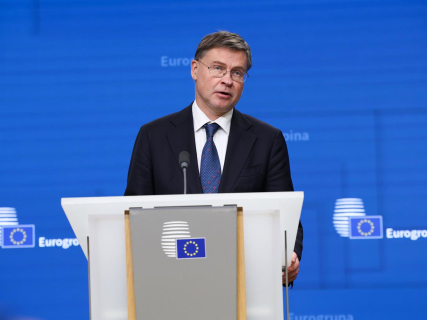

The European Commission has cooled this Thursday the request from Italy and Greece to further extend the flexibility of the fiscal rules to address the impact of the energy crisis. Brussels argues that the current framework already offers sufficient leeway to react to the situation and warns that introducing additional exceptions repeatedly could undermine the credibility of fiscal policy.
"We cannot introduce new fiscal flexibilities all the time. In fact, this could raise doubts about our collective determination to maintain a rules-based fiscal framework at a time when the credibility of our commitment to fiscal sustainability is a vital asset. So we should not put it at risk," defended the European Commissioner for Economy, Valdis Dombrovskis, at a press conference after the Eurogroup meeting in Luxembourg.
The Latvian official emphasized that the renewed economic governance framework already incorporates "several elements of flexibility" that allow for consideration of the current situation, and called for "fiscal prudence" in light of the recent rise in debt yields and spreads within the eurozone.
When directly asked whether these statements imply a rejection of the demands from Rome and Athens, Dombrovskis avoided a definitive slam and indicated that the Commission will analyze their proposals "in greater depth," after having contacts on the same Thursday with the finance ministers of both countries.
The stance of the community executive contrasts with a more divided scenario among euro partners. The president of the Eurogroup, Kyriakos Pierrakakis, explained that some finance ministers "spoke positively" about the ideas from Italy and Greece, while others "expressed greater reservations."
Even so, he specified that there is a meeting point in the need to "protect citizens, households, and those in need across Europe," but also to "preserve fiscal stability and credibility" of the common budgetary framework.
The Greek minister has summarized the discussion in the search for the "appropriate balance" between both goals, in a context where certain states are suffering more intensely from the rising cost of energy, while others are more concerned about the evolution of public accounts and debt markets.
According to Pierrakakis, the discussion will now move to the level of heads of State and Government, while Dombrovskis has pointed to a more "nuanced and technical" debate on how to interpret some provisions of the fiscal rules, instead of generally opening new margins of flexibility.
Alert for the debt, but without "alarm"
The exchange on fiscal policy has coincided with recent tensions in the debt markets. Pierrakakis has assured that the Eurogroup remains "attentive and vigilant," although "not alarmed," attributing part of the increase in yields to global factors such as high energy prices, the expectation of higher interest rates, and the increase in private debt issuance.
"My second observation is that the differentiation in the debt spreads that we usually see in this context responds to how the markets value the fiscal and economic fundamentals of each country. It is always like this. Differentiation does not mean fragmentation," he emphasized.