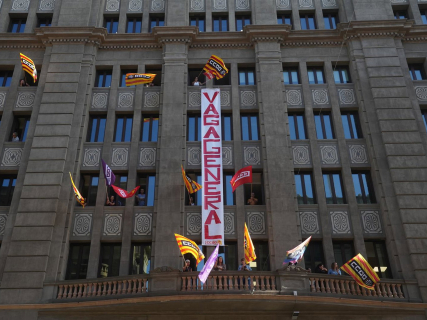

CCOO will focus one of its main demands in the general strike on November 11 on demanding urgent measures to contain the price escalation, understanding that the current inflation is "weighing down the economy" of households.
The union recalls that inflation stood at 4.9% in September, while wages only advanced on average by 3.05%. In CCOO's view, this mismatch between prices and wages is deteriorating the ability of millions of families to face essential expenses such as housing, the shopping basket, children's education, or healthcare and care.
In an inflationary scenario linked to the crisis in the Middle East, the confederal secretary of Trade Union Action and Strategic Transitions of CCOO, Javier Pacheco, has admitted that the measures implemented by the Government since April through various royal decrees have partially cushioned the social impact of the price increase, but he emphasized that "they have not prevented inflation from eating away at the wage increases of the vast majority of working people."
The union leader has insisted that wages, with an average increase of 3.05%, remain well below the year-on-year inflation of September, which, he has emphasized, widens the gap between the cost of living and remuneration.
Furthermore, Pacheco has emphasized that salaries cannot bear a 12% increase in housing prices that, according to CCOO's data, has been sustained for an extended period in recent quarters. "The working class has said 'enough' in the streets these last weeks and is saying 'enough' in workplaces with the preparation of the general strike on November 11," he pointed out.
The union emphasizes that the call for November 11 also aims to force companies to agree on salary increases of between 4% and 7% in collective agreements, and demands from the Executive a 7% increase in the interprofessional minimum wage (SMI) to compensate for the impact of inflation.