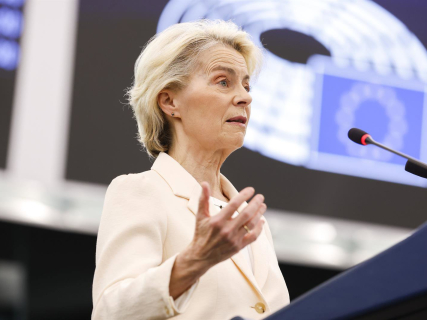

A group of experts appointed by the President of the European Commission, Ursula von der Leyen, to assess the internal functioning of the community Executive has presented this Monday a package of nine proposals aimed at modernizing its management. Among the proposed measures are reviewing the role of decentralized agencies spread across the Member States with a view to a possible reduction, opening certain senior management positions to external candidates, promoting greater use of Artificial Intelligence (AI), and simplifying internal procedures.
The director of the group and former Secretary-General of the Commission, Catherine Day, has explained the conclusions of the report by stating that "Our analysis has revealed that the Commission has deep expertise and highly motivated and committed staff, but its structures are not designed to make the most of that expertise. Some of its processes are excessively burdensome and, in certain areas, a greater willingness to take risks would be desirable."
In a brief appearance without a question-and-answer session, alongside Von der Leyen and the Commissioner for Budgets, Piotr Serafin, Day has urged to open an internal reform process that allows for the "redefinition of its purpose, establishing its core values," with the intention of strengthening the "sense of collaboration in the service of the EU" both politically and in the administration of the Commission.
Except for the review of the role of the agencies and the recommendation to reformulate the function of the General Secretariat as a "strategic center," two changes that would require negotiations with the Council (governments) and the European Parliament, the rest of the proposals could be implemented directly by the European Commission without the need for further processes; although Day has clarified that they do not promote immediate reforms, but rather the group of experts proposes a reflection during the almost three years remaining in the legislature to leave the decisions and concrete measures in the hands of the next Commission.
Brussels will now analyze the document and, combining it with other contributions from the institution's staff, will work on the development of initiatives to simplify and streamline its functioning by the end of the year. In this context, Serafin has stated that he has a sufficient mandate to "undertake far-reaching changes," while Von der Leyen has justified a "large-scale" review because, in the current geopolitical situation, "Europe needs to be fast, simple, and effective."
Review of agencies and the role of AI
Among the central axes of the report is the examination of decentralized agencies located in different parts of the Union, in order to verify whether their mandates remain relevant and to study "possible mergers --total or partial-- and, when appropriate, the elimination of some of them," according to the text released this Monday.
The analysis highlights the "constant increase in their number, costs, and staffing," despite the small size of several of these structures, and points to the need to consider the "transformative impact" of AI on their functioning. According to the report's data, the EU has 35 agencies with a combined annual budget of 3 billion euros and more than 15,000 employees, in addition to six executive agencies with 420 million euros and a workforce of 3,305 workers.
Openness to external candidates and new organizational culture
The high-level group also proposes opening the selection of some senior management positions to "external candidates," with the aim of "bringing new talents and perspectives to the organization," although it warns that, once appointed, they will need specific support to navigate the complex inter-institutional environment and quickly adapt to the internal culture of the Commission. It is also proposed to extend this "flexibility" in the selection processes beyond managerial positions.
Another idea that will be submitted for consideration by the Community Executive is to reinforce the concept of "one single Commission," so that the directorates-general are no longer perceived as watertight compartments. The goal is to prioritize cooperation, flexibility, and results, for example by replacing the scheme of proposals by department with cross-cutting files in the preparation of all relevant legislative or policy initiatives.
General Secretariat, deregulation, and offices in the capitals
The experts also advocate redefining the role of the General Secretariat so that it can act as a "strategic center" that directly connects the political level with the administrative one and sets the priorities. They also propose introducing a specific phase each year to "deprioritize" certain regulations, in order to reduce the accumulation of "obsolete laws and the bureaucratic burden of the system."
Among the additional recommendations is to ensure the effective compliance with the obligation of rotation of senior officials every five years, a rule already in force but that is violated in numerous cases. Likewise, it is suggested to review the role of the offices of the European Commission in each of the capitals of the Twenty-Seven so that they become "essential strategic resources," thus reinforcing their role in representation and in the implementation of community policies on the ground.