
1
Most read
2
3
4
5
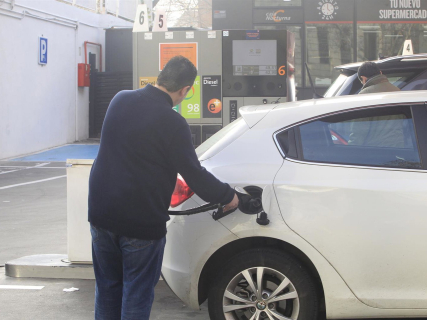
The price of fuels has chained this week its ninth consecutive increase, with which it already adds a rise of up to 24% since the reduction of VAT to 10% expired at the beginning of last July, thus reaching highs since the third week of March. Specifically, the average price of a liter of diesel has increased this week by 0.21% compared to the previous one, standing at 1.865 euros. For its part, the average price of a liter of gasoline has climbed this week to 1.732 euros, after rising by 0.52% compared to last week, according to data from the European Union's Oil Bulletin consulted by Europa Press. With these new increases, the price of diesel accumulates a rise of 24%, while that of gasoline adds a rise of 20.4%. This spike and change in trend in fuel prices consolidated after the Government approved a royal decree law on June 29 in an extraordinary Council of Ministers to address the consequences of the conflict in the Middle East, in which the reduction of VAT to 10% on fuels that had been included in the first package of anti-crisis measures in March expired. However, the reduction of the special hydrocarbon tax (IEH) was approved, which meant a reduction of 15 cents/liter in July, 10 cents starting from August 1, and, in principle, was expected to be five cents in September, although it has ultimately been raised to 20 cents per liter for diesel starting this September 1 due to the sharp rise in its price in July. In any case, these prices from the oil bulletin do not yet reflect these changes in the IEH that have been in effect since Tuesday, as their data corresponds to the period between August 25 and August 31. The reduction in fuel taxation had led to five consecutive drops and an accumulation of a decrease of up to 11% for diesel, and to touch annual lows for gasoline. Thus, after the increases in these last nine weeks, the average price of diesel and gasoline stands at the doors of 1.883 euros and 1.733 euros per liter, respectively, which were touched in the week prior to the entry into force in March of the first fiscal measures of the Government to contain the impact on prices of the war in Iran.LLENAR EL DEPÓSITO DE DIÉSEL, CASI 25 EUROS MÁS CARO. With this week's prices, filling an average 55-liter diesel tank costs 102.57 euros, about 25.13 euros more than a year ago, when it amounted to about 77.44 euros. For gasoline vehicles, filling an average tank (55 liters) currently entails an outlay of about 95.26 euros, almost 14 euros more than a year ago, when it was at 81.29 euros. Despite the upward trend in recent months since the outbreak of the conflict in Iran, both fuels have always remained far from the highs recorded in the summer of 2022, in July, when gasoline reached 2.141 euros and diesel 2.1 euros. The price of fuels depends on multiple factors, such as their specific quotation (independent of that of oil), the evolution of crude oil, taxes, the cost of raw materials and logistics, and gross margins. In addition, the evolution in the quotation of crude oil does not directly translate to fuel prices, but does so with a time lag.LOS PRECIOS EN ESPAÑA, MÁS BARATOS QUE LA MEDIA EUROPEA. With these levels, the price of unleaded gasoline 95 remains in Spain below the average of the European Union, which is at 1.949 euros per liter, and of the eurozone, with an average price of 2.030 euros. In the case of diesel, the price in Spain is also lower than the EU average, which is 2.039 euros, and of the eurozone, where it marks a price of 2.099 euros.