
The report prepared by the General Commissariat for Foreigners and Borders and sent to the magistrate of the National Court María Tardón points to the intervention of the state apparatus of Morocco.
According to sources from the Government familiar with the report, the investigation would not have found solid indicators of the existence of a criminal organization, mafia, or network dedicated to planning and directing the mass entry.
Against this hypothesis, the analyzed elements would point to the use from Moroccan territory of means and capabilities typical of a state structure.
The same sources indicate that it is precisely the influence of that state structure that shifts the focus from the phenomenon of irregular migration organized by criminal networks to a possible scenario in which the Moroccan state would have intervened, facilitated, or actively allowed the movement of thousands of people towards the Spanish border.
This information contrasts with what was conveyed by the director general of the National Police, Francisco Pardo, to Minister Fernando Grande-Marlaska that “there is no police report attributing to the Moroccan Security Forces the planning or execution of what happened on July 30 and 31 in Ceuta.”
No solid indications of a criminal organization
One of the points included in the police analysis is the absence of sufficient elements to attribute the organization of the mass entry to a criminal structure.
The investigation has studied whether behind the events there was a human trafficking network, an organization dedicated to irregular immigration, or some type of mafia structure responsible for coordinating movements towards Ceuta.
According to these governmental sources, no solid indicators have been located that would support that hypothesis.
The focus shifts towards a possible state structure
The elements analyzed in the report, according to these sources, would point to the use or availability of means and capabilities typical of a state structure from Moroccan territory.
Instead of an operation attributable to criminal networks dedicated to human trafficking, the collected indications would point to a possible intervention, facilitation, or active tolerance of structures linked to a state.
The role of Moroccan agents, under investigation
Among the aspects analyzed by the researchers is precisely the action of members of the Moroccan security forces during the hours prior to and during the mass entry.
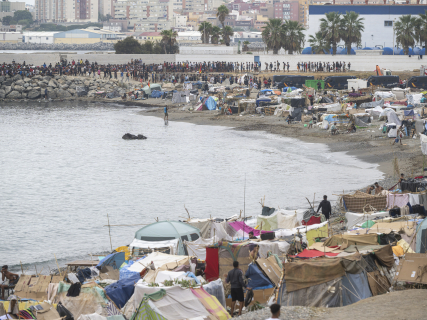
The known information about the document points to the presence of uniformed and plainclothes agents who would have intervened in the movements of the people concentrated in the vicinity of Castillejos and in their displacement towards the points from which access to Ceuta occurred.
The report also analyzes the different behavior and profile of the people who participated in the different waves of entry, as well as the organization of the movements towards the border.
These elements are what lead the researchers to consider that the means employed do not necessarily fit with the usual functioning of a criminal network for human trafficking.
The final assessment now corresponds to Judge Tardón, who must relate this report to the rest of the actions and with the document that the Civil Guard is also pending to provide.
A key issue for the National Court
The judicial investigation began precisely to determine if the events could have a dimension that exceeded the ordinary management of a migratory crisis.
Judge María Tardón requested reports from the National Police and the Civil Guard to determine if there were indications of crimes related to the independence or security of the State.
The question that must be clarified is whether the collected indications allow for the verification of an organized intervention from state structures and, in that case, who made the decisions, what means were used, and for what purpose.
Prior planning and "active guidance" of the Moroccan forces
Other media also point in the same direction. EL MUNDO, which claims to have accessed the conclusions of the report from the National Center for Immigration and Borders sent to Judge María Tardón. According to the newspaper, the document indirectly points to Morocco's participation due to the prior planning of the operation, the action of its security forces, and the dismissal of an organization led by mafias.
The report states that there was a “prior planning” with an earlier intellectual authorship and another material during the execution. The investigators would also appreciate a “strategic and operational direction” developed through different phases, schedules, access points, and profiles of people.
Among the highlighted elements is the initial scarce presence of the Forces and Security Corps of Morocco and, subsequently, their “active guidance of the crowd” towards certain crossing points.
The police unit also considers that the entry responded to “objectives different from migratory ones.” This conclusion is supported by the concentration of people in defined places and times, the facilitation of routes and transfers, and the behavior attributed to Moroccan agents.
Uniformed and plainclothes agents directed the border collapse
Let us remember that El Español, that revealed the existence of the report, states that the document concludes that the entry was guided by uniformed and plainclothes Moroccan agents. The outlet claims that the CENIF provided images from the moments before and simultaneous to the massive arrival to support that interpretation.
According to their information, the Police describes a “planned process to collapse the border control system” and progressively reduce the Spanish response capacity.
The operation would have developed through different waves . First, profiles with greater physical capacity and preparation to swim across were directed towards the border. Once the Spanish devices were saturated, more vulnerable and numerous groups began to arrive.
El Español asserts that the report interprets the migratory appearance as the cover of an operation with a different purpose. The actions of uniformed gendarmes and plainclothes agents would have allowed directing the movements and adjusting the successive phases to the response offered from the Spanish side.