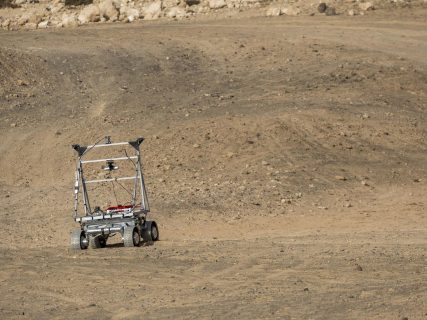

The Spanish technology group GMV has carried out tests on the Canary Island of Fuerteventura of a 'software' developed by the European Space Agency (ESA) that makes it possible for rovers or astromobiles —vehicles prepared to move autonomously or manned on the surface of a planet, a moon, or another celestial body for exploration and scientific data collection— to move at greater speed.
Specifically, these trials were completed last Thursday in Lajares, a locality belonging to the municipality of La Oliva, in Fuerteventura, with the aim of validating an onboard autonomy framework formed by an advanced guidance, navigation, and control (GNC) system, called Fastnav, and a new perception subsystem based on artificial intelligence (AI), named Hawkeye, which applies onboard inference to recognize obstacles and risk areas.
Over the course of eleven days, the company installed and verified the GNC system as part of NOMAD, a modular autonomous navigation system that enables lunar rovers to move quickly and safely across the surface of the Moon based on information received from different sensors and at various distances, as detailed in a statement.
Development in the United Kingdom and institutional support
During the campaign, GMV conducted trials based on possible mission scenarios, including the exploration of craters and routes in low visibility conditions that reproduced regions in permanent shadow. The activity, developed by GMV teams in the United Kingdom, is co-financed within the General Support Technology Program (GSTP) and also has the backing of the UK Space Agency (UKSA).
This technology, which started as an initiative of the Technology Development Element (TDE) of the ESA and later evolved through the GSTP risk reduction framework, has transitioned from being an early-stage proposal to consolidating as a validated autonomous navigation capability, which will enable faster lunar exploration missions with greater scientific reach.
In this regard, the company has emphasized that the exploration of the Moon is once again positioned as a "priority" in international space roadmaps.
Autonomous robotic systems for lunar exploration
"The polar regions of the Moon are of special interest due to the possible presence of water and other volatile compounds, as well as their extreme conditions: in some regions in permanent shadow, temperatures can approach 30 K (around -243 °C), and the lack of light makes navigation difficult," he explained, indicating that the regolith and mineral resources, including metals and rare earth elements, could also be "useful" for future missions.
The "Technology Vision 2040" of the ESA recognizes that technology is its "starting point" and sets a roadmap to achieve a sustained presence, both robotic and human, beyond Earth, supported by rovers and highly autonomous robotic systems capable of exploring and operating using 'in situ' resources.
The push for supporting technologies for rovers and landing modules (and, in the long term, for human presence on the lunar surface) has become a "priority" for the space industry and for the ESA itself.
"The GSTP helps ensure that these fundamental technologies are developed and reach the necessary level of maturity to strengthen Europe's competitiveness, so that the right technologies are available with the necessary level of maturity when they are needed," he reported.
Finally, GMV has noted that the most recent phase of the Fastnav project integrates Hawkeye, which enhances the navigation system through AI capabilities.
Together with Anime (developed under the ESA's Innovation and Navigation Support Program), these three modules make up NOMAD, a modular autonomous navigation system that helps lunar rovers move quickly and safely across the Moon using information from various sensors and at different distances.