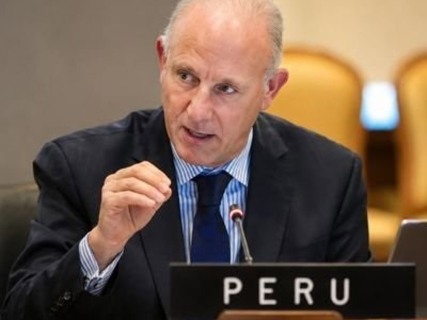

Peru has officially nominated former chancellor Javier González-Olaechea to occupy the General Directorate of the International Labour Organization (ILO) for the period 2027-2032. He will compete for the position with the second vice president and Minister of Labour and Social Economy, Yolanda Díaz, as well as with the current head of the organization, the Togolese Gilbert F. Houngbo.
The election of the new director general will take place on November 16 through secret voting, and the designated person will assume their duties on October 1, 2027.
González-Olaechea was Minister of Foreign Affairs of Peru and held high-level positions within the ILO. He also worked as an advisor to ambassador Javier Pérez de Cuéllar, former Secretary-General of the United Nations, and held responsibilities in the Ministry of Labour and Employment Promotion, the Presidency of the Council of Ministers, the Ministry of the Interior, and the Ministry of Energy and Mines.
His program to lead the ILO, under the title "A Dignified Life in the Disruptive Era," proposes to adapt the institution to a context marked by artificial intelligence, automation, digital platforms, and ecological transition, while preserving its central objective of promoting social justice.
Among his priorities is the strengthening of labour standards and rights, as well as the updating of the tripartite model so that governments, employers, and workers can anticipate changes and reach agreements before they lead to open conflicts.
González-Olaechea's approach is structured around four main pillars: standards and rights, employment, social protection, and social dialogue. It includes, among other measures, a specific tripartite dialogue on artificial intelligence and work, in order to ensure transparency, data safeguarding, and human oversight; a global alliance on future skills and the transition from informality to formality; a social protection system that accompanies labour transitions and also covers self-employed, informal, and platform workers; and tools for anticipation, negotiation, and conflict prevention. In this framework, he also proposes to strengthen the application of ILO Convention 169.
The candidate advocates, moreover, for an ILO more focused on results, with greater analytical and forecasting capacity, better coordination between the headquarters and the field offices, and management linked to budgets, responsibilities, schedules, and specific indicators.
As part of the electoral process, on September 23, the candidates will present their programs in Geneva before the full current board of the ILO and the representatives of the 187 member states.
Díaz focuses her proposal on labor rights
Díaz formally registered her candidacy on August 7. In the strategic vision document that accompanies her proposal, which Europa Press has accessed, the Spanish minister proposes the creation of a "Global Charter of Labor Rights" with the rank of a convention, with the aim of establishing a minimum floor of universal protection for workers in the face of the major challenges of the 21st century and pulling the organization out of the current "management of decline."
The text, under the title "Recovering the leadership of the ILO: Social dialogue as a beacon of social justice in a transforming world," argues that the organization is at a decisive moment.
According to the Spanish candidate, if the current financial and program crisis continues, the ILO — the only predecessor organization of the League of Nations that survived World War II — will face an "existential risk to the fulfillment of its mandate and its relevance as the main institutional project built to ensure the parallelism between economic development and social progress."
A universal floor of rights in the face of current challenges
The core of Díaz's proposal for the minimum rights of workers is the approval of a new unified international standard. In her view, a decade after the declaration of the centenary, "in the face of global challenges, it is necessary to reaffirm the existence of a universal floor of labor rights."
To this end, she proposes a "Global Charter of Labor Rights, which adopts the form of a Convention," designed to "systematize the great principles developed by the ILO throughout its history and, at the same time, incorporate the new challenges of work in the 21st century."
The diagnosis made by Díaz emphasizes that the crisis of the ILO goes beyond the financing problems arising from the non-payment of contributions by some member states and also includes internal deficiencies that cause a "fragmentation of technical capacity in the face of other multilateral actors, such as the World Bank or the OECD."
To reverse the underfunding, the candidate proposes to promote new voluntary contributions from donor governments, development agencies, regional banks, and public-private collaboration initiatives.
She specifies, however, that to avoid further dispersion of the institutional agenda, the ILO must promote that these contributions be "multiannual and unconditional" and be allocated to common strategic funds. At the internal level, she advocates for introducing additional financial adjustments.
Five action axes for the ILO
The program of Yolanda Díaz guides the future action of the ILO around social dialogue and five strategic lines: digital and climate transitions; sustainable businesses and fair competition; decent work and social protection; fighting inequalities and gender equality; and the aforementioned "Global Charter of Labor Rights."
The second vice president also emphasizes the importance of deepening the internal democratization of the organization and consolidating it as a multilateral forum where "the voice of the Global South and that of workers and employers participate on equal terms with governments."
Díaz closes her proposal appealing to her experience in seeking consensus: "This vision, supported by my experience in governing a country that has known an exceptional period of expansion and quality job creation, based on dozens of social dialogue agreements, can decisively contribute to strengthening the role of the ILO," concluding that "the time has come to trust in the leadership of a woman" to lead the organization.
A possible first woman and first Spaniard at the head of the ILO
The ILO, created in 1919 and the first specialized agency of the United Nations, integrates governments, business organizations, and trade unions from its 187 member states. Its tripartite structure makes it the main space for the development of labor standards, the promotion of employment, social protection, and the encouragement of social dialogue.
With the candidacy of Yolanda Díaz, Spain aims to strengthen "a key institution to face the challenges of the labor market" in a scenario of "profound economic, technological, and environmental transformations," consolidating the ILO as a "global reference in the defense of decent work and social justice."
Spain is the country that has ratified the most agreements with the ILO, with a total of 141. If elected, Yolanda Díaz would become the first Spanish and the first woman to lead the organization.
The ILO governing body will hold private meetings with the candidates on November 9, and the secret ballot will take place on November 16. The mandate of the new person who occupies the General Directorate will begin on October 1, 2027.
The duration of the mandate in the General Directorate of the ILO is five years. To be elected, the candidacy must obtain the support of more than half of the members of the governing body with voting rights.