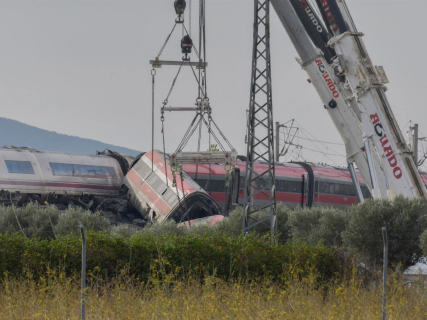

Renfe and Iryo, with the backing of the insurers QBE and Intact Insurance, have already put into operation the procedure to process the advances on the compensation to which the victims of the Urda railway accident (Toledo) are entitled, in which 69 people have lost their lives so far, according to sources from both companies told Europa Press.
The regulations require that this advance be paid within a maximum of 15 days and for a minimum amount of 21,000 euros per deceased passenger. However, Iryo has announced that it will raise that amount and pay 35,000 euros per victim.
The Australian QBE and the Canadian Intact Insurance have already initiated the mechanism to advance the financial compensation to those affected by the accident, as reported by the newspaper "Expansión".
In the case of Iryo, civil liability coverage is provided by Intact Insurance, which assures that it is "in close communication" with the operator as a result of the accident.
"We are aware that Iryo has informed the affected people about this mechanism and about the channels enabled for its management," they tell Europa Press from Intact, specifying that it is the railway company itself that maintains direct contact with those affected and takes charge of the processing.
"For our part, we continue in contact with our client and consider it important to act with caution while the procedures advance and the circumstances of the accident are clarified," add the insurer.
Likewise, they recall that Regulation (EU) 2021/782 of the European Parliament and of the Council, relating to the rights and obligations of railway passengers, provides for the possibility of delivering advances to the victims or their relatives, and that these payments "do not imply recognition of liability, but rather serve to trigger immediate relief for the victims".
Iryo has issued a statement on economic assistance for the Urda accident in which it details for users the available financial support measures and the procedure to request them.
According to this European regulation, the railway company indicates that it will pay the injured in the accident "an economic advance to meet their immediate economic needs, proportionate to the damages suffered," and specifies that those affected may contact the email address buzonafectados6076@iryo.eu.
"Iryo will also pay, under the same terms, advances to the relatives of the sadly deceased travelers, in this case for a total amount of 35,000 euros per deceased person," adds the statement.
Sources from the company stress that the effective start of the payments will depend on the requests submitted by the victims and their families, although they confirm that "the measure has already been made available."
Renfe and the insurer QBE
In parallel, QBE is among the insurance companies of Renfe and Adif, and also participates in part of Iryo's insurance program. "At this time, we are fully committed to providing the necessary cooperation and to facilitating the support that corresponds to the authorities, the affected people and their relatives," QBE sources tell Europa Press, who also convey their condolences and support to the victims and those around them.
"From QBE, in Adamuz we went one step further to support those affected, advancing payments from the very first moment. In Toledo we will maintain that same commitment, acting with responsibility, closeness and humanity, and with full respect for the judicial process underway," add the entity.
Renfe, for its part, recalls that the information relating to its insurance is available on its website. To process the compensation and the medical or psychological assistance of the Compulsory Travelers' Insurance (SOV), it is necessary to complete the accident notification form. The operator notes that the amounts are adjusted to what is provided for in the Regulations of the Compulsory Travelers' Insurance and that the corresponding compensations will be paid.
In application of Royal Decree 1575/1989, of December 22, which approves the SOV Regulations, Renfe Viajeros has signed with the company Everest Insurance (Ireland), Spanish branch, compulsory accident insurance for users, intended to compensate them or their legal successors when they suffer bodily injury in an accident occurring during train journeys operated by Renfe, "provided that the circumstances established in the aforementioned regulations are met".
Renfe sources confirm to Europa Press that this insurance was activated "from the very first moment" of the accident, with coverage for lodging, transfers, psychological support and first aid for those affected and their families. Their transfers to the different points of care were also organized and separation between Renfe staff and travelers in the planned accommodations was arranged.
Deadlines, minimum amounts and scope of compensation
Regulation (EU) 2021/782 of the European Parliament and of the Council, of April 29, 2021, on the rights and obligations of rail passengers, sets out the responsibilities of railway companies in the event of death or injury to passengers.
Its Article 15, included in Chapter III, establishes that, when a traveler dies or is injured, the company "shall pay without delay, and in any case no later than 15 days after the person entitled to compensation has been identified, the advances necessary to meet immediate economic needs, proportionally to the damage suffered".
This advance may not be less than 21,000 euros per deceased traveler. In addition, it "shall not constitute recognition of liability" and may be deducted from any amount that is subsequently paid under the regulation itself, without giving rise to reimbursement "except where the damage suffered has been caused by the negligence or fault of the traveler or where the person who received the advance is not the person entitled to compensation".
In the event of injury or other damage to the traveler’s physical or mental integrity, compensation shall cover the necessary expenses, in particular those of treatment and transport, as well as redress for the economic loss caused, whether arising from total or partial incapacity for work or from increased needs, as provided in Article 28 of Chapter I.
If the traveler dies, damages and losses shall include the essential expenses resulting from the death, such as the transport of the body and the funeral rites.
"If, by reason of the death of the traveler, persons whom he or she had or would have had in the future an obligation to support under the law were deprived of their livelihood", they shall also be entitled to compensation for the loss of such resources, the regulation concludes.