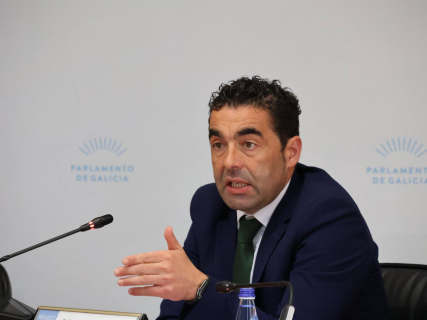

The president of the Diputación de Pontevedra, Luis López, has highlighted the solidity of his government to get ahead, fiscal year after fiscal year, the provincial budgets on time thanks to its absolute majority —the only one of the four Galician diputaciones in the hands of a single party—, which, as he stressed, allows him not to have to make "rebajas de ningún tipo" in accounts that in 2027 will reach 261.8 million, almost 10% more, that is, 23.2 million additional.
During his appearance this Monday in the Comisión de Economía, Facenda e Orzamentos of the Parlamento de Galicia, he advanced that the new accounts will continue focused on cooperation with the town councils, to which the Diputación plans to channel this year 325 million through ordinary and extraordinary plans.
In his intervention, in which he stressed that he "will not fail to show respect" to the Chamber by giving the commission a "plantón" as his "predecessor" "did for seven years", alluding to the socialist Carmela Silva, he insisted that the budget is the direct result of political stability and the management of the current team. He also recalled that, after liquidating the "25 million debt inherited" from the bipartito, the institution has now chained together two fiscal years with zero debt.
Luis López stressed that collaboration with the 61 municipalities continues to be the axis of the accounts, with "for the fourth consecutive year one out of every three euros" being allocated to invest in the town councils through the Cooperation service, with almost 82 million, 8% more. This allocation raises the overall effort with the concellos to 325 million when the resources already committed in other strategic programs are added.
Among them, he mentioned four extraordinary sports infrastructure Plans (28 million), two Extra Plans (73 million), the Vía Depo (8 million) and the Espazo Depo (20 million). "More than 325 million allocated to finance all the small and medium-sized municipalities, regardless of political color." This figure, he added, could increase with the Intermunicipal Assistance service, whose budget will grow in 2027 by 10% (4.2 million), and with other lines such as aid for the Servizo de Axuda no Fogar (SAF), close to 3.5 million.
"Contrary to four years ago, we are not a provincial council of two cities nor only of 59 municipalities. We are the provincial council of the entire province," the provincial leader has emphasized, who has also detailed the investments planned in Vigo and Pontevedra.
In the case of Vigo, he has explained that an initial reserve of 5 million for cooperation agreements is maintained, a commitment that rises to 67 million including the allocations for the Balaídos stadium, the recovery of the Cine Fraga, the attracting of routes for Peinador or the interventions in the Teis pool, Finca Matías, the humanization of San Toque or the Calvario road, among other interventions.
For Pontevedra, he has indicated that, to the 2.5 million allocated for agreements, investments worth 43 million are added intended for the greenway between Arcade and the city, the opening of the Santa Clara gardens, the renewal of the Pasarón turf, the 2027 Art Biennial, the remodeling of Príncipe Felipe or the improvement of the Salcedo road. "Despite the blockade, the Provincial Council is investing like never before in both cities," he has stressed.
The provincial president has also mentioned other spending areas, such as that allocated to sport, with 11.2 million; the boost to sustainable tourism typical of the Rías Baixas, with 9.3 million to continue enhancing the provincial attractions —festivals, festivities of tourist interest or gastronomy—; the strengthening of culture, which increases its resources by 63% compared to 2023; and the maintenance of the 1,600 kilometers of the provincial road network, which will have more than 40 million.
"We were asked to break with the servility of an entire institution toward two cities and today, both the small and medium-sized municipalities as well as Vigo and Pontevedra receive as never before to invest, with more than 2,000 works and 600 million euros mobilized," he has said.
Criticism from PSdeG and BNG
From the opposition, Socialist deputy Carlos López Font has argued that if the figures are "historic" it is due to the "good performance of the economy" thanks to Sánchez's Government, recalling that the majority of the funds that feed the provincial councils come from the State. "Listening to him, it would seem that we are before an administration that generates these increases, when that is not true," he has stated.
He added that the budgets promoted by Luis López show that "there is no new project" in his term, but rather that many of the initiatives of the previous government continue, to which he attributed the launching of new policies. At the same time, he regretted that in certain areas the PP had not followed the "innovative path" of its predecessors and had opted to "destroy already consolidated policies".
He also censured the current provincial executive for giving "money from the whole province" to a banking entity with the purchase of the Cine Teatro Fraga in Vigo, a bank that "has an enormous debt with the city Vigo and with all of Galicia". "They had a magnificent opportunity to lead the city's claim for it to be transferred to the city free of charge," he pointed out, also criticizing the "low level of execution". "From the personal affection I have for you, which you know, I hope that next year I will not have to appear before this Parliament," he concluded.
For his part, the BNG deputy Paulo Ríos reproached the provincial president for coming to the Chamber at the end of the term claiming that his main plan is the cooperation plan designed by the previous government. "It says very little about his political action," he stated, to emphasize that what is evident is that "what there was before was the PP's Diputación, neither of cities nor of town councils, the PP's".
He also maintained that the Diputación has ceased to be a benchmark in areas such as historical memory, equality policies and the prevention of gender violence or waste and environmental management. "They made cuts without anyone forcing them," he denounced, while accusing the PP of using the budgets to "perpetuate itself in power" and "feed a series of cacique networks".
Defense of the PPdeG
In reply, the parliamentary spokesperson for the PPdeG, Alberto Pazos, considered it "incredible" that in the 21st century the mere presence of a public representative in the Chamber serves to show two "diametrically different" ways of understanding politics, institutional loyalty and service to citizens.
He contrasted the stability of the administrations governed by the PP with the "shameful situation" lived by "a country paralyzed by the incapacity of the socialist government, supported by the BNG, incapable of complying with its minimum obligations".
Pazos has defended that, after the departure of Carmela Silva, the Diputación de Pontevedra has once again become a shield for all the municipalities and has stopped functioning as a "battering ram with which to attack the municipalities that do not share acronyms or loyalties" with the previous executive. "In fact, we can assure that Luis López has met with more mayors and mayoresses in four years than Carmela Silva in eight", he has pointed out, underscoring that this Diputación "does not veto the councilors because of their political affiliation".
Finally, he has highlighted that this is the largest budget in the history of the institution and, at the same time, the "most municipalist" of the democratic period.