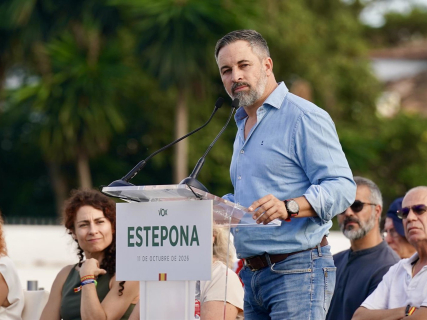
Abascal promises to pay pensions and guarantee housing "by any means" and reinforces his call for in-person voting.

Abascal promises to pay pensions and make housing cheaper "by any means", links immigration and the price crisis, and urges to vote in person on November 29.

4 minutes

fotonoticia 20261011195906 1920

fotonoticia 20261011195906 1920

Add DEMÓCRATA to Google

Ask FREN

Published

Last updated

4 minutes

Most read

The president of Vox, Santiago Abascal, has assured this Sunday that, if his party governs, pensions "will be paid no matter what" and that access to housing "will be recovered no matter what and at any price." At the same time, he has insisted on asking his supporters to vote in person on the next November 29, except for those who have "no other remedy."

In a rally held in Estepona (Málaga), Abascal has accused the PSOE of having "invented and spread" that Vox intends to privatize pensions, a claim he has rejected. "We don't care about the model and the formula, but the pensions of the elderly who have earned them after working a lifetime will be paid at any price and no matter what. And the future of the young will also be recovered no matter what and at any price. And access to housing will be recovered the same way," he emphasized.

Before several hundred attendees (1,500, according to the organization), the leader of Vox has reiterated his message in favor of in-person voting. "To vote in person. Those who have no other remedy, should do it another way. It is not a distrust of the system, it is a distrust of Pedro Sánchez," he stressed, before accusing the president of the Government of having "stolen the elections in his own party."

Abascal has warned his followers to prepare for "lies, attempts at cheating, intimidation, and provocations," and has asked them not to respond to those attempts. In addition, he has urged them to talk with family and friends to try to convince those who, he said, "have thrown in the towel" or are considering abstaining.

"The dirtiest government in history" and criticism of the unions

The Vox leader has pointed out that the polls predicting an advance of his formation are "the main enemy" and has asked to distrust "any single poll." In his opinion, "there is no family gathering, there is no football match, there is no hobby, there is no excuse that is valid for all of us to go to the polls to recover the course of Spain," he maintains.

Abascal has insisted that "these are not normal elections" and has accused the Executive of being "the dirtiest government in the history of Spain." "We must be prepared for the worst, from calmness, from tranquility, without entering into any kind of danger," he pointed out.

He has also held the Government of Spain responsible for having starred in "eight years of criminal legislature" and for having led the citizens to "the greatest loss of purchasing power in the last half century" or "in the last century." In that line, he has attacked the unions, which he has reproached for having remained "silent as the dead" during that time.

"Remigration," immigration, and housing crisis

In another part of his speech, the leader of Vox has defended "remigration" and has explained that his party proposes it not because they do not like "people from outside" nor "out of hatred for those from outside," but "out of love for those from within." He has emphasized that political leaders have an obligation "first and foremost to the nationals."

In this context, he has thanked those who have come to Spain "at other times to work," collaborate with Spaniards, respect the laws, pay taxes, and respect the culture of the country. In his view, they too are harmed, just like Spaniards, by a phenomenon of "mass immigration" and "migratory invasion."

"Those who come illegally to Spain must be repatriated. Those who come to Spain to commit crimes must go back to their own country to serve their sentence. Criminals must be deported," Abascal has stated, who has also argued that those who have come "to live off social benefits that do not reach Spaniards" must "remigrate to their own country."

The president of Vox has linked these proposals to the housing market and has denounced that, under the Government of Pedro Sánchez, housing has become more expensive "by 74% and rent by 40%." He has pointed to the head of the Executive as "the direct culprit of evictions" and of "the housing crisis."

He has added that, in the last five years, five million people have entered Spain and "no housing has been built." "If the houses are the same, prices go up," he has argued, asking with whom Spaniards looking for housing compete if "everyone who enters illegally" is regularized "all at once."

Alongside "remigration," Abascal has presented as key points of Vox's response the "national priority" and "deregulation." Regarding the first, he has claimed that Spaniards should be "the first in their own homeland" and has defended that national priority implies that "the borders of Spain are defended at sea and on land" and that pending investments are made in Spain "and not in Morocco."

Regarding deregulation, he explained that Vox proposes to eliminate "administrative barriers" and "ideological and absurd laws" that, he said, raise costs and delay the construction of housing, the start-up of businesses, and other projects. He also denounced "fiscal abuse" and demanded that taxes be "the least" and be oriented "much more towards national interests."

Quero demands "to recover normality" in Spain

Before Abascal's intervention, the national spokesperson for Housing of Vox and former deputy for Málaga, Carlos H. Quero, explained that Vox's pre-campaign starts with the goal of "recovering a country and recovering the normality of a country." He placed the problem of housing, the increase in the cost of living, waiting lists in healthcare, the deterioration of public services, and insecurity as some of the factors that, he stated, condition the daily life of numerous citizens.

Quero described Spain as "an immense queue," "an immense saturation," and "an immense collapse," and lamented that what was once considered "normal" —having a job with which to buy a house, start a family, go to the doctor when needed, or have functioning services— has transformed into "a luxury."

The national spokesperson for Housing of Vox concluded that it is essential to give "a change of course" and assured that it is "the hour of the people of Vox" and "the hour of Santiago Abascal."

More key points, information and questions with FREN

AI-GENERATED CONTENT

What is the current status of the parliamentary processing of Vox's proposals on pensions and housing?

Vox's own proposals on pensions and housing generally have limited parliamentary progress: several have been stopped even before their substantive debate, and as of today, only some initiatives related to housing and registration remain formally active in the Congress. Meanwhile, major reforms on pensions and housing advancing in the Cortes come from other groups, with Vox usually positioned in opposition to them.

Vox's proposals on pensions

In the area of Social Security and family-related benefits, Vox has tried to open several legislative paths, but all those clearly identified have already concluded unsuccessfully:

  • Subsidy for foreign minors deprived of liberty (122/000056). Bill to amend the consolidated text of the General Social Security Law and eliminate a specific subsidy for minors without Spanish nationality interned in centers. It was debated in the Plenary of the Congress and the consideration was rejected on September 10, 2024 (170 votes in favor, 178 against). The initiative is definitively closed and the rejection agreement was published on September 13, 2024.
  • 100% discount on employer contributions during leave for birth and child care (122/000171). This bill sought to recover the full discount on employer Social Security contributions during maternity or paternity substitutions, reversing the changes of Royal Decree-law 1/2023. Although it was admitted for processing and published in March 2025, on May 6, 2025 the initiative lapsed and its processing was closed, without becoming a system reform.
  • Improvement of the benefit for caring for sick children (122/000029). Also linked to the Social Security benefits system, this proposal was stopped by the Government itself. After expressing its disagreement under article 134.6 of the Constitution, the Congress Board agreed on May 14, 2024 that it was not appropriate to submit it to the Plenary for consideration. The processing ended without substantive debate.

Beyond these specific initiatives, Vox's program advocates a structural reform of the system towards a mixed model, with an individual capitalization component and greater weight of private savings, but these programmatic lines have not yet translated into an advanced bill. Meanwhile, major ongoing pension reforms (such as early retirement without cuts for long contribution careers or the mutualists' gateway to RETA) are being promoted by other groups, with Vox voting against or abstaining depending on the case.

Vox's proposals on housing

In housing and closely related matters, Vox currently maintains some initiatives in process, although none have yet passed the first major legislative milestones:

  • Amendment of the Urban Leases Law to strengthen the tenant's right of first refusal and redemption (122/000193). This bill aims to restore the tenant's preferential acquisition rights when the housing is sold together with others in the same building or the entire building. The Chamber has admitted it for processing and sent it to the Government, and the initiative still awaits the debate on consideration in the Plenary. It is therefore in an initial but active phase.
  • Accessibility and horizontal property (122/000075). Although formally focused on eliminating architectural barriers and regulating accessibility works in homeowners' associations, it has a direct impact on housing habitability. It has also been admitted for processing and is pending the Plenary's decision on whether to consider the text. Until that debate occurs, it does not enter the substantive amendment phase.
  • Municipal registry, squatting, and illegal immigration (122/000039). Bill to amend the Local Regime Bases Law to toughen registration conditions in cases of housing occupation and irregular residence. This initiative has advanced somewhat more: after admission, the amendment submission period was opened and extended until April 16, 2025. This indicates it has passed the initial threshold and is in the commission work phase, pending closure of the amendment period and preparation of a possible report.

In the Senate and other regional parliaments, Vox has also registered initiatives to toughen the fight against squatting and prioritize nationals in access to protected housing and aid, but at the state level, the identified housing proposals are mainly in admission and amendment phases, without having reached final approval.

In summary, the current balance is that Vox's main proposals on pensions have been rejected or vetoed and are closed, while in housing it maintains several active bills (on leases, accessibility, and registry), all still in early processing phases and pending to overcome major consideration debates and, if applicable, commission report preparation.

Can you detail the main content of Vox's bill to amend the Urban Leases Law and how it would affect tenants and large holders? What parliamentary steps would remain for Vox's housing initiatives if the Plenary were to consider them? How do Vox's proposals on pensions compare with the reforms promoted by the Government and other parties in this legislature?

What are the legal competencies of the president of Vox and what is Santiago Abascal's political background?

The president of Vox is not a public State office, but an internal party position. His “legal competencies” derive from Vox's statutes and party law, not from the Constitution or laws regulating the Government. Santiago Abascal, who has held this Presidency since 2014, is also a deputy in the Congress for Madrid and a member of the Permanent Deputation, thus combining internal organic functions with institutional responsibilities.

1. Legal competencies of the president of Vox

According to the practice of Spanish parties and what emerges from Vox's internal life, the party Presidency broadly has these functions:

  • Political and legal representation of the party: the president is Vox's highest public figure. He represents it before institutions, media, other political formations, and affiliated international organizations, embodying the party's official position.
  • General political direction: sets the ideological line and political and electoral strategy. Under his leadership, major messages, programmatic priorities, and alliances are defined, both in Spain and at the European level (for example, his presidency of the “Patriots for Europe” platform and his role in the Disenso foundation).
  • Relationship with internal bodies: presides over or effectively influences the functioning of the National Executive Committee and other leadership bodies. The party Assembly elects the leadership and renews or endorses the Presidency; once elected, the president promotes and coordinates these bodies' activities.
  • Organization of teams and lists: participates in configuring candidacies, appointing spokespeople and organizational cadres, and changes in the leadership (for example, internal replacements and dismissals affecting figures like Javier Ortega Smith). Formally articulated through collective bodies, but presidential leadership is decisive.
  • Coordination of parliamentary groups and coalition governments: sets red lines in negotiations with other parties, validates or vetoes regional and local pacts, and guides Vox groups' behavior in the Congress and regional chambers. This includes decisions such as entering or leaving governments and conditioning regional budgets.
  • Internal discipline: promotes, together with guarantee bodies, responses to internal dissent, disciplinary proceedings, or suspensions of membership, and publicly defends the authority of the leadership arising from the Assembly.

All this is framed within Vox's statutes and the Organic Law of Political Parties: these are competencies over the party's internal organization and political action, not executive powers over the Administration. Abascal cannot issue regulations or make government decisions by being president of Vox; those powers depend on the institutional positions the party holds where it governs or co-governs.

2. Santiago Abascal's political background

Origins and education. Santiago Abascal Conde was born in Bilbao in 1976 and grew up in Álava, in a family linked to the Basque right. He holds a degree in Sociology. His political socialization occurred in a context of ETA violence and strong confrontation between Basque nationalism and constitutionalism, a framework that would mark his later discourse focused on Spain's unity.

Stage in the Popular Party. He was active in the Basque PP and developed his first institutional career in that party:

  • Councilor in the Llodio (Álava) City Council between 1999 and 2007.
  • Procurator in the Álava General Assemblies (2003-2004).
  • Deputy in the Basque Parliament (2004-2009).

Later he was appointed to various freely designated positions in the Community of Madrid, including the direction of the regional Data Protection Agency and other public entities. In parallel, he promoted the Foundation for the Defense of the Spanish Nation (DENAES), focused on a strongly national discourse opposed to the autonomous model.

Break with the PP and founding of Vox. From 2012–2013 he distanced himself from the national PP leadership, accusing it of weakness against nationalism, terrorism, and Catalan independence, as well as abandoning conservative principles. In 2013 he formally left the PP and participated in creating Vox, registered at the end of that year as a new right-wing national party. In 2014 he was elected president of Vox with broad membership support and has been repeatedly endorsed since.

Rise to prominence and current leadership. The key turning point came with Vox's success in the 2018 Andalusian elections, where it became a decisive force for the regional government. In the 2019 general elections Abascal won a seat for Madrid and Vox entered the Congress strongly, consolidating his image as the national leader of the radical right. He has maintained the seat in subsequent legislatures and is a member of the Permanent Deputation, placing him at the core of parliamentary activity.

Ideologically, his trajectory is associated with intense Spanish nationalism, recentralization of powers, a hard line on immigration and security, and opposition to gender equality policies, democratic memory, and the climate agenda. Under his presidency, Vox has gone from an extra-parliamentary party to an actor capable of influencing regional governments and the state political debate.

Can you detail what Vox's statutes say about the formal functions of its Presidency and the National Executive Committee? What role has Santiago Abascal played in Vox's negotiations to form regional and local governments with the PP? How has Abascal's ideological discourse evolved from his stage in the Basque PP to his current leadership of Vox?

What results did Vox obtain in the last general elections and how many seats does it currently have in the Congress?

In the last general elections held in Spain, on July 23, 2023 (23‑J), Vox obtained approximately 12.4 % of the valid votes, which translated into 33 seats in the Congress of Deputies. In the current XV Legislature, according to available data, Vox still has 33 elected deputies, although internal movements have affected the distribution of those seats among groups.

Vox's results in the July 23, 2023 general elections

According to analyses published by the newspaper Demócrata and other sources referencing official data from the Central Electoral Board, Vox's result on 23‑J was as follows:

  • Vote percentage: around 12.4 % of the votes cast.
  • Votes in absolute numbers: about 3 million votes (slightly above that threshold, according to various sources consulted).
  • Seats in Congress: 33 deputies, making Vox the third largest force in number of seats, behind the Popular Party and the PSOE.

In the comparison made by Demócrata between the estimates of the pollster 40dB. on the eve of 23‑J and the actual result, it is expressly stated that Vox obtained 33 seats compared to the 38 projected by that poll: Demócrata's analysis of 23‑J .

Vox's situation in the Congress in the XV Legislature

After the constitution of the Congress resulting from the 2023 elections, the representation of Vox was set at 33 seats. This figure remains the reference when parliamentary analyses and polls compare the current result with that of 23‑J:

  • Various demographic studies cited by Demócrata repeatedly note that “Vox obtained 12.4 % of the votes and 33 deputies in the 2023 general elections” as a starting point to project subsequent rises or falls.
  • Similarly, analyses of the right-wing bloc indicate that PP and Vox together had 170 deputies on 23‑J (137 from PP and 33 from Vox), a figure used as a basis for comparison for new majorities depicted by current legislature polls.

Based on this, the current composition can be summarized as follows:

  • Vox elected deputies: 33, which are the seats obtained in 2023 and still count for the results of that election.
  • Vox Parliamentary Group: has been affected by internal movements. For example, Demócrata reports that former leader Javier Ortega Smith has broken with Vox's group in Congress and left the party discipline, joining the Mixed Group: information about Ortega Smith's departure .

Such changes mean that, while the number of seats Vox won at the polls remains 33, not all those deputies currently belong to the Vox Parliamentary Group. Some are now members of the Mixed Group, which has organizational consequences (speaking times, committee presence, parliamentary resources), but does not alter the original data: Vox obtained 33 seats in the last general elections.

Context: polls versus official results

Since 2024 and especially throughout 2025 and 2026, numerous polls published by Demócrata and other media have projected a significant rise of Vox in voting intention and hypothetical seats, often doubling or nearly doubling the 33 deputies obtained in 2023. However, these projections:

  • Are not official results, but estimated voting scenarios.
  • Do not change the institutional snapshot until new elections are held and a new Congress is constituted.

Therefore, until new general elections and an official new seat distribution occur, the answer to your question is clear: Vox obtained around 12.4 % of the votes and 33 seats in the last general elections (23‑J 2023) and currently has 33 elected deputies in Congress, with the caveat that one of them has left the group and is in the Mixed Group.

Play

Test your knowledge with FREN!

How much do you know about this topic? Answer the following 3 questions.

What has Santiago Abascal promised regarding pensions if Vox governs?

Question 1 of 3

What is one of the reasons Abascal gives for requesting in-person voting?

Question 2 of 3

What has Abascal proposed as a solution to the housing crisis?

Question 3 of 3