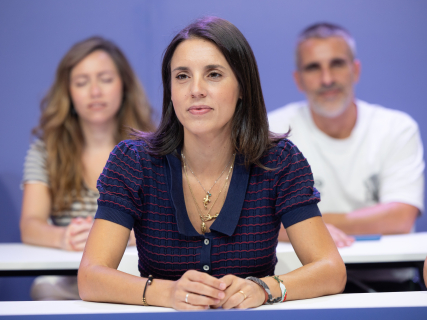

The unity of the left for the general elections on November 29 is being negotiated territory by territory. Given the difficulties in reaching a state agreement between Podemos and Frente Amplio, the conversations have shifted to different constituencies, where the organizations explore collaboration formulas that allow them to jointly run for the Congress of Deputies.
The main advance occurred this Thursday in Canary Islands, where Podemos, Nueva Canarias-Bloque Canarista, Izquierda Unida, and Movimiento Sumar have reached an agreement to present themselves under the name Unidad del Pueblo Canario (UPC). The understanding brings together in the same candidacy formations that maintain differences regarding the electoral strategy across Spain.
Podemos' candidate for the general elections, Irene Montero, has celebrated the pact and announced that her party will continue "seeking agreements in more territories". "We have reached an agreement with Nueva Canarias, IU, and other parties to run together in the elections," she stated in a post on X, in which she thanked the work of those who participated in the negotiations.
The former Minister of Equality has defended that the Canary alliance "is the way" and concluded her message with a "We continue," a statement that comes as the left-wing organizations face the final hours to register their electoral coalitions.
Hemos llegado a un acuerdo con Nueva Canarias, IU y otros partidos para presentarnos juntos a las elecciones. "Unidad del pueblo canario" será el nombre de la coalición. Y seguimos buscando acuerdos en más territorios. Gracias, compañeros y compañeras, es el camino. Seguimos https://t.co/GxphebhjEM
— Irene Montero (@IreneMontero) October 15, 2026
For its part, Frente Amplio has highly valued an agreement forged "thanks to the effort and generosity of all political actors," which they consider an example to follow in the rest of the territory. In a statement, the platform calls on "all parties" to advance "towards a great coalition for the whole country" and to close "unity candidacies at the state level," "also in Madrid and Barcelona."
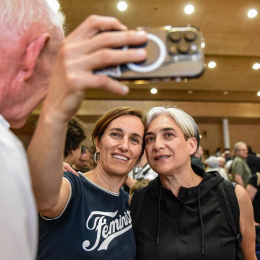
Canarias closes the first agreement and Montero wants to extend it to other territories
The coalition Unidad del Pueblo Canario brings together Nueva Canarias-Bloque Canarista, Podemos, Izquierda Unida, and Movimiento Sumar. The agreement, announced this Thursday, implies a shared candidacy in the archipelago and allows these organizations to overcome their state differences to run together in the Canary constituencies.
The formations have placed among their priorities housing, public services, and the defense of the interests of Canarias. The alliance also represents a change from the formula that had been initially proposed, with Nueva Canarias and the parties of Frente Amplio, but without the participation of Podemos.
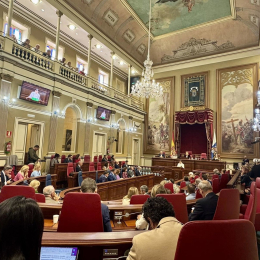
The satisfaction expressed by Irene Montero contrasts with the difficulties in reaching a state-level pact. Podemos wants to extend the territorial model, while Izquierda Unida insists that any negotiation must take place within Frente Amplio, the coalition they share with Movimiento Sumar, Más Madrid, and the Comuns.
Aragón, Baleares, and Comunidad Valenciana keep negotiations open
Apart from Canarias, the most advanced conversations are concentrated in Aragón and Baleares, where the organizations seek formulas for understanding with the forces at the autonomous level. However, the contacts known up to this Thursday do not allow for joint candidacies that incorporate Podemos and the parties of Frente Amplio to be considered closed.
In Aragón, the negotiations are taking place in a scenario where the Chunta Aragonesista constitutes one of the relevant territorial actors to articulate a shared candidacy. In Baleares, the conversations also intersect with the presence of the island formations, especially MÉS, and with the search for agreements adapted to the different constituencies.
The Valencian Community continues to be one of the territories where understandings are explored. Compromís occupies a central position in the conversations, although there is still no closed pact that integrates all the involved forces. The final configuration of the candidacies will depend on the negotiations that take place before the expiration of the legal deadline.
In the Balearic Islands, there is also a specific precedent for electoral collaboration for the Senate. The candidacy Eivissa al Senat brings together PSOE, IU, Ara Eivissa, and Movimiento Sumar, with external support from Podemos, but that understanding does not equate to a general agreement for the lists to Congress across the islands.
The map of left-wing agreements for the 29N
Situation as of October 15, 2026. Distinction is made between announced pacts, open conversations, and scenarios of separate candidacies. The agreements for the Senate are expressly identified.
| Territory | Status of the agreement | Situation of the negotiations |
|---|---|---|
| Canary Islands | CLOSED AGREEMENT | Podemos, Nueva Canarias, IU, and Movimiento Sumar will run under the brand Unity of the Canarian People. |
| Aragon | UNDER NEGOTIATION | Territorial contacts with the Chunta Aragonesista as one of the relevant actors. No confirmed joint pact. |
| Balearic Islands | UNDER NEGOTIATION | Conversations with territorial forces. In Ibiza, there is a specific agreement for the Senate with external support from Podemos. |
| Valencian Community | UNDER NEGOTIATION | Contacts around Compromís continue. There is no confirmation of a joint candidacy from the entire space. |
| Catalonia | SEPARATE ALLIANCES | Podemos has reached an agreement with ERC, while the Comuns remain in the Broad Front. |
| Madrid | SEPARATELY* | Podemos and the Broad Front maintain differentiated candidacies, with no announced integration agreement. |
| Rest of the territories | UNCONFIRMED | No joint pact has been announced. Podemos proposes territorial agreements and IU advocates negotiating within the Broad Front. |
Source: Announcements from political formations and public statements. Situation as of October 15, 2026. *The separate candidacy in Madrid is the expected scenario until an agreement is announced. Open negotiations do not imply a definitive pact.
Catalonia and Madrid, the main obstacles to a joint candidacy
The territorial conversations advance while the state directions maintain distinct positions on the electoral formula. Ione Belarra has acknowledged this Thursday that an agreement in Madrid and Barcelona is "very difficult" and has proposed to Izquierda Unida shared candidacies in other provinces to avoid the dispersion of the vote.
The proposal excludes the two largest constituencies, where Podemos and Frente Amplio maintain different strategies. In Madrid, the purples bet on Irene Montero, while Frente Amplio has promoted the candidacy of Ada Colau for the Presidency of the Government and has Emilio Delgado as an electoral reference in the community.
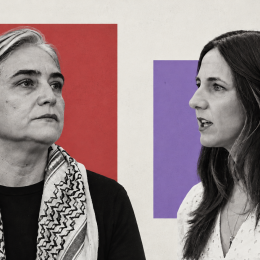
In Catalonia, the distance has widened after the collaboration agreement reached between Podemos and Esquerra Republicana, which contemplates the participation of people linked to Podemos in the republican lists and the collaboration of Gabriel Rufián with Irene Montero during the campaign. The Comuns, integrated into Frente Amplio, maintain their own electoral project.
Izquierda Unida rejects negotiating outside of Frente Amplio
The federal coordinator of IU, Antonio Maíllo, has rejected Podemos' offer to close bilateral agreements in different communities without counting on the rest of the organizations of Frente Amplio. "Izquierda Unida is not going to negotiate with Podemos leaving the Frente Amplio," he stated this Thursday, defending the continuity of the shared project with Movimiento Sumar, Más Madrid, and the Comuns.
This difference conditions the scope of the provincial conversations. For Podemos, the territorial agreements would allow gathering candidacies where the organizations find points of understanding, without the need to integrate into a single state coalition. IU, on the other hand, defends that any incorporation must be negotiated respecting the common framework of Frente Amplio.
With the deadline to register coalitions about to end, Canarias currently constitutes the confirmed example of understanding between Podemos and the organizations of Frente Amplio, while Aragón, Baleares, and the Comunidad Valenciana keep various negotiation avenues open. The outcome will determine whether the Canary formula extends to other constituencies or remains an exception within a fragmented electoral scenario.