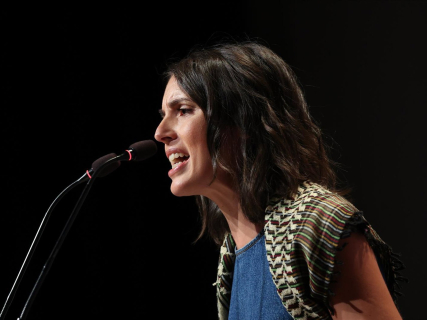

The MEP and leader of Podemos, Irene Montero has ruled out this Tuesday that her party will integrate into the Frente Amplio, although she has kept open the possibility of reaching an electoral agreement with the organizations that make up this space ahead of the general elections on November 29.
During an interview on La Hora de La 1, from TVE, Montero acknowledged that an agreement among the different forces to the left of the PSOE “is what people are asking for” and confirmed that the conversations remain open. However, she rejected that this collaboration implies the incorporation of Podemos into the structure of the Frente Amplio, which brings together Movimiento Sumar, Izquierda Unida, Más Madrid, and the Comuns.
The distinction is relevant for the electoral negotiations, since Podemos considers sharing candidacies with other organizations without renouncing its political autonomy or its own procedures for choosing representatives. This formula would allow negotiating a coalition without the need for the purple party to join the project promoted by the parties that make up the Frente Amplio.
Montero clarifies the terms of the agreement with Rufián
The leader of Podemos has also specified the scope of the understanding with Gabriel Rufián, from Esquerra Republicana de Catalunya (ERC), which she has defined as a collaboration to “be able to team up for the general elections”.
As she explained, the pact includes the presence of Podemos candidates on the ERC lists, although the number of representatives they ultimately obtain will depend on the electoral results. Montero clarified that this understanding is independent of the Podemos primaries, from which the names of those who will run in the elections will emerge.
In this way, the agreement with ERC establishes a path of electoral collaboration between both formations without replacing the internal candidate selection process of Podemos, which maintains its commitment to primaries as a procedure for configuring its lists.
The pact with ERC does not close the door to the Frente Amplio
Montero has pointed out that the collaboration with ERC does not prevent reaching agreements with other political forces that share objectives, so conversations with the Frente Amplio can continue despite the differences over the organizational formula.
The position of Podemos introduces a distinction between integration into a political platform and the constitution of an electoral coalition. While the former would imply joining the already constituted space, the latter would allow different organizations to run together while preserving their identity and structures.
This difference takes on special importance given the proximity of the elections, as parties must resolve their alliances before the legal deadline for registering coalitions expires. Friday, October 16 is the deadline to communicate these agreements to the Electoral Board, according to the election calendar for the 29N.
The electoral fragmentation and the distribution of seats
The negotiation also has consequences for the distribution of seats, especially in provinces that elect a small number of deputies. The Spanish electoral system distributes the 350 seats in Congress through provincial constituencies and applies the D'Hondt formula, so the concentration of votes in a candidacy can favor the obtaining of representation compared to its dispersion among several lists.
This effect is not uniform across the territory, as it depends on the number of seats assigned to each province, the percentage of votes for the candidacies, and the competition with the other parties. In small constituencies, two forces running separately may end up without representation despite jointly gathering a sufficient volume of votes to contest a deputy.
In this context, Podemos' decision to negotiate agreements with ERC and keep conversations open with the Broad Front leaves both the territorial scope of the alliances and the composition of the candidacies pending. The possibility of running under the same electoral formula does not necessarily imply that all parties must integrate into a single political organization.
The keys to the negotiations for the 29N
The agreement explained by Montero contemplates that candidates from Podemos will run on the lists of ERC, although it has not yet been specified how many representatives from the purple formation will be able to obtain a seat. Their names will come from the primary process of Podemos.
Regarding the Broad Front, the leader has ruled out the integration of her party into the platform, but not an electoral coalition among independent organizations. The conversations remain open and the agreement with ERC does not exclude other pacts.
The main unknown is whether these negotiations will allow for the articulation of shared candidacies before the deadline to register coalitions, or if the different forces will end up competing separately in part of the territory.