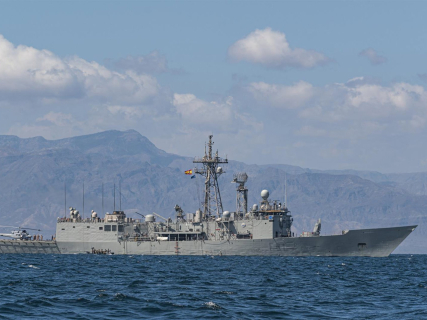
Spain deployed frigates in response to incursions by Moroccan ships in Ceuta.

The incidents occurred between the end of July and the beginning of August. The information published this Monday in El País reveals its military dimension.

1 minute

fotonoticia 20260807115928 1920

fotonoticia 20260807115928 1920

Add DEMÓCRATA to Google

Ask FREN

Published

Last updated

1 minute

Most read

Moroccan military ships entered Spanish waters in Ceuta without authorization, according to El País. The response included a naval deployment and Defense management. The newspaper notes that the Navarra replaced the Santa María due to a malfunction. Its sources do not confirm coordination with the entries of migrants.

Which ships participated and when they arrived

The presence of Spanish units had already been reported during the summer. On August 7, El Español reported the arrival in Ceuta of the frigates Santa María and Navarra, coming from the naval base of Rota.

Both joined the operation in which the Rayo was present, a Maritime Action Ship in the area since the beginning of that week. The information placed their tasks in maritime surveillance and deterrence.

The coverage published then by El País specified the dates: the frigates arrived on Thursday, August 6, and the Rayo had done so on Monday, August 3. Among the functions of the deployment was also support for the military of the General Command of Ceuta.

Two frigates of the same class

The Santa María, identified as F-81, names its class of frigates. The Navarra, F-85, belongs to that same family and is the fifth unit of the series, according to the official records of the Navy.

The chronology is essential to interpret the news: the dispatch of ships was known in August. The revelation this Monday provides information about the incidents that prompted the Spanish response.

...

More key points, information and questions with FREN

AI-GENERATED CONTENT

What are the competencies of the Ministry of Defense in the protection of Spanish territorial waters?

The Ministry of Defense, through the Armed Forces and particularly the Navy, has a permanent responsibility for the surveillance and protection of maritime spaces in which Spain exercises sovereignty, sovereign rights, or jurisdiction. This function is military and strategic in nature and is exercised as a contribution to the State's action at sea, without replacing the police, customs, fisheries, or rescue competencies that correspond to other civilian agencies.

According to Organic Law 5/2005, on National Defense, and the maritime security doctrine of Defense, among the main competencies of the Ministry of Defense in territorial waters and other maritime spaces of national interest are:

  • Surveillance of maritime spaces of sovereignty, responsibility, and national interest, maintaining continuous naval presence to detect anomalous or potentially hostile activities.
  • Defense of sovereignty and territorial integrity in the maritime domain, including the protection of maritime borders and essential maritime communications.
  • Protection of maritime infrastructures and resources of interest for national security (navigation routes, submarine cables and gas pipelines, energy installations, etc.).
  • Prevention and response to security threats, such as hostile actions by other States, terrorism, piracy, or proliferation of weapons.
  • Support to other State agencies in combating illicit trafficking and in search and rescue tasks, when the situation requires it.

The fundamental Defense instrument at sea is the Navy. An agreement published in the Official State Gazette (BOE) with the Xunta de Galicia recalls that, as a component of the Armed Forces, the Navy is assigned the mission of guaranteeing Spain's sovereignty in accordance with Article 8 of the Constitution and that, in fulfilling these missions, the Armed Forces conduct maritime space surveillance operations as a contribution to the State's action at sea. The Navy has an integrated maritime surveillance system centralized in the Maritime Action Operations and Surveillance Center (COVAM), which permanently monitors maritime spaces of national interest and coordinates the actions of ships, aircraft, and other means.

Operationally, these functions are articulated through the so-called Presence, Surveillance, and Deterrence Operations (OPVD), under the control of the Maritime Operational Command (MOM), which depends on the Chief of the Defense Staff. These operations take place in territorial waters, contiguous zones, and other maritime areas of interest, and aim to:

  • Maintain a continuous naval presence in sensitive areas (Strait of Gibraltar, Alboran Sea, surroundings of Ceuta and Melilla, archipelagos, etc.).
  • Improve knowledge of the maritime environment, distinguishing routine activity from suspicious behavior.
  • Comprehensively protect maritime spaces of sovereignty and national interest, in close collaboration with other public agencies with competencies in the maritime domain.

Regarding coordination with other bodies, the practice described in official agreements and operational activity shows a clear functional division:

  • Civil Guard: the Organic Law of Security Forces and Corps and the Ministry of the Interior's organic regulations establish that the Civil Guard, through its Maritime Service, exercises custody, control, and surveillance of coasts, borders, ports, airports, and maritime spaces where Spain exercises sovereignty. Its missions are essentially police-related: combating irregular immigration, drug trafficking, cross-border crime, as well as controlling certain administrative and fiscal activities.
  • Maritime Rescue (SASEMAR): according to the consolidated text of the State Ports and Merchant Marine Law, it is entrusted with public services of human life rescue at sea, prevention and fight against marine pollution, maritime and navigation safety in waters where Spain exercises sovereignty or jurisdiction.

The specific contribution of the Ministry of Defense thus focuses on the military and strategic dimension of maritime security, while the Civil Guard assumes the role of ordinary maritime police and Maritime Rescue manages civil emergencies and rescues. However, cooperation is close: Navy ships conducting coastal surveillance patrols usually operate “jointly with other public agencies with competencies in the maritime domain, such as the Civil Guard Maritime Service, Customs Surveillance, and Maritime Rescue,” and the Navy's surveillance system shares information with civilian rescue centers and the Interior Ministry.

Overall, it can be said that the Ministry of Defense does not exclusively hold the protection of Spanish territorial waters, but it does play an essential and irreplaceable role in military surveillance, sovereignty protection, and response to threats that transcend the police domain, integrating its capabilities with those of Interior, Transport, and other departments to provide comprehensive protection of the maritime space under Spanish jurisdiction.

Could you detail exactly what Organic Law 5/2005 says about the surveillance of maritime spaces by the Armed Forces? How is the Maritime Action Operations and Surveillance Center coordinated in practice with Maritime Rescue and the Civil Guard in a specific emergency? What legal differences exist between the competencies of the Navy in territorial sea and in the Spanish exclusive economic zone?

What is the professional and military career of the commander of the frigate Navarra?

The current commander of the frigate “Navarra” (F-85), of the Spanish Navy, is Frigate Captain Valentín Calvar Cerecedo. According to information available in specialized and defense media, he assumed command of the ship around August 2025, replacing a previous commander, and since then he has led the crew of this frigate of the 41st Escort Squadron, based in Rota.

Valentín Calvar Cerecedo's career follows the classic pattern of a surface Navy officer with a career marked by operational assignments on frigates, training ships, and patrol vessels. He entered the Naval Military School in September 2000, the officer training center of the Navy located in Marín (Pontevedra). After completing five years of studies and embarked training, he obtained his officer commission in July 2005, beginning his career as a warfare officer in Fleet units.

In his early years of service, the current frigate captain gained experience aboard various Navy frigates. According to information published by provincial press and defense media, he has been assigned to the frigates “Canarias”, “Reina Sofía”, and “Blas de Lezo”. These units, from the F-80 and F-100 series, regularly carry out escort missions, maritime surveillance, air defense, and participation in NATO and European Union naval groups. This experience has allowed him to gain firsthand knowledge of operations in theaters such as the Atlantic, the Mediterranean, and the Indian Ocean.

In addition to his time on frigates, Valentín Calvar has been embarked on two very symbolic ships within the Navy: the training ship “Juan Sebastián de Elcano” and the aircraft carrier “Príncipe de Asturias”. Service on the “Elcano” is usually linked to training midshipmen and institutional representation during long training cruises, while the assignment on the “Príncipe de Asturias” involved operating in a complex naval air combat group environment, with embarked aviation and advanced command and control capabilities.

As is customary for officers who reach the command of a frigate, before assuming responsibility for the “Navarra” he commanded smaller units. Specifically, he has been commander of the patrol vessels “Tabarca” and “Atalaya”. These types of ships, used for maritime surveillance, control of sovereignty areas, combating illicit trafficking, and protection of fishing resources, provide very direct experience in leading small crews and autonomous tactical management at sea, a common step prior to commanding larger units.

In terms of training and specialization, consulted sources highlight that the current commander of the “Navarra” holds the fundamental specialty of Artillery and Missiles, focused on the employment and direction of the ship's weapon systems (both artillery and anti-air and anti-surface missiles), as well as specific qualification as an ATACO (tactical aircraft control officer and air defense of the group). Additionally, he is staff qualified, which means he has completed advanced courses preparing officers for operational planning, joint operations command, and staff positions in national or international headquarters.

Since taking command of the frigate “Navarra,” Valentín Calvar Cerecedo has continued accumulating operational experience leading this unit. The “Navarra” has participated in deployments in the Mediterranean and the eastern Atlantic, including its integration in NATO naval activities, where it has operated alongside other allied navies. In 2026, according to defense press and the newspaper Demócrata, the “Navarra” deployed alongside the frigate “Cristóbal Colón” within a broad training and presence device that included its integration into the Standing NATO Maritime Group 2 (SNMG-2) and exercises such as Neptune Strike, under the direction of the commander of the 41st Escort Squadron, Captain Rafael Mira Calvo, who embarked with his Staff on the “Navarra” itself.

It is important to note that the frigate “Navarra” has had other commanders in previous stages and that some historical publications mention officers such as Francisco Javier Vázquez Sanz or José María Treviño Ruiz as former commanders of the ship. The available information clearly distinguishes Valentín Calvar Cerecedo as the current commander, so his professional profile should not be confused with those predecessors.

Overall, the known career of Frigate Captain Valentín Calvar Cerecedo combines complete training at the Naval School, extensive experience on escort frigates, service on emblematic Navy ships, command of patrol vessels, and solid technical and staff qualifications. All these elements fit the profile required by the Spanish Navy to entrust the command of a frigate like the “Navarra,” a key asset in the surveillance, deterrence, and international cooperation missions in which Spain participates.

What legal requirements must be met for foreign ships to navigate Spanish territorial waters?

In Spain, the regime for navigation of foreign ships in territorial waters (and, where applicable, maritime internal waters accessible from the sea) combines international law of the sea — fundamentally the United Nations Convention on the Law of the Sea (UNCLOS) — with domestic regulations, among which stand out Law 14/2014, on Maritime Navigation and Royal Decree 186/2023, Regulation on the Management of Maritime Navigation, as well as specific rules such as Order 25/1985 on calls of foreign warships.

The requirements vary depending on whether it concerns:

  • Simple innocent passage through the territorial sea, without entering port.
  • Entry into internal waters or Spanish ports.
  • Civilian ships versus State ships (warships and other public vessels).
  • Ships carrying dangerous cargo or presenting special risks.
1. Innocent passage of foreign ships
  • UNCLOS recognizes all foreign ships the right of innocent passage through Spain's territorial sea, provided navigation is swift, continuous, and does not harm the peace, good order, or security of the coastal State.
  • Royal Decree 186/2023 specifies that:
    • Entry into Spanish maritime spaces is considered authorized when the ship limits itself to exercising innocent passage and navigates laterally without heading to a Spanish port, provided it respects UNCLOS, Chapter IV of Title I of Law 14/2014, and applicable international and national regulations.
    • The Maritime Captaincy may require immediate information about the ship (position, cargo, condition, regulatory compliance) and adopt measures to prevent risks to the safety of persons, navigation, or the marine environment.
  • Spain may suspend or condition temporarily the exercise of innocent passage in certain areas when required by defense, security, or marine environment protection, in accordance with UNCLOS and Law 14/2014.
2. Calls at ports and entry into internal waters
  • Law 14/2014 establishes that all ships may enter Spanish ports open to national and international traffic, but:
    • Subject to compliance with port regulations, maritime safety, customs, immigration and foreign affairs, police, health, environmental, and fisheries regulations.
    • Entry authorization is granted by the Port Authority, and the Maritime Captaincy controls safety, pollution prevention, and may authorize or prohibit ship entry and exit.
  • The Regulation on the Management of Maritime Navigation provides:
    • An integrated call procedure, whereby the ship requests entry by completing forms and prior notifications (including crew, passengers, cargo, especially if dangerous).
    • The possibility to deny or condition entry if the ship poses a risk to maritime safety, port facilities, or the environment.
3. State ships and ships with dangerous cargo
  • Law 14/2014 generally excludes State ships and vessels (including warships) from its ordinary application, except where expressly provided, and treats them specifically.
  • Order 25/1985 regulates calls of foreign warships in Spanish ports and anchorages and their passage through the territorial sea in peacetime:
    • Calls (accidental, unofficial, and official) require prior request and authorization through diplomatic channels.
    • It defines the concept of warship and details conditions of stay, services they may receive, and obligations to respect Spanish laws and orders.
  • Regarding ships with dangerous or radioactive goods, Royal Decree 186/2023 requires:
    • Express authorization from Maritime Captaincy for entry into Spanish maritime spaces of ships carrying certain classes of dangerous goods, single-hull tankers in certain circumstances, damaged ships, or those posing serious risk.
    • Enhanced notifications and the possibility to order inspections, conditional anchoring, mandatory port entry, or expulsion from Spanish waters.
4. Documentation, safety, and marine environment protection
  • Foreign ships must:
    • Be duly flagged and registered in their flag State, with international certificates of safety and pollution prevention (SOLAS, MARPOL, etc.) recognized by Spain.
    • Comply with maritime safety requirements, crew, equipment, and plans and inspections that the Spanish maritime administration may impose under international, European, and national regulations.
    • Observe Spanish navigation police rules in all maritime spaces where Spain exercises sovereignty, sovereign rights, or jurisdiction (routes, speed limits, traffic separation zones, etc.).
  • Spain, as coastal State and port authority, has broad powers to:
    • Inspect foreign ships, immobilize or expel them if they violate safety or environmental protection rules.
    • Condition or prohibit entry to ships that represent a disproportionate risk to safety or the environment.

In summary, foreign ships may navigate Spanish territorial waters under the regime of innocent passage without complex procedures, but when heading to ports or posing specific risks (due to their State nature or cargo) they are subject to a dense network of prior authorizations, notifications, safety controls, and environmental protection measures provided by UNCLOS, Law 14/2014, the Regulation on the Management of Maritime Navigation, and specific regulations on warships and dangerous goods.

Could you detail what activities cause passage to cease being considered innocent according to the Law of the Sea and Spanish regulations? What diplomatic procedure is followed to authorize the call of a foreign warship at a specific Spanish port? What specific powers does a Maritime Captaincy have to inspect or immobilize a foreign ship that violates environmental regulations?

Play

Test your knowledge with FREN!

How much do you know about this topic? Answer the following 3 questions.

What prompted the deployment of Spanish frigates in Ceuta in August?

Question 1 of 3

Which Spanish ships participated in the naval deployment in Ceuta in August?

Question 2 of 3

Why was the frigate Santa María relieved in the Ceuta deployment?

Question 3 of 3