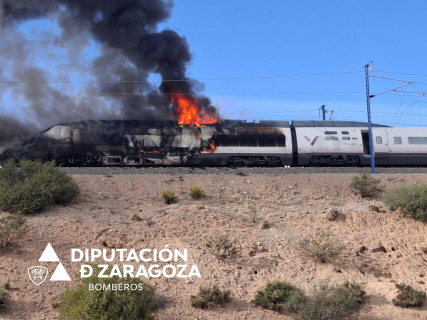
Renfe warns of possible new delays this Monday on the Madrid-Barcelona line after the fire of an AVE in Zaragoza

The operator allows free changes and cancellations, after a fire on an AVE forced the interruption of train circulation for several hours.

2 minutes

fotonoticia 20261012225926 1920

fotonoticia 20261012225926 1920

Add DEMÓCRATA to Google

Ask FREN

Published

Last updated

2 minutes

Most read

Renfe has warned of possible delays on the high-speed line Madrid-Barcelona after the incident recorded on Monday, October 12, when a fire in an AVE forced the interruption of railway circulation for several hours. The company has warned that the service may experience disruptions in the departures and arrivals of some trains.

The operator has enabled changes and cancellations of tickets at no cost for affected travelers. It has also indicated that it will contact them via SMS or email, through the data associated with the reservation, if their train is affected.

The fire of an AVE interrupted the line in Zaragoza

The incident occurred around 16:05 on Monday at the height of Ricla, in the province of Zaragoza. The affected train had left Madrid-Puerta de Atocha at 14:27 and was destined for Figueres, in Girona. The fire was detected in the tail cabin of the convoy.

The 283 passengers traveling on board were evacuated following safety protocols. Renfe reported that no injuries had been recorded and that emergency services intervened to extinguish the flames and allow inspection of the railway infrastructure.

The incident forced the suspension of high-speed circulation between Madrid and Barcelona and caused the stopping of trains at different stations, in addition to the cancellation of scheduled departures during the afternoon. At that time, the causes of the fire were not known and Renfe announced an investigation to clarify what happened.

Once the fire was extinguished and the necessary checks on the infrastructure were carried out, Adif began the gradual recovery of railway traffic. The resumption was not immediate: operations had to be reorganized after several hours of interruption.

According to the balance released by Renfe, the incident affected 33 trains and 12,979 travelers. Of the affected services, 18 had not been able to leave their origin stations and another 14 were stopped at different stations on the line.

The company's forecast was that, around 23:00, all trains that remained stopped at their origin stations would already be circulating. The notice published this Tuesday indicates that disruptions may still occur in some services, so travelers should check the specific situation of their train.

How to check the train status and request changes

Renfe recommends using its official channels to check if the planned service is maintained or has changes. The company has the railway information account InfoRenfe on X, in addition to its customer service channels and its website.

Travelers whose train is affected may request changes or cancellations at no cost, according to the notice issued by the operator. Renfe states that it will contact them by SMS or email using the information provided when making the reservation.

The company has not detailed in the notice which specific trains may experience delays nor how long the alterations could last. Therefore, checking the status of each service before traveling is the most useful reference for those planning to travel between Madrid and Barcelona.

More key points, information and questions with FREN

AI-GENERATED CONTENT

What is the parliamentary procedure for investigating serious incidents in railway infrastructure in Spain?

In Spain, serious incidents in railway infrastructure (accidents, systemic failures, safety issues) are addressed in parliamentary sessions through the ordinary set of control and political investigation instruments provided in the Regulations of the Congress and the Senate, without a "special railway" procedure. Depending on the severity and timing, investigation committees, work in standing committees, questions, appearances, and motions are combined.

1. Available parliamentary instruments

In the Congress of Deputies, the institutional axis is usually the Transport Committee (or equivalent, depending on the name in each legislature), as the standing committee competent in railway matters. Regarding that incident, the following can be activated:

  • Investigation committee (art. 52 of the Congress Regulations): a non-standing committee created "on any matter of public interest." It must approve a work plan, can appoint rapporteurs, and require the presence of any person to be heard. It concludes with a report debated and voted on in Plenary.
  • Monographic sessions of the standing Transport Committee: to analyze the incident, request explanations from the competent ministry or involved public companies, and agree on resolutions or non-legislative proposals.
  • Subcommittees or study panels within the competent committee, for more prolonged technical analysis, with expert appearances and report preparation.
  • Oral questions in Plenary or committee and written questions: to obtain specific information about causes of the incident, responsibilities, corrective measures, compensations, etc.
  • Interpellations to the Government and, if applicable, motions following interpellations, which establish a political position on the management of the accident or on railway safety policy.
  • Requests for appearances of Government members, senior officials, heads of public business entities, and other involved actors.
  • Requests for information and documentation to the Government and public Administrations through the Congress Board or committees, with a general obligation to provide it except in specific cases.
  • Non-legislative proposals (PNL) in committee or Plenary, urging the Government to adopt regulatory changes, strengthen safety, review protocols, etc.

In the Senate, there is an equivalent range: standing Transport committees, investigation committees, study subcommittees, questions (oral in Plenary and committee, and written), appearances, motions, and non-legislative proposals specific to the Upper Chamber.

2. Who can promote each instrument and majorities

In the Congress, the creation of an investigation committee requires Plenary agreement and can be proposed, according to the Regulations:

  • By the Government.
  • By the Congress Board.
  • By two parliamentary groups.
  • Or by one fifth of the deputies.

The approval majority is the simple majority of the Plenary, unless something different is agreed in political practice.

Appearances in committee can be requested by parliamentary groups or by a minimum number of committee members, and are usually agreed by simple majority of the committee or the Board and Spokespersons of the committee, depending on the type of appearance (Government members, heads of public entities, experts, etc.).

Oral questions, interpellations, PNLs, and motions are registered at the initiative of deputies or groups, with the formal requirements of each procedure. Their inclusion in the agenda and, if applicable, their approval depend on the Board of Spokespersons, the Board, and the majorities of Plenary or committee (usually simple majority for PNLs and motions).

The Senate operates with analogous rules: investigation committees can be promoted by groups or a relevant number of senators (around a quarter of the Chamber, according to its Regulations), and are approved by simple majority of the Plenary; questions, appearances, and PNLs follow similar logics to those of the Congress.

3. Coordination between Congress and Senate

Congress and Senate are autonomous Chambers: each can open its own investigation committee or work line on the same railway incident. There is no formal hierarchy between their investigations, nor a mandatory coordination mechanism.

However:

  • Mixed Congress-Senate committees can be created if both Chambers agree, at the proposal of their Boards and after hearing their Boards of Spokespersons.
  • Informal political coordination is frequent: time sharing, document exchange, and reciprocal submission of conclusions or resolutions to the Government.
  • Each Chamber approves its own report and sends it to the Government; sometimes the works carried out are mutually considered.
4. Appearance of public companies, private companies, experts, and victims

Investigation committees (and, to a lesser extent, standing committees) can "require the presence of any person to be heard," through the Presidency of the Chamber. This formula includes:

  • Heads of public companies such as Renfe or Adif (presidencies, general management, safety managers, etc.).
  • Executives of private companies involved (construction companies, maintenance companies, private operators).
  • Technical experts (engineers, experts, academics) and representatives of regulatory or safety bodies.
  • Victims and associations of affected persons, when the committee considers it relevant to hear their testimony.

Appearances must comply with the Constitution and the legislation developing article 76.2 CE: the summoned person is warned of their rights and obligations, may attend accompanied, and there are limits for secret, reserved matters, data protection, or ongoing judicial procedures. Parliamentary conclusions do not bind courts nor modify judicial resolutions, although they can be sent to the Public Prosecutor if signs of illegality are detected.

What specific competencies does Adif have in managing railway incidents compared to Renfe?

Adif and Renfe play complementary but clearly differentiated roles in managing railway incidents. The key is to distinguish between infrastructure and network circulation (Adif's scope) and transport service and passenger care (Renfe's scope).

Specific competencies of Adif in incidents

Adif (and Adif-High Speed) is the railway infrastructure manager of the General Interest Railway Network. According to its Statute (Royal Decree 2395/2004) and the delegation agreements published in the BOE in 2025, its functions are specified as:

  • Management and maintenance of infrastructure: tracks, catenary, signaling, control and telecommunications systems, interlockings, level crossings, tunnels, as well as stations and technical facilities.
  • Management of circulation: from the Traffic Regulation Centers, it organizes, regulates, and coordinates the passage of all trains (Renfe and other operators), assigns capacity, and sets circulation conditions.
  • Detection and treatment of network incidents: when there is a failure in signaling, catenary, track, or control systems, Adif:
    • Detects the anomaly (through its systems or driver alerts).
    • Imposes speed limitations, diverts traffic, or cuts the line if necessary for safety.
    • Deploys technical teams to repair the incident and decides when circulation is restored, totally or partially.
  • Contingency and emergency plans: the Adif Board delegates to its presidency the approval of:
    • Guidelines for internal investigation of railway accidents.
    • The annual report of incidents and accidents derived from the provision of railway service.
    • A contingency plan with necessary measures to restore normality "in case of accident, technical failure, or any other incident that disrupts railway traffic."
  • Coordination with railway companies and emergencies: in accidents like Adamuz, Adif coordinates from its control centers:
    • Communications with drivers and conductors.
    • Information about the state of the track and circulation.
    • Conditions for emergency teams to act safely on the infrastructure.
  • Operational information: communicates to operators (Renfe, Iryo, Ouigo, etc.) which sections are affected, what detours or restrictions apply, and when line capacity is recovered.

In summary, faced with an incident affecting the network, Adif is the one who controls the system's "traffic light": what can circulate, how, at what speed, and when the restriction is lifted.

Specific competencies of Renfe in incidents

Renfe Operadora is a railway company: it operates passenger and freight trains over Adif's infrastructure. In an incident, its functions focus on service operation and passenger relations:

  • Management of rolling stock and personnel:
    • Driving, conductors, and onboard and station service personnel.
    • Diagnosis and repair of train failures; operational decision to continue, evacuate, or withdraw a trainset, always respecting safety conditions set by Adif and the State Railway Safety Agency.
  • Passenger care:
    • Information about delays, cancellations, platform changes, transfers, or alternative transport.
    • Application of passenger rights (refunds, compensations, re-accommodations, meals) and assistance protocols for victims in serious accidents.
  • Service planning and rescheduling:
    • Schedule adjustments, train cancellations, reinforcement of others, composition changes.
    • Hiring and organizing buses or other alternative means when infrastructure does not allow normal circulation.
  • Communication with Adif:
    • Notifies incidents detected by drivers on track.
    • Receives real-time circulation instructions and relays them to its personnel.
    • Cannot decide alone to reopen a line or lift speed restrictions: those are Adif's decisions; Renfe adapts operationally to them.

Practical difference in responsibilities

  • Infrastructure incident (signaling, catenary, damaged track, tunnel flooding):
    • Adif: detects, protects circulation, repairs, and sets operating regime (cut, detours, speed limits).
    • Renfe: reorganizes its trains, offers alternatives, and attends affected passengers.
  • Train or service incident (rolling stock failure, internal fault, personnel problem):
    • Renfe: primarily responsible for resolving the failure, deciding train treatment, and managing user care.
    • Adif: orders circulation around the failed train and enables, if applicable, maneuvers to remove it.

In summary, in incident management Adif is responsible for the network and circulation, while Renfe is responsible for the train and the passenger. Practice shows that almost all relevant situations require coordinated action, but each entity acts within a competential perimeter well defined by railway regulations.

Can you explain which regulations (laws and royal decrees) define these competencies of Adif and Renfe in more detail? How are responsibilities and possible compensations to passengers distributed when a delay is caused by Adif and not by Renfe? What role do the State Railway Safety Agency and the CIAF have in railway accidents regarding Adif and Renfe?

What legal requirements must Spanish railway companies meet to guarantee safety on high-speed routes?

In Spain, safety in high-speed services is supported by a regulatory framework highlighting the Law 38/2015, of September 29, on the railway sector, and the Royal Decree 929/2020, of October 27, on railway operational safety and interoperability, along with regulations on railway personnel (Order FOM/2872/2010 and its amendment through Order FOM/679/2015). These norms transpose, among others, Directives (EU) 2016/798 (railway safety) and 2016/797 (interoperability), and set the requirements that companies operating high-speed trains on the General Interest Railway Network must meet.

License and safety certificate

Law 38/2015 defines railway companies as entities whose main activity is the transport of passengers or goods by rail and requires:

  • To have a railway company license, granted by the State Railway Safety Agency (AESF), accrediting appropriate corporate form, financial capacity, professional competence, and civil liability coverage.
  • To meet requirements of good reputation and absence of certain serious or very serious sanctions in safety and labor regulations.

Royal Decree 929/2020 develops the operational safety regime and establishes that, before providing services on high-speed lines, the company must obtain a single safety certificate, in coordination with the European Railway Agency when applicable. This certificate verifies that:

  • The company applies an effective safety management system (SMS).
  • It complies with technical, operational regulations and national standards applicable to the lines on which it will operate.

Safety management system and risk management

RD 929/2020 introduces the concept of operational safety as the quality by which risks associated with railway operation are reduced and controlled to an acceptable level. For this, the company's SMS must:

  • Identify hazards and assess risks arising from high-speed train operation and supporting activities.
  • Establish preventive and mitigation measures, including operational limits, procedures for degraded situations, and contingency and service continuity plans.
  • Incorporate common safety methods and common safety indicators, with periodic reports.
  • Provide for internal investigation of incidents and accidents, audits, and continuous SMS review.

Rolling stock, interoperability, and infrastructure

In high speed, companies may only use trains that have the authorization for placing on the market or circulation corresponding, according to RD 929/2020 and the Technical Interoperability Specifications derived from Directive (EU) 2016/797. They must guarantee:

  • Technical compatibility of rolling stock with fixed subsystems: track gauge, electrification, signaling (for example, ERTMS when required), and design speed.
  • Documented preventive and corrective maintenance programs, inspections, fault management, and immediate withdrawal from service when deficiencies affecting safety exist.
  • Coordination with the infrastructure manager (ADIF and ADIF-High Speed) regarding fencing, level crossings, grade separations, track works, and temporary speed restrictions.

Driving and safety personnel

Safety in high speed largely depends on personnel qualification:

  • Order FOM/2872/2010, amended by Order FOM/679/2015, regulates the conditions to obtain and maintain the qualifying licenses of personnel related to circulation safety (drivers, traffic managers, work supervisors, etc.): age requirements, minimum training, command of Spanish, and psychophysical aptitude.
  • Controls for alcohol and psychoactive substances, causes for suspension or revocation of licenses, and requirements for periodic refresher and update courses are established.
  • RD 929/2020 develops aspects such as maximum driving and rest times, as well as control of these times by companies.

Passenger information, emergencies, and supervision

Although RD 929/2020 excludes civil protection and citizen security from the definition of operational safety, it requires the SMS to integrate contingency plans and procedures for emergencies onboard and on infrastructure, coordinated with the infrastructure manager and, when applicable, with Civil Protection devices.

The company must ensure that personnel know and apply communication protocols with control centers and external service notification, as well as that passengers receive adequate safety and incident response information.

Finally, the AESF exercises supervision and inspection functions over the sector: it can access facilities and trains, demand corrective measures, and suspend or revoke licenses and certificates when serious non-compliances are detected, thus reinforcing the continuous obligation of companies to maintain high safety standards on high-speed routes.

Play

Test your knowledge with FREN!

How much do you know about this topic? Answer the following 3 questions.

Where did the AVE fire occur that forced the suspension of traffic between Madrid and Barcelona?

Question 1 of 3

What measures has Renfe taken for travelers affected by the incident?

Question 2 of 3

How many trains were affected by the incident according to Renfe's report?

Question 3 of 3