
The Supreme Court has confirmed the precautionary measures affecting certain registrations in the Electoral Census of Absent Residents (CERA) linked to the so-called grandchildren's law and has established that they will remain in force for the general elections on November 29. The Third Chamber has dismissed the appeal for reconsideration from the State Attorney's Office against the order of September 10, a decision that Iustitia Europa has celebrated as a support for the judicial initiative that the organization launched at the end of June.
The ruling maintains the suspension of the electoral effects of the registrations included in the precautionary measures, except in cases where the consular registrations prove compliance with the requirements established by the court. The resolution refers to 163,020 voters registered in the CERA as of the census closing date of August 1, 2026, within the universe affected by the controversy over the application of the eighth additional provision of the Law of Democratic Memory.
One of the most relevant points of the order is the reproach to the Administration for the lack of information regarding the execution of the measures. The Supreme Court states that the degree of compliance is "non-existent or, at least, unknown," given that neither the General Administration of the State nor the National Institute of Statistics has provided data that allows determining how many files have been reviewed and what the scope of the actions taken is.
The Chamber also rejects that the Administration can justify the lack of execution due to a material impossibility when this arises from its own actions. "Material impossibility of executing a judicial order cannot be claimed when the cause of non-compliance lies with the Administration itself responsible for fulfilling it," the court points out.

Pardo claims the initiative of Iustitia Europa
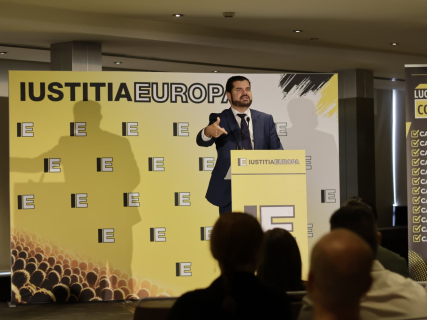
The president of Iustitia Europa, Luis María Pardo, has celebrated this Monday the decision and has claimed that it was his organization that opened this judicial avenue by filing a complaint with the Central Electoral Board on June 28. The initiative sought to examine the control and traceability mechanisms of certain incorporations into the external census.
"The Supreme Court has confirmed that the transparency and traceability of the census are a democratic requirement, even when the elections have already been called," Pardo states in the legal assessment released this Monday.
The leader maintains that the party raised a question that, in his opinion, had not been addressed until then by other parties: how to verify the documentation that supports each registration, what requirements have been accredited, and what controls allow for the reconstruction of the administrative procedure.
"For years, elections were held and no one wanted to open this debate. On June 28, we decided to do it ourselves. Iustitia Europa was born from civil society and it had to be precisely civil society that raised a fundamental question: who is part of the census, how did they get there, and what controls exist to guarantee its traceability", he states.
Pardo considers that the confirmation of the precautionary measures has special significance because the elections have already been called. "The State appealed the precautionary measures and the Supreme Court confirms them in full. The protection we achieved on September 10 is still in effect and today has a specific electoral date: November 29," he emphasizes.
The compliance with judicial orders at the center
For the president of Iustitia Europa, the lack of information about the execution of the measures constitutes one of the most significant aspects of the resolution. "There is a resolution from the Supreme Court, there is an obligation to execute it, and, a month later, the Chamber itself states that it does not know what the level of compliance is," he points out.
Pardo insists that administrative difficulties cannot become an argument to nullify a judicial decision. "Administrative difficulty can never become a mechanism to undermine a judicial resolution," he asserts, demanding that the Administration execute what the court ordered.
The party places traceability at the center of its legal strategy. As its president explains, it is not only about knowing the number of affected individuals, but also about being able to reconstruct each file, identify the documentation provided, and verify what criteria were used to authorize the registration.
The very car recalls that the cleaning of the census is an essential element for democratic legitimacy and warns that doubts about its regularity can affect the legitimacy of the elected representatives. Pardo highlights that pronouncement as a confirmation of the relevance he attributes to his party's initiative.
"The legitimacy of our institutions arises from the popular will, and the popular will demands a census subject to the law, verifiable and transparent," he states.
Iustitia Europa has also announced that it will remain vigilant regarding potential actions before the Constitutional Court, as the PSOE has already advanced, and has demanded respect for the separation of jurisdictions, for effective judicial protection, and for the resolutions already issued.
The procedure remains pending a definitive resolution on the merits. Meanwhile, the Supreme Court maintains the precautionary measures in the established terms, with express effects on the elections of November 29. For Pardo, the decision confirms that the electoral call does not exempt the administrations from complying with judicial resolutions and that the transparency of the census must also be guaranteed during an ongoing electoral process.