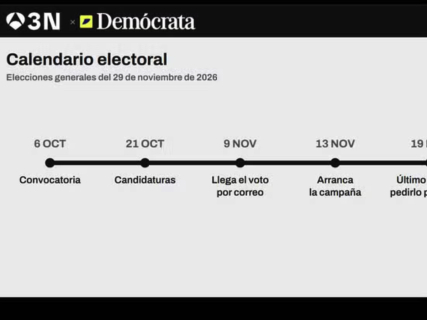
The electoral calendar of Demócrata arrives at Antena 3 Noticias to follow the key dates of 29N

Antena 3 Noticias incorporates the interactive calendar developed in collaboration with Demócrata into its coverage of the general elections. The tool allows consulting the main deadlines and events up to the date with the polls.

CalendarioDemocrata

CalendarioDemocrata

Add DEMÓCRATA to Google

Ask FREN

Published

Last updated

2 minutes

Most read

Elecciones 29N · Encuestas

La media de las encuestas

Media a 24 de octubre de 2026 · 15 institutos

  • PP31,4 %
  • PSOE26,9 %
  • Vox18,8 %
  • Sumar6,4 %
  • Podemos3,1 %
  • ERC2,2 %
010203040ene 2024jul 2024ene 2025jul 2025ene 2026jul 2026

Media del último estudio de cada instituto en 30 días y su evolución semanal desde el 23J. Partidos con al menos un 2 %.

Todas las encuestas

Elecciones generales del 29 de noviembre · Demócrata

The electoral calendar of Demócrata is part of the coverage of 29N by Antena 3 Noticias. The Atresmedia outlet has published a guide that incorporates this interactive tool to help readers follow the steps of the electoral process: from the presentation of candidacies and the start of the campaign to the different voting modalities.

Check here the interactive electoral calendar and the complete guide of Antena 3 Noticias

A tool to orient oneself before going to the polls

An electoral call is not summarized in the day of voting. Before that, procedures and deadlines occur that affect differently those who vote in person, request a mail-in vote, or are outside of Spain.

The calendar allows placing those moments within the same sequence. Its usefulness is especially clear for those who need to anticipate a management: knowing the deadline to request a voting modality is not the same as knowing until when it can be deposited.

The guide from Antena 3 Noticias and Demócrata accompanies the interactive with explanations about the main milestones. Readers can consult there the dates and locate the procedure that corresponds to them according to their situation.

Demócrata and Atresmedia: electoral information that also serves to participate

This collaboration brings the work of Demócrata to the digital coverage of Antena 3 Noticias and connects political information with a practical need of citizens: understanding how an election is organized and what they must do to participate.

The parliamentary and legislative specialization of Demócrata finds a direct application in these formats. In addition to reporting what the candidates say or how the campaign evolves, the interactive tools help explain the procedures that make voting possible.

The calendar is integrated into the series of resources that Antena 3 Noticias presents in collaboration with this outlet to follow the path towards November 29.

The electoral special of Demócrata: polls, candidacies, and the pulse of the networks

The calendar is part of the special of general elections of Demócrata, which brings together current events, analysis, and tools to follow the race towards 29N. A space that allows moving from the news of the day to a broader view: who is running, how the polls evolve, and what the next steps of the electoral process are.

Among its resources are the average of polls, the monitoring of its evolution, and the consultation of candidacies by provinces. These tools accompany journalistic coverage and help organize a campaign in which national decisions, territorial alliances, and disputes for each seat coexist. They are joined by service guides to resolve the practical doubts of voters.

The coverage also incorporates Poder Digital, a tool to observe another dimension of the political competition: the ability of leaders to connect with their audiences and generate conversation on social networks. Its indicators allow for comparing profiles and following their evolution beyond the number of followers.

With this set of resources, Demócrata offers different entry points to 29N: the calendar to anticipate deadlines, the candidacies to know the options of each territory, the polls to follow trends, and Poder Digital to analyze political conversation. All of this, along with the information and analysis of the general elections special.

More key points, information and questions with FREN

AI-GENERATED CONTENT

What parliamentary procedures are necessary to call general elections in Spain?

Calling general elections in Spain does not generally require a vote or authorization from the Congress or the Senate. In an early election, the initiative corresponds to the Prime Minister, following deliberation by the Council of Ministers, and the King formalizes the dissolution and the call through a royal decree. Parliamentary intervention changes when elections result from a failed investiture or certain constitutional reform procedures.

1. Early election: without parliamentary approval

Article 115 of the Constitution allows the Prime Minister to propose, under his exclusive responsibility, the dissolution of the Congress, the Senate, or both Chambers. Therefore, he does not need to gather a parliamentary majority, approve a law, or submit the decision to a prior debate.

The legal sequence is as follows:

  • Deliberation of the Council of Ministers: it is mandatory, although the power to propose corresponds to the Prime Minister.
  • Proposal of dissolution: the Prime Minister submits it to the King.
  • Royal decree: the King formalizes the dissolution and call, with the countersignature of the Prime Minister, who assumes responsibility for the act.
  • Publication in the Official State Gazette (BOE): makes the call official and activates the electoral calendar.

The public announcement by the Prime Minister does not replace these steps nor dissolve the Cortes by itself. The decree sets the election date and the constitution of the new Chambers.

2. Limits to early dissolution

The presidential power is subject to constitutional restrictions:

  • Dissolution cannot be proposed while a motion of no confidence is being processed.
  • A new dissolution cannot occur before one year has passed since the previous one, except in the case of a failed investiture.
  • The Congress cannot be dissolved while a state of alarm, exception, or siege is declared, according to article 116.5.

These limitations do not turn the call into a parliamentary decision: they delimit when the presidential power can be exercised.

3. Failed investiture: here there is a prior parliamentary procedure

Article 99.5 establishes a different path. If two months pass from the first investiture vote without any candidate obtaining the confidence of the Congress, the King must dissolve both Chambers and call elections. The period does not start on the election day nor on the day of the Congress constitution.

In the investiture, an absolute majority is required in the first vote; if not reached, there is another vote forty-eight hours later, where a simple majority suffices: more favorable than opposing votes. Successive candidacies can be processed within the period.

Once the two months expire, the dissolution is not voted on. The presidency of the Congress submits the decree to the King's signature and countersigns it. This is specified in article 172 of the Congress Regulations.

4. End of the term and constitutional reform

If there is no early election, the parliamentary term lasts four years and elections must be called at its end, without specific authorization from the Chambers. The Constitution sets elections between thirty and sixty days from the end of the term and requires convening the elected Congress within twenty-five days after the vote.

There is also an exceptional case: the aggravated constitutional reform procedure. Approval of its principle by two-thirds of each Chamber leads to the dissolution of the Cortes and elections.

5. What remains after dissolution

The Permanent Deputations preserve the corresponding constitutional functions; that of the Congress can act on royal decree-laws and exceptional states. They do not authorize the electoral call. In short, the ordinary call does not require parliamentary permission: prior votes are only decisive in the special constitutional cases described.

What are the competencies of the Central Electoral Board in the electoral process?

The Central Electoral Board (JEC) is the highest electoral administration body in Spain throughout the electoral process. Its competencies mainly come from the Organic Law of the General Electoral Regime (LOREG) and focus on guaranteeing transparency, objectivity, and the principle of equality among candidacies throughout the elections.

First, the JEC exercises a function of direction and interpretation of electoral law. This means it issues instructions and circulars that clarify how the LOREG should be applied, addressed to lower electoral boards (autonomous community commissions, provincial, zone, and external zone boards). These instructions standardize criteria and prevent disparate interpretations on issues such as propaganda, deadlines, or electoral documentation.

Secondly, the JEC is the highest supervisory and control body of the entire electoral process. It oversees the actions of other electoral boards, can review their agreements when appeals are filed, and ensures that the principles of neutrality, equality, and transparency are respected. Many agreements of provincial or zone boards can be appealed before the JEC, which resolves finally in the electoral administrative route.

A very relevant block of competencies relates to the proclamation of results. The JEC performs the general scrutiny in certain processes (for example, the vote of Spaniards residing abroad) and participates in the overall verification of official results. It is responsible for definitively proclaiming the elected deputies and senators in general elections, as well as representatives in the European Parliament, once the scrutiny is concluded and incidents that may affect the validity of the votes are resolved.

The JEC also plays a central role in the control of the electoral campaign and media. It sets criteria on the distribution of free propaganda spaces in public media, supervises the coverage plans of RTVE and other public media, and can order corrections if it detects imbalances or violations of the principle of political pluralism. Likewise, it controls the realization and dissemination of electoral polls during the legally regulated period.

Another key competency is the guarantee of neutrality of public powers during the electoral process. The JEC resolves complaints related to partisan use of institutional resources, institutional propaganda campaigns during prohibited periods, inaugurations and official acts likely to influence the vote, use of institutional websites and social networks, or symbols and public buildings for electoral purposes. When it detects infractions, it can order cessation of the conduct and, if applicable, impose sanctions.

In the sanctioning field, the JEC can initiate proceedings and sanction electoral infractions provided in the LOREG. This includes, among others, violation of rules on surveys, carrying out campaign acts in prohibited periods (such as reflection day), irregular placement of propaganda in certain spaces, or disobedience to its agreements. Its sanctioning decisions can be appealed before the contentious-administrative jurisdiction, but meanwhile they bind the affected parties.

Additionally, the JEC handles challenges related to candidacies and ballots: appeals against agreements of proclamation or exclusion of candidacies, correction of errors in ballots, denominations, acronyms, and symbols, as well as issues of incompatibilities or ineligibilities arising later. It also intervenes when conflicts arise over the presence of certain expressions or emblems in campaign acts, assessing whether they violate neutrality rules or the fundamental rights involved.

Finally, the JEC resolves numerous queries submitted by lower electoral administrations, political parties, public powers, or media about the interpretation of regulations during the electoral process. Although many of these queries are resolved through agreements or general instructions, in practice they constitute a function of “electoral administrative jurisprudence” that sets criteria for present and future processes.

In summary, the JEC combines normative functions (interpretation and instructions), control and supervision, proclamation of results, protection of institutional neutrality, and sanctioning power. With all this, it acts as the ultimate guarantor that elections are conducted with cleanliness, equal opportunities, and respect for democratic legality.

What requirements must Spanish citizens residing abroad meet to vote in general elections?

Spaniards who habitually reside abroad can vote in general elections if they have the right to vote and are registered in the Electoral Census of Absent Residents (CERA) valid for that call. They can do so by mail to their consular office or by personally depositing the vote at an enabled center. They no longer have to request the vote in advance: the 2022 reform eliminated the so-called requested vote.

1. Having the right to vote and being on the census

The general requirements are to have Spanish nationality, be eighteen years old on election day, and not be deprived of the right to vote. To vote as a resident abroad, it is also necessary to be registered in the CERA corresponding to the Spanish constituency in which one participates.

Consulates process registrations, removals, and changes of address of Spaniards residing in their jurisdiction. Therefore, it is important to check census registration and keep the address updated: electoral documentation is sent there.

According to article 39 of the Electoral Law, the applicable census is the one closed on the first day of the second month prior to the call. Consulates must offer a consultation service for eight days, from the sixth day after the call; during this period, claims about census data can also be submitted. Registering after the closure does not guarantee inclusion in those elections.

2. Obtaining electoral documentation

The Electoral Census Office automatically sends envelopes, registration certificates, instructions, and the list of enabled centers. In a second shipment, it sends the official ballots. The 2022 reform also allows downloading ballots from the official page indicated in the instructions.

If the documentation does not arrive, enabled consular centers must have ballots and envelopes, as well as means to provide duplicates of the necessary census certificates. Not receiving the shipment does not by itself oblige renouncing the vote.

3. Choosing a modality and proving identity
  • Personal deposit in ballot box: takes place between the eighth and third days before the elections, both included, within the announced schedule. Identification with Spanish passport or DNI, nationality certificate, or, failing that, consular registration certificate is required. One of the CERA registration certificates must also be presented.
  • Postal sending to the consulate: must be done after the definitive proclamation of candidacies and, at the latest, the fifth day before the elections. Certified mail will be used when possible. The vote must reach the consular office, at the latest, the second day before the election.

For postal sending, the envelope addressed to the electoral board must contain the voting envelopes, a census certificate signed on the back with the DNI or passport number, and the required identification documentation. This set is placed in the envelope addressed to the consulate, along with the second census certificate. The 2023 Electoral Instruction details this preparation.

4. Do not confuse residence with temporary stay

These rules correspond to those registered in the CERA. Being temporarily outside Spain does not equate to being a resident registered abroad. If a person registered in the CERA is in Spain during the elections, they can request postal voting here, indicating that condition and their temporary address; it must be sent to the competent electoral board, not to a polling station.

Play

Test your knowledge with FREN!

How much do you know about this topic? Answer the following 3 questions.

What tool has Antena 3 Noticias incorporated in its coverage of 29N?

Question 1 of 3

What does the interactive electoral calendar offered by Demócrata allow you to consult?

Question 2 of 3

What political dimension does the Poder Digital tool included in the coverage analyze?

Question 3 of 3