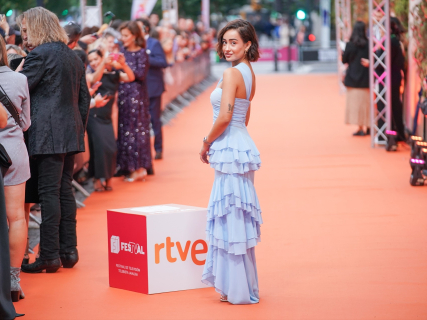

Marina Rivers began to gain followers during the lockdown, when TikTok became one of the main entertainment spaces for millions of young people. Her first videos talked about trends, humor, and personal content, and little by little her themes evolved to incorporate social and political debates. Today, the content creator is also a regular television collaborator who does not shy away from speaking out on controversial issues.
Marina Rivera Saldaña (Madrid, 2002), known as Marina Rivers, has built a community that exceeds seven million followers on TikTok and two million on Instagram. An audience that allows her to convey her opinions to a particularly young public, outside of traditional political information channels.
Her profile on social media stands out for defending positions on feminism, LGTBI rights, and equality. Although her interventions are often identified with progressive and leftist ideas, Rivers has never presented her content as an unconditional support for a specific party. This difference became especially relevant this summer, when she became one of the protagonists of an institutional campaign about democracy.
From TikTok to television
The popularity of Marina Rivers began to grow during the pandemic. Like many other content creators, she found in TikTok a platform from which to publish videos, make viral trends, and create a community of followers.
Over time, her activity stopped being limited to social media. Rivers began to peek into the world of television and to participate in conversations about current affairs. This evolution led her to share space with journalists, politicians, and other collaborators in television studios or advertising campaigns.
One of her first experiences on television came with TardeAR, the Telecinco program initially presented by Ana Rosa Quintana, to which she joined as a collaborator. Just over a year later, she went through Todo es mentira, on Cuatro, where she participated in discussions and debates about politics.
She has also participated in Traveling with Chester, the interview program of Risto Mejide. In May 2025, the host asked her if she had considered dedicating herself to politics. Rivers replied that she was interested in that world, but that the hate received on social media made her dismiss that possibility: "I love it, but I have already had enough hate in my life to dedicate myself to it".
Her television career also includes MasterChef Celebrity 9, a competition in which she was the runner-up in 2024, behind Inés Hernand. In 2026, she returned to the kitchens of RTVE to participate in MasterChef Celebrity Legends, still airing and for which she is positioned as one of the favorites.
This presence is complemented by her participation in The Rearguard, the current affairs and humor space of RTVE Play presented by her friend and colleague in MasterChef, Inés Hernand. There, she takes advantage of her training in Law and Economics to satirically bring to trial some of the trends and controversies of the present.
An influencer who talks about politics
Marina Rivers is not one of those influencers who prefer to stay out of politics. Between TikTok videos and collaborations with brands, she finds time to talk about feminism, taxes, racism, or LGTBI rights. She identifies with leftist positions and has no qualms about discussing them publicly, even though it has cost her more than one controversy on social media.
Her interest in these issues is also related to her academic training. Rivers is studying the double degree in Law and Economics, studies that she combines with her work as a content creator.
In August 2025, during a discussion on Everything is a Lie, she criticized the rise of certain discourses among young people. "Before, it was embarrassing to say you were homophobic or racist, now it's in fashion", she stated. She has also defended the importance of taxes to finance public services and has questioned messages that present any tax contribution as something negative.
In an interview with El Confidencial, published in March 2026, he summarized his way of understanding current affairs like this: "Everything is politics in life, you cannot be apolitical". For Rivers, political decisions affect everyday issues and young people should be interested in them, although he also acknowledges that it is not necessary to have an opinion on everything or to do so immediately.
He can publish a video about his personal life and, shortly after, comment on a parliamentary controversy or respond to statements he considers discriminatory. Politics is part of his usual content, and his opinions reach millions of followers who do not necessarily turn to social media for information.
"Dmocracia", the Government's campaign that sparked controversy
The episode with the greatest political impact of his recent career came in June 2026, when Rivers participated in "Dmocracia", a communication campaign promoted within the government program "Spain in Freedom. 50 years".
The initiative used the aesthetics of an urban clothing brand to spread democratic values among young people. It included sweatshirts, t-shirts, and pants designed by the Bnomio studio, as well as promotional content featuring influencers like Marina Rivers and Sara Fructuoso.
The garments were not intended for commercial sale. It was a promotional collection linked to an institutional campaign that used the language of fashion and social media to reach younger generations. However, images of Rivers wearing the "Dmocracia" clothing, some circulated with the Congress of Deputies as a backdrop, sparked a strong controversy in July.
The controversy intensified when messages began to circulate attributing to the Government an expenditure of about 15 million euros to create a clothing brand. The figure was incorrect.
As explained by the Secretary of State for Democratic Memory, the approximately 14.6 million euros corresponded to the budget of a much broader program of commemorative activities. The maximum cost communicated for the specific "Dmocracia" campaign was 386,000 euros, including production and dissemination.
"Democracy is neither left nor right"
In light of the repercussions of the campaign, the influencer published a video to explain why she had accepted to participate and respond to the criticisms received. Rivers assured that the commission had come to her through a private company and denied having a direct contractual relationship with the Executive. "I have no type of contract with the Government of Spain", she stated then.
She also rejected that participating in an initiative about democracy implied politically identifying with the PSOE or with the Government of Pedro Sánchez. "Democracy is neither left nor right, it belongs to all Spaniards", she defended, before explaining that she had understood the proposal as a campaign to commemorate the conquest of democratic freedoms.
The content creator also denounced the insults received during the controversy. Among them were those from the MEP Alvise Pérez, who published a derogatory message directed at her. Rivers admitted that the use of public money could be a subject of debate, but questioned the criticisms that used comparisons with other social needs to discredit her participation.
The 20,000 euros and the promise to donate them
The controversy also reached the remuneration that Rivers was to receive for the campaign. The influencer announced in July that she would donate the entire amount obtained from her participation and that she would publish a receipt to verify the operation.
Subsequently, it was revealed that the expected amount amounted to 20,000 euros. However, weeks later, messages began to circulate questioning whether she had fulfilled her commitment.
In August, Rivers spoke again on the matter and explained that she had not yet received the payment, as advertising work can take several months to be paid, and for that reason, she did not yet have a receipt for the donation. The creator insisted that she still intended to give the money to a charitable organization when she received it.
The digital power before the 29N: Influencers in campaign?
The trajectory of Marina Rivers reflects a transformation of influence on the internet. Creators who started by publishing entertainment videos have expanded their areas of intervention to become regular participants in political and social debates.
In her case, politics is not an isolated content, but a recognizable part of her media presence. Rivers talks about feminism, taxes, rights, and extremist discourses, intervenes in television talk shows, and addresses a community of millions of followers who can find her opinions while consuming entertainment videos.
Her training in Law and Economics is also part of that public image. Although her professional activity has mainly developed in communication and content creation, she resorts to legal and economic issues in many of her social media videos.
Just over a month before the general elections of November 29, Rivers represents a generation of communicators whose ability to influence public debate does not depend on the media.