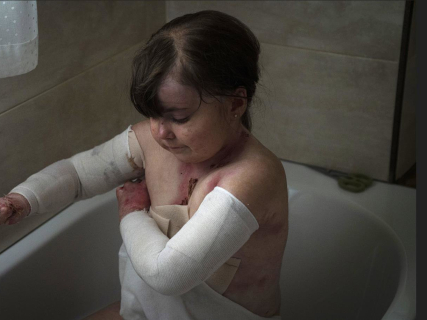

The director of the DEBRA Spain Association, Evanina Morcillo, has expressed her confidence that the medication 'Vyjuvek' can be funded by the public system "before the end of the year" to treat patients with the so-called butterfly skin disease.
"The Ministry and the pharmaceutical company continue their price and reimbursement negotiation process" and "we trust that before the end of the year a new proposal will be discussed for the inclusion of 'Vyjuvek' in the Interministerial Commission on Prices of Medicines (CIPM)" and that Health and the autonomous communities "will agree this time on a positive resolution to incorporate this therapy into the National Health System (SNS), as soon as possible," she pointed out in statements to Europa Press.
Morcillo detailed that, for now, four autonomous communities have begun to dispense the drug, specifically "Andalusia, Canary Islands, Castile and León, and Catalonia," and that "other communities, such as Aragon and Balearic Islands, have already approved some cases and communicated their decision to finance the treatment through the special situations medication route, although they have not yet started its administration." In contrast, territories like the Basque Country "have rejected, for the moment, this access route, waiting for 'Vyjuvek' to be incorporated into SNS funding," she added.
As a consequence, "the current situation is generating territorial inequity and significant emotional wear and tear on families, who live with uncertainty during the wait and, in some cases, the rejection of their requests." "Therefore, it is urgent to expedite negotiations to ensure equitable access to treatment throughout Spain and prevent the place of residence from determining patients' opportunities," she demanded.
Coinciding with the celebration, this Sunday, October 25, of the International Butterfly Skin Day, she recalled that "in Spain there are around 200 people with dystrophic epidermolysis bullosa eligible for their professional, under clinical criteria, to request the therapy," and that "more than 30 patients have begun treatment" or "have approval to receive it and are waiting for the start date to be confirmed or for the hospital to complete the necessary training."
Reduces pain and improves quality of life
Regarding the impact of the therapy, Morcillo has indicated that the assessment conveyed by families "is very positive," as they "talk about chronic wounds that begin to heal after years, less pain, a reduction in the time spent on care, and an improvement in autonomy and quality of life." "They also express relief, hope, and, above all, the desire for other affected people to access the treatment," he emphasized.
In this context, he cited the case of Andalusia as an example, which "was the first autonomous community to communicate its decision to finance 'Vyjuvek' through the special situations medication route for all patients who met the established clinical criteria." "As of today, it is the autonomous community with the most patients receiving this treatment," he specified.
"We are especially pleased to see how it is contributing to improving the quality of life of these people and their families, and we trust that this progress can be extended to the entire territory to ensure equitable access to therapy throughout Spain," he added.
However, Morcillo has clarified that, although the drug "represents an unprecedented therapeutic advance" for those who receive it, "it is not a cure and is not indicated for all types of butterfly skin." "Moreover, its effects focus on the treatment of wounds, so affected individuals still need comprehensive, ongoing care tailored to the particularities of their disease," he warned.
In this regard, he stressed that "the pending needs are numerous" and that among the most relevant are "Physiotherapy and rehabilitation, specialized dental care, home nursing care" and "financing of products for daily care, such as creams and lotions."