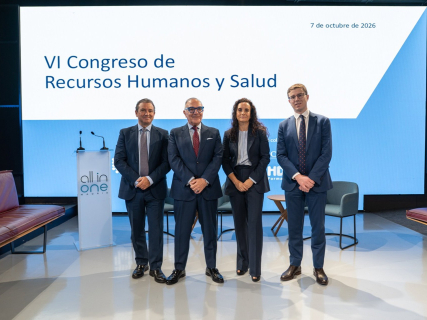

The president of the Spanish Private Healthcare Alliance (ASPE), José Manuel Baltar, has emphasized that "the healthcare organizations that best care for their professionals will also be the ones that best care for their patients," encouraging to "continue promoting policies aimed at attracting, developing, and retaining talent."
During the opening in Madrid of the 'VI Congress on Human Resources and Health of ASPE', Baltar reiterated that "the quality of care ultimately depends on the professionals who are part of the healthcare organizations." This event focused on flexibility in team management, well-being in the work environment, the role of artificial intelligence (AI), and opportunities for professional development.
The congress, organized with the support of CaixaBank, Livo, HDS Formación, and Cursos FNN, included, among others, the presence of the director of Institutions Madrid of CaixaBank, Juan Antonio Peña, and the manager of the Ruber Internacional Hospital in Madrid and president of the Human Resources Commission of ASPE, Olga Ginés. The program included a lecture by the professor of Applied Economics at the University of Las Palmas de Gran Canaria, Beatriz González López-Valcárcel.
The expert has argued that there is a "close relationship" between "regulation, planning, and human resource management." She warned that "future regulatory reforms could increase hiring needs in the sector" and advocated for the implementation of "more flexible management models, adapted to the expectations of professionals and based on data and evidence to facilitate more effective planning."
In her speech, she emphasized that "management models need data, they are an antidote against debates." Next, the heads of Digital Transformation of Ribera Salud, Tania Menéndez; of People Strategy of the same group, Ana Azorín; of Organizational Transformation and Digital Evolution of HM Hospitales, Cristina Castaño; and of Digital Transformation, People, and Organization of Quirónsalud, Arantxa Amor, delved into how AI is changing the management of people in the healthcare field.
AI in Human Resource Management
The speakers have agreed that AI "will play a key role in the transformation of human resources processes, optimizing tasks and improving the experience of professionals and candidates." They have also pointed out that "the main challenge is to generate trust and facilitate the adoption of these tools, ensuring that they complement the human component of people management."
In another panel, the head of Labor Relations in the People Department of ATRYS, Carmen Ruiz; the director of Prevention, Health, and Labor Wellbeing of Vithas, Francisco Javier Fuertes; the director of Human Resources of the University Clinic of Navarra, María Teresa Ahugetas; and the corporate director of Human Resources of IMED Hospitals, Montse Planelles, focused their interventions on the wellbeing and mental health of healthcare professionals.
Subsequently, the corporate head of Development, Assistive Innovation, and Nursing Projects of Quirónsalud, Alberto Martín; the manager of Viamed Fuensanta Hospital, Esther Escalero; the director of Nursing of CEMTRO Clinic, Saioa Rodríguez; and the director of Projects and Training Consulting of FNN Courses, Alberto Rando, presented the 'AVANCE Project.' This initiative, promoted by ASPE as a consensus sector proposal, seeks to establish a common framework that drives the professional progression and utilization of the talent of nurses and nursing auxiliary care technicians (TCAE), with the aim of ensuring safe, efficient, and quality healthcare.
At the closing, the general secretary of ASPE, Luis Mendicuti, highlighted the consolidation of the congress "as a reference space to share experiences and address common challenges in the management of healthcare human resources." In addition, he reiterated the employers' commitment to "continue promoting initiatives that respond to the needs of the centers and their teams."