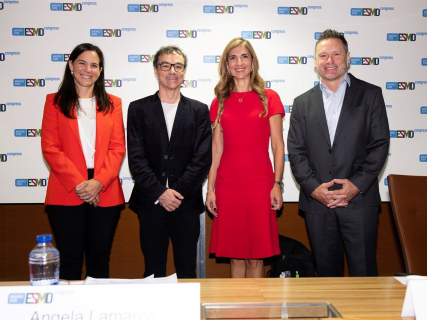

The president of the European Society for Medical Oncology (ESMO), Dr. Fabrice André, has pointed out that oncologists have taken on the challenge of researching how to optimize cancer treatments, "adjusting their doses and duration in such a way that they maintain their maximum efficacy with fewer side effects."
He emphasized that carrying out this task constitutes an "important responsibility," during the inaugural session of the Congress that the scientific organization is holding in Madrid until October 27. Throughout these days, specialists will present the latest advances in new therapies, the use of artificial intelligence (AI) to accelerate drug development, and also personalized immunotherapies aimed at preventing relapses.
The head of the Communication Committee of ESMO, Dr. Ángela Lamarca, has detailed that the meeting will bring together more than 40,000 attendees, 2,400 new studies, nearly 2,000 works hosted on the virtual platform, 12 presidential abstracts, and 230 sessions. Following this data, André has emphasized that optimizing therapies "offers three main advantages."
"First, it reduces the side effects associated with some cancer therapies, with the consequent benefit for the quality of life of patients," he indicated. He then added that, "second, it allows for cost savings in terms of healthcare services, as fewer resources are consumed." "Finally, it improves access to treatments," he noted, referring to this line of research also known as 'de-escalation.'
However, he warned that this type of trial is more complex to design than traditional clinical studies. While the latter usually compare a new therapy with the standard treatment, optimization work requires defining different variables and, in many cases, of greater complexity.
Collaborative work and the role of patients
In order to implement these projects, ESMO works closely with patient associations, caregivers, and healthcare professionals directly involved in the daily care of people with cancer. "From the early phases of optimization studies, that collaboration is essential," indicated the presidents of the Scientific Committee of ESMO, Drs. Yelena Janjigian and James Larkin.
They have recalled that "clinicians, patients and their caregivers and other professionals are the first to ask questions of this type, whether it would be possible to adjust a therapy in quantity or time, with the same safety, and what steps would need to be taken, exactly, to study this type of variables," and they have put as "examples of success" "the studies that have proven the possibility of reducing radiotherapy in some specific types of tumors, sometimes being able to eliminate it completely."
Likewise, they have advanced that Congress will include a monographic section dedicated to the use of AI, along with others focused on strategies for cancer prevention and early diagnosis. In this context, experts have also presented an initiative to humanize scientific communication, aimed at both patients and families as well as the researchers responsible for disseminating their results and the journalists who communicate them, to whom a decalogue of specific recommendations has been offered.