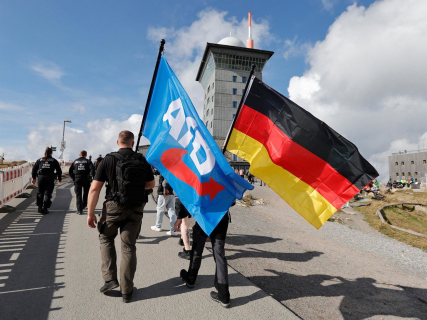

The electoral victory of Alternative for Germany (AfD) in Saxony-Anhalt had its first institutional consequence of national scope this Tuesday. Tobias Rausch has been elected president of the regional Parliament, becoming the first AfD politician to reach the presidency of a Landtag since the founding of the party.
Rausch, 35 years old, was elected during the constitutive session of the Chamber with 48 of the 82 votes cast, against 29 votes against and five abstentions. The figure is particularly significant because AfD has 39 of the 83 seats in the new Parliament, so their candidate necessarily needed support from other parties.
BSW had previously announced that its five deputies would support the AfD candidate, considering that it was appropriate for the most voted force to propose the president of the Chamber. However, the votes of AfD and BSW only totaled 44, which means that at least four other deputies supported Rausch in a vote that was held secretly.
This situation has no precedents in German politics. AfD had managed to occupy vice presidencies and other parliamentary positions in different federal states, but had never placed one of its representatives at the head of a regional Parliament. Rausch now holds one of the main institutional positions in Saxony-Anhalt.
Much more than directing debates
The presidency of the Landtag does not grant AfD control of the regional Government nor allows Rausch to determine the legislative agenda by himself, but it is not merely a ceremonial position either. The president directs the plenary sessions, grants speaking turns, supervises the votes, and ensures compliance with the regulations, with the ability to impose order measures during debates.
His powers go beyond the hemicycle. According to the Parliament of Saxony-Anhalt itself, the president represents the Landtag, presides over the Council of Elders, and directs all parliamentary administration, in addition to exercising the corresponding powers over his staff. He also has the right of admission and police authority within the premises of the Chamber.
Among his powers is also the appointment and dismissal of the president, the vice president, and other members of the regional Court of Auditors, as well as the data protection officer of the state, under the terms established by the regulations of Saxony-Anhalt.
The relevance of the election lies, therefore, in that AfD goes from participating in a regional Parliament for the first time to institutionally leading one of them, with direct capacity over its internal functioning and administration.
AfD needed votes outside its ranks
The appointment cannot be explained solely by the electoral result. AfD won the regional elections on September 6 and has 39 deputies, exactly the same number as CDU, SPD, The Greens, and Die Linke combined. The BSW completes the Parliament with five other representatives.
The formation of Sahra Wagenknecht had announced that it would support Rausch out of respect for parliamentary rules and the principle that it is the largest force that should propose the president. CDU had announced its abstention, while SPD, The Greens, and Die Linke had rejected backing AfD's candidate.
The secret vote has prevented determining where the four additional supports that Rausch has received beyond the 44 that AfD and BSW total come from. His election evidences, in any case, that the parliamentary barrier against AfD has not functioned uniformly in the constitution of the new Chamber, although it does not allow attributing those additional votes to any specific formation.
A leader of AfD's internal structure
Rausch has been a member of AfD since 2013, has been part of the Parliament of Saxony-Anhalt since 2016, and since 2021 has served as the parliamentary director of his group, a position especially relevant for organizing the activity of the formation within the Chamber. He also serves as the general secretary of AfD in Saxony-Anhalt.
This last responsibility had precisely provoked criticism before his election. The former president of the Bundestag, Norbert Lammert, warned about the difficulty of reconciling an institutional responsibility that requires impartiality with a leadership position within a political party. Rausch has defended that he can separate both functions and has committed to exercising the presidency with parliamentary fairness.
His figure has also been surrounded by controversy due to nepotism accusations related to hiring in the AfD environment. Rausch has rejected the accusations and has maintained that he did not intervene in the hiring of his relatives. CDU had questioned whether AfD should maintain its candidacy despite this information, although it decided not to block his election by voting against it.
A precedent for AfD in Germany
The arrival of Rausch to the presidency acquires an additional dimension due to the political situation of the party in Saxony-Anhalt. The regional organization of AfD is classified by the Office for the Protection of the Constitution of the state as a confirmed far-right organization, a circumstance that has served SPD, the Greens, and Die Linke to justify their rejection of the candidate.
The election does not in itself mean that AfD has broken the isolation it maintains with the rest of the major German parties. CDU, SPD, the Greens, and Die Linke continue to rule out governmental cooperation with the formation, while the BSW has indeed held conversations with AfD after the regional elections.
It does represent, however, a qualitative leap in the institutional presence of the party. Until now, the electoral growth of AfD had increased its weight in the regional parliaments without allowing it to access the presidency of any of them. Since this Tuesday, one of its leaders occupies the position responsible for representing the entire Parliament of Saxony-Anhalt and for guaranteeing the rights of all its deputies, including those of the formations that oppose AfD outright.
The precedent also comes at a particularly delicate moment for regional politics. AfD is the leading force of the new Parliament but lacks an absolute majority, so it needs external support to translate its electoral victory into the Executive. The election of Rausch demonstrates that such support can appear for certain institutional decisions, although it does not imply that there is an equivalent majority to invest a president of the regional Government.