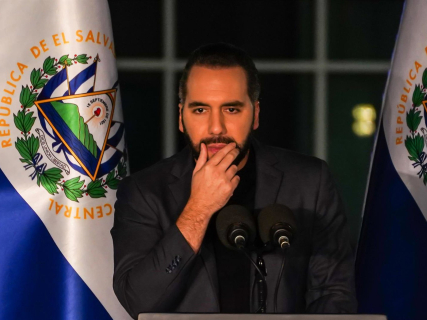

The president of El Salvador, Nayib Bukele, has denied that his Administration is going to release half of the prisoners linked to gangs and has specified that the mentioned percentage refers only to a possible review of files of people imprisoned for collaborating with these criminal structures. His words come after he announced a plan this week that could translate into "parole" for about 50% of the inmates for collaboration with these organizations.
According to his explanation, around half of this group could opt for penitentiary benefits through the Zero Leisure program, a work and reintegration plan that contemplates the reduction of effective prison time.
"We believe, in a prior review, that approximately 50% could enter the Zero Leisure program to be able to get out faster, reformed, instead of waiting ten years to get out more criminal," Bukele has indicated, in response to reports that spoke of a supposed massive release.
The head of State has emphasized that this is not an automatic exit, but a process in which the authorities will analyze each case regarding the degree of participation of each inmate. "We are going to review the cases and we are going to see what level," he has said, stressing that not all collaborators of a gang have had the same role nor share identical criminal responsibility.
Bukele has criticized the headlines that, according to him, have presented the initiative as the release of tens of thousands of incarcerated individuals and as a symptom of weariness of his security policy. "No gang member is going to be released. Never," he has emphasized, marking the difference between members of the gangs and those who, without formally integrating, have provided some type of support.
"I hope that the media that reported that we were going to release half of the prisoners and that we were going to release 46,000 (people) issue a correction," he has claimed, asking for at least a clarification on the true scope of his words in case a complete rectification is not published.
Social reintegration and tightening of penalties
In his speech, the Salvadoran president has taken the opportunity to advocate for the criminal reforms promoted by his Government and emphasize that the penitentiary system must combine punishment with preparation for the return of inmates to life in society.
In this sense, he has highlighted the Cero Ocio program, emphasizing that thanks to this initiative thousands of prisoners participate in labor and educational activities. He has also defended that penitentiary benefits are a tool to reduce the recidivism of those who eventually regain their freedom, and not a show of leniency towards criminality.
At the same time, Bukele has recalled that in April his Executive introduced life imprisonment in El Salvador and has praised the measure for preventing certain criminals from returning to the streets. He has also highlighted the increase in penalties for belonging to illicit associations, which, according to the data presented, have gone from between two and four years to between 20 and 40 years in prison.
The president has defended that both lines of action are complementary, arguing that not all crimes can be punished with life imprisonment and that even in countries with harsher penal policies there are sentences that allow for eventual release from prison. "That is not being soft on criminals," he has stated, referring to reintegration programs.