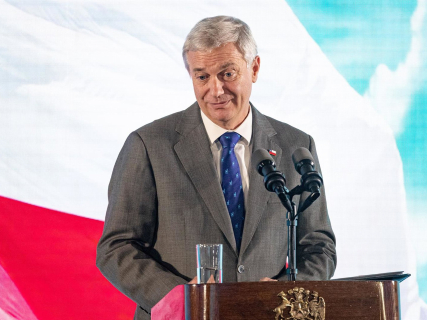

The president of Chile, José Antonio Kast, has announced this Monday the Budget Law for 2027, the first he signs since he took office. The project sets a total net expenditure of 105.8 trillion Chilean pesos (95.220 million euros), which represents an increase of 1.5% compared to 2026, and proposes to Congress the authorization to incur debt of up to 25 billion US dollars (22.290 million euros).
The initiative, which "considers a growth in expenditure of 1.5% compared to 2026," has been presented by Kast as a way to "reconcile the response to the main needs of the country with compliance with fiscal commitments," according to the Chilean Executive itself.
The volume of borrowing that La Moneda is now requesting exceeds that authorized in the last budget of former president Gabriel Boric, set at 17.4 billion dollars (15.510 million euros). In addition, the figure proposed by Kast also surpasses the debt ceiling of Boric's first budget, when a maximum of 15 billion dollars (13.370 million euros) was requested, according to the Chilean newspaper 'La Tercera'.
The borrowing request, included in article 3 of the project, covers both the amortizations and the interests of the fiscal debt. Additionally, there is an extra authorization of up to 600 million dollars (534 million euros), as detailed by the newspaper 'El Mercurio', which also mentions the total planned expenditure amount of 105.8 trillion Chilean pesos.
In the explanatory message that accompanies the initiative, consisting of 72 pages, Kast emphasizes that this is the "first budget of his administration" and that it is organized around three priority axes: "childhood, security, and employment and economic reactivation." The document specifies that the social benefits established by law, including the Guaranteed Universal Pension (PGU), remain protected.
As the Chilean president has emphasized, the design of the Budget aims to respond to the "main needs" of the citizens and, at the same time, respect fiscal rules. The Government has emphasized that, of every 1,000 dollars (890 euros) that the State disburses, more than 600 dollars (534 euros) will be directed to pensions, health, and education.
The project also incorporates a five-year spending plan and includes the review of 632 programs belonging to 23 ministries, with the aim of evaluating their performance and reallocating resources if necessary.