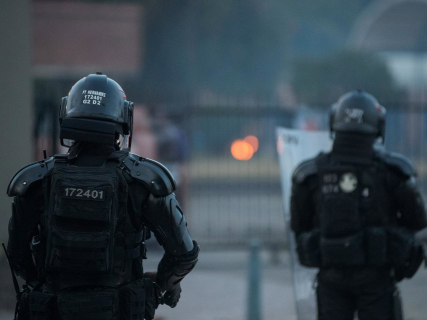

The Colombian Executive has initiated a new reorganization of the National Police by which the former Dialogue and Order Maintenance Unit (UNDMO), created during the mandate of former president Gustavo Petro, will be replaced by another structure with a different name and will again incorporate a riot squad to act in contexts of social protest.
This reconfiguration is outlined in a resolution signed this Tuesday by the general director of the National Police, General Jesús Barrera Peña, a document that several Colombian media have accessed.
The resolution, eight pages long, establishes a new internal architecture, distributes the competencies among its different dependencies, and sets a maximum deadline of 90 days to complete the administrative procedures prior to the effective implementation of the changes, as detailed by the newspaper "El Tiempo".
The UNDMO will be replaced by the National Anti-Riot Unit (UNADI), which in turn will incorporate the Mobile Anti-Riot Squads (ESMAD), thus recovering the name and the acronym that were used before the reforms promoted by Petro's Government (2022-2026).
The UNADI will be under the National Deputy Chief of Police Service and will act only when the capacities of other state instances are insufficient or are overwhelmed. It will be made up of eight regional units, from which 30 Mobile Anti-Riot Squads will depend, five of them based in Bogotá, the capital of the country.
The reform goes beyond a simple nominal change: the Police redefines its internal structure, consolidates a new chain of command, and evidences a shift in the current Executive's strategy regarding public disorder. Sectors of the opposition and civil society interpret this movement as an attempt to restrict freedoms and limit the right to protest.
In this context, tens of thousands of people demonstrated this Wednesday in the main cities of Colombia to demand improvements in labor conditions, in the educational system, and in other areas, in what has become the first national strike against the Government of De la Espriella.
The mobilizations, driven by unions, student organizations, the opposition, and various social collectives, took place a day after the approval of the decree that "defines the new protocol of action of the authorities within the framework of public demonstrations" and that "regulates the legitimate use of force by the State to protect citizens and guarantee the right to peaceful protest."