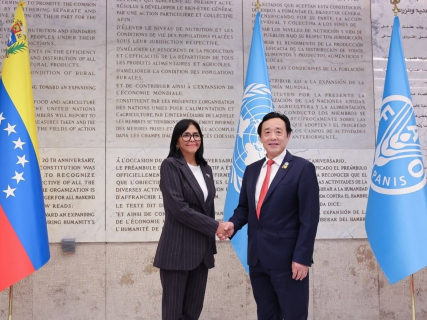

The acting president of Venezuela, Delcy Rodríguez, emphasized this Monday in Rome that the conversations with the United States and with opposition sectors have been decisive for the economic rebound of the country. During her speech, she also advanced the implementation of the Venezuela Alimenta Plan, a strategy aimed at accelerating the eradication of hunger in Venezuelan territory.
"We have begun to reverse that reality. The national dialogue with opposition factors, as well as the diplomatic dialogue with the United States, has contributed to the necessary political stability to produce and grow," Rodríguez highlighted in her speech before the plenary of the Food and Agriculture Organization of the United Nations (FAO).
According to the leader, these approaches, both at the bilateral level and in the sectoral, have had a "direct impact" on the "economic normalization" of Venezuela, contributing to creating a more favorable environment for productive activity.
In her speech, Rodríguez highlighted a report that reflects a decrease in undernourishment to 3%, compared to the 5.3% recorded in 2025. She added that acute malnutrition in children under five years old fell from 14.8% in 2019 to 1.3% at the end of 2025, accompanied by an index of 73.7% in exclusive breastfeeding, data that she presented as evidence of an improvement in nutritional indicators.
The leader has maintained that the crisis of shortages worsened significantly after the sanctions imposed starting in 2017, which severely impacted the agricultural productive fabric and limited the country's ability to guarantee basic supplies.
"Unfortunately, after that came a very difficult period. Venezuela faced a deep internal political confrontation that caused a strong contraction of our economy. A situation that was worsened starting in 2017, with the progressive imposition of unilateral coercive measures," she recounted.
Rodríguez detailed that these punitive measures restricted access to international financing, the purchase of agricultural inputs, technologies, spare parts, equipment, and other key components to keep food production chains operational.
Venezuela Alimenta Plan
In this context, Rodríguez has specified that the Executive will activate the Venezuela Alimenta Plan through a legislative initiative that will be debated in Parliament, with the aim of reinforcing food sovereignty by articulating different productive sectors of the country.
The proposed norm aims to integrate and coordinate national capacities to consolidate a program whose central purpose is to achieve the goal of zero hunger, aligned with international commitments regarding food security.
"I announce that I will present in the coming days to the Venezuelan parliament a new law for the local economy that allows communal economy, community economy, and entrepreneurship economy, the gearing and productive chaining for food production, with the large agri-food industry," he explained. "All of us, without exception, are going to contribute to this higher objective," he emphasized.
Furthermore, the Venezuelan official has highlighted the contradiction between the enormous global technological potential and the persistence of hunger crises derived from factors such as climate change and armed conflicts.
"We live, moreover, a paradox that is difficult to accept: humanity today has productive, scientific, technological capabilities like never before known. However, simultaneously, while millions of people lack sufficient food, a considerable proportion of the food we produce is lost after the harvest or ends up being wasted," he highlighted before mentioning the Gaza Strip or Sudan.