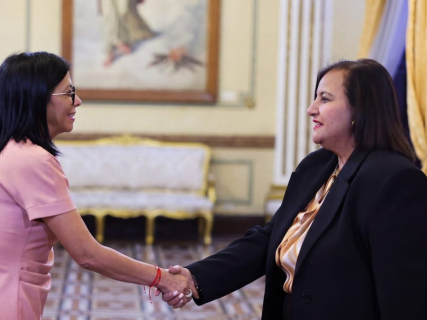

The acting president of Venezuela, Delcy Rodríguez, has held a meeting at the Miraflores Palace with the top negotiating representatives of the Government and the opposition, with the aim of reviewing the third cycle of conversations, a process that has the explicit support of the United States after confirming "tangible results" in the progress towards democratization and stabilization of the country.
According to a statement released by the Venezuelan Presidency, Rodríguez has met with the head of the Executive delegation, Jorge Rodríguez, and with the coordinator appointed by the National Assembly of 2015, Dinorah Figuera. The meeting has allowed for a review of the agreements reached after six days of work, articulated in two plenary sessions and fifteen meetings, continuing an institutional agenda focused on the "political stability of the Nation."
Among the understandings reached in this third round is the commitment to initiate a thorough review of the political disqualifications that prevent various opposition leaders from running for office, as well as the creation of a parity delegation responsible for managing the recovery of Venezuelan gold held at the Bank of England, whose resources will be directed to the victims of the recent double earthquake.
Support from the United States for the process
In parallel to the meeting in Miraflores, the U.S. Department of State has made public a statement in which it celebrates the conclusion of this stage of the dialogue. The spokesperson for U.S. diplomacy, Thomas Pigott, has emphasized that this process led by the Venezuelans themselves continues "strengthening democratic institutions, expanding political freedoms, and laying the groundwork for free, fair, and credible elections."
Washington has highlighted the concrete advances of this phase, including the agreement to review "repressive laws," the steps taken to amend the Law Against Hatred, and the progress in rebuilding an independent Supreme Court, which is currently advancing in the selection of 32 new judges. Likewise, the United States has focused on reinforcing press freedom by restoring access to more than 70 websites that had remained blocked.
In terms of Human Rights, the U.S. Administration has valued that the interim Government has released a "significant number" of political prisoners since the start of the reconciliation process, surpassing 1,000 releases since the 'Operation Absolute Resolution' (which culminated with the capture of former president Nicolás Maduro last January). Nevertheless, the State Department has reiterated its demand for "immediate release" for all those detained for political reasons who remain in prison.
The official text reaffirms the unwavering support of the Donald Trump Administration and Secretary of State Marco Rubio for the figure of Dinorah Figuera and the agreed roadmap. This backing from the White House for the current negotiation path contrasts with the situation of the also opposition leader and Nobel Peace Prize winner, María Corina Machado, who recently reported having been sidelined from the Caracas talks due to Washington's preference for bolstering the country's stability within the framework of the current institutional setup.