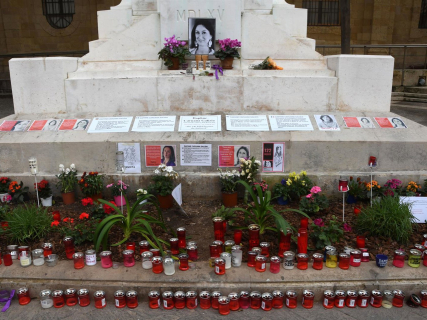

A Maltese court has declared businessman Yorgen Fenech not guilty of the two charges he faced for allegedly ordering the murder of journalist Daphne Caruana Galizia in 2017, when she was investigating corruption cases affecting the Government of Malta in the context of the Panama Papers.
The acquittal came after the jury issued a verdict of not guilty by eight votes to one on each of the crimes attributed to him, complicity and conspiracy, after eight hours of deliberations, according to the newspaper 'Times of Malta'.
The Daphne Caruana Galizia Foundation has lamented Fenech's acquittal "nine years" after the journalist was murdered, "denying her the justice she deserves." "The institutional failures that allowed her murder remain unresolved and unreformed," it reproached in a statement.
In the same vein, the NGO Repubblika has described the ruling as "disappointing" and expressed its support for the reporter's family, which for nine years has had to endure "the revelation of the most intimate details" of her death, "years of criminal proceedings, continuous attacks, and defamation," in addition to an "intolerable burden" in "fighting for the truths that the State itself was obliged to uncover."
"The verdict, however, does not require Malta to pretend that the evidence heard during this trial was never heard. It does not erase the findings of the public investigation and does not answer the deep questions that remain about corruption, impunity, political interference, and state failures," it stated in another statement.
For its part, the organization Occupy Justice has emphasized that there can be no talk of full justice until responsibilities are clarified in "the complete chain" of those who ordered the journalist's crime "and until the institutional failures exposed" after her murder are corrected, as "the fight for justice" continues.
"The work does not end here. Malta still needs the truth, accountability, protection for journalists, and institutions that act before corruption and impunity become irreversible," the collective argued.
Political reaction and criticism of the investigation
The leader of the opposition Nationalist Party, Alex Borg, was the first leader to speak out about the verdict, calling on citizens to gather in front of the Maltese Parliament. He claimed that, although "they respect the verdict," it does not mean "to remain silent" in the face of the doubts that have arisen during the judicial process.
Borg has insisted that this decision does not close the chapter on the murder nor exempts the State from its political responsibility for the serious shortcomings that undermined the investigation, including the lack of proper evaluation of evidence due to the authorities' delay in seizing, extracting, or analyzing key information contained in phones, computers, and other devices.
"This is not about minor details. How much evidence was lost and how many lines of investigation were left unexplored in time? How different would the Prosecutor's stance have been if from day one we had independent institutions, free from conflicts and the pressure of power?" he questioned.
The family of the journalist went to court to request that Silvio Valletta, former deputy commissioner of the Police of Malta --and husband of Justyne Caruana, then minister of the Labour Party government-- be removed from the case, alleging a lack of impartiality after his close relationship with Fenech became known, with whom he even traveled abroad while leading the investigations.
To these doubts about the management of the evidence were added continuous leaks of confidential information about the course of the investigation, which would have allowed those involved to anticipate the actions of the authorities for years.
A long process marked by appeals
The judicial procedure has been prolonged for years because Fenech filed various challenges related to the circumstances of his arrest, the alleged illegality of the detention, the supposed failure of the Maltese State to protect his health, and the way the judicial proceedings were conducted, which, according to his version, violated his right to a fair trial within a reasonable time.
The investigations pointed to the fact that the businessman would have paid around 150,000 euros to the material authors of the attack, after the journalist revealed months before her death the existence of an opaque company registered in the United Arab Emirates, called 17 Black, owned by Fenech and allegedly used to channel illegal commissions to high-ranking officials of the Maltese Executive.
Two other people --Robert Agius, known as "Ta Maksar", and his partner Jamie Vella-- were found guilty in June 2025 of supplying the explosive used in the murder. In 2022, the brothers George and Alfred Degiorgio accepted 40-year prison sentences after admitting that they placed and detonated the bomb. A third implicated person, Vince Muscat, was sentenced to 15 years after confessing and providing details about the crime.
The murder of Caruana Galizia and its consequences
Caruana Galizia died on October 16, 2017, at the age of 53, when a bomb placed in her car exploded in front of her home in Bidnija. At the time of her murder, she was investigating a case derived from the Panama Papers, related to alleged bribes channeled from 17 Black to shell companies linked to the chief of staff of former Prime Minister Joseph Muscat, Keith Schembri, and to the then Minister of Tourism, Konrad Mizzi, in Panama.
A report published in 2021 concluded that the risk to her life intensified starting in 2016, when she exposed the overseas businesses of prominent Maltese leaders following the leak of the Panama Papers.
Fenech, the head of the Tumas Group and advisor to ElectroGas Malta, was arrested in November 2019 while sailing on his yacht after leaving a Maltese marina. The accusation was supported by the testimony of his driver, Melvin Theuma, who confessed to having acted as an intermediary in the murder and received a pardon in exchange for cooperating with the Justice.
His detention, combined with suspicions that high-ranking government officials could be involved, triggered a wave of protests across the country in December 2019 that put then-Prime Minister Joseph Muscat in jeopardy. The journalist had also revealed that the 'premier's' wife was the owner of a company in Panama called Egrant.