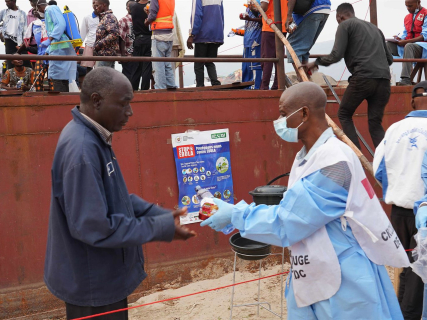

The Ebola outbreak declared in mid-May in the Democratic Republic of the Congo, the deadliest recorded so far in the country, continues to leave victims: 2,184 deceased in 54 health areas, with a special incidence in the northeastern province of Ituri, which has become the main focus of the epidemic.
According to the latest count released by the Congolese government, with data updated until last Tuesday, the total number of confirmed infections amounts to 4,665, of which 634 patients remain hospitalized in various medical centers.
The health authorities of the country have also confirmed the detection of Ebola in a new health area, Buta, located in the province of Haut-Uele, in the north of the Congolese territory, which expands the map of the virus's spread.
The World Health Organization (WHO) warned at the end of last week about the extreme severity of the current scenario. The outbreak, corresponding to the Bundibugyo strain — for which there is still no authorized vaccine — was officially declared on May 15 and remains concentrated mainly in the northern province of Ituri.
Ituri is also one of the most violent regions on the African continent, a context of insecurity that notably complicates the work of medical teams and the organization of the health response. This combination of factors has skyrocketed the mortality rate of the virus, which is approaching the levels of the outbreak recorded between 2018 and 2020.
The UN Assistant Secretary-General for Humanitarian Affairs and head of OCHA, Tom Fletcher, warned this Friday that the disease caused by this virus "is gaining ground" in the Democratic Republic of the Congo, with one death "every 30 minutes."
"We cannot allow the virus to surpass our capacity to respond," he emphasized after an emergency meeting of the Inter-Agency Standing Committee, the body that coordinates the assistance of UN agencies and their partners, with whom he has agreed to "intensify" the "collective" response to Ebola.
Fletcher also announced a new allocation of 30.5 million dollars (26.3 million euros) from the Central Emergency Response Fund (CERF) of the United Nations, which adds to the 24 million dollars (more than 20 million euros) already released for both the Democratic Republic of the Congo and four other neighboring states.
At the same time, he has announced the sending of 20 more specialists to reinforce the response "on the front line," although he has specified that it would be necessary to double the number of teams responsible for ensuring "safe and dignified burials" and "triple the treatment capacity" to contain the advance of the outbreak.
The British diplomat has insisted that "this is a wake-up call" and has demanded "speed, scope, and solidarity before this virus overwhelms us even more." "More than 2000 people have already died. Many more are at risk. The world must react and act," he has concluded.