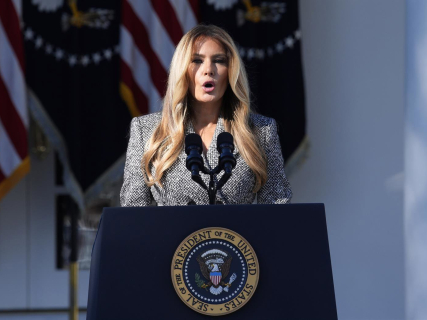

The First Lady of the United States, Melania Trump, has managed to broker a temporary ceasefire between Russia and Ukraine in the Ukrainian locality of Oleshki, located in the south of the country. The objective of the agreement is "to allow the entry of humanitarian aid and prepare an evacuation of civilians through a designated safe corridor," as communicated by the White House.
The U.S. statement establishes October 29 as the start date of the truce. However, the Russian command has specified that the cessation of military operations by its forces will begin on October 27 at 04:00 in the morning (Moscow time, one hour less in mainland Spain and the Balearic Islands), as detailed by the Chief of the General Staff of the Russian Armed Forces and First Deputy Minister of Defense, Army General Valeri Gerasimov.
Oleshki, under Russian control, has become one of the main symbols of the destruction and scarcity caused by the Russian invasion of Ukraine and the war. In the city, tens of thousands of inhabitants are trying to survive practically without food, without electricity supply, and without access to medicines.
The First Lady and her team have maintained direct contacts with the leaders of Russia and Ukraine to outline the conditions of this limited ceasefire, including technical aspects, schedules, procedures, and clauses of the pact, acting as a mediator between the parties.
Civilian non-military officials from both countries will coordinate to visit the neighbors of Oleshki in their homes and assess what type of support they require. "Those who wish to evacuate will receive coordinated support and transportation to their preferred destination. I foresee that some will want to go to Russia and others to Ukraine," explained the First Lady.
The entire operation will be supervised by an "impartial U.S. media organization to accompany and document the work of the Russian and Ukrainian teams on the ground throughout the process."
The Human Rights Commissioner of the Ukrainian Parliament, Dmitro Lubinets, has confirmed the existence of the truce on his social media, where he expressed his recognition to the U.S. First Lady "and her team (for) the leadership efforts and coordination" between the Ukrainian and Russian delegations.
"First of all, the ceasefire will be guaranteed; secondly, a humanitarian shipment will be delivered in Oleshki; and, thirdly, the free movement of the civilian population from Oleshki will be guaranteed," stated Lubinets, who has led the talks on behalf of Kiev.
However, he emphasized that this is a "highly complex" operation that will unfold "gradually," so he promised to inform the Ukrainian population about its progress and the results it yields.
Later, in a video, he confirmed the signing of a "agreement" that includes "preparation for the ceasefire, demining of the roads, provision of humanitarian aid, and reopening of the exits."
Lubinets had already warned about the seriousness of the situation in Oleshki. "People are not only suffering from the lack of food and medicine: they are dying," he declared in an interview with RBC-Ukraine.
According to the UN Human Rights Monitoring Mission in Ukraine, no food shipments have reached the city since May 26. For his part, the head of the Regional Military Administration of Kherson, Oleksandr Prokudin, has reported that Russian forces "are holding about 2,000 people hostage, of which nearly 50 are children, forced to survive without food, electricity, or water."