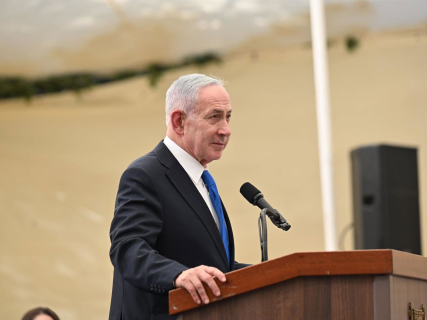

The Israeli Prime Minister, Benjamin Netanyahu, has lashed out this Friday against the President of Turkey, Recep Tayyip Erdogan, whom he has labeled as an "antisemitic dictator" after the new diplomatic clash between both countries following Israel's bombing of a military base in Syria. According to Netanyahu's version, these facilities were to be used as a deployment area by the Turkish Army.
Both Damascus and Ankara have flatly rejected the argument put forward by the Israeli government to justify the attack on the Abu al Duhur airbase, located in northern Syria. Syrian authorities have insisted that, contrary to what Netanyahu claims, "there was no intention to establish a Turkish base there, nor a Turkish military presence."
The Turkish government interprets that, with this bombing, Netanyahu intends to build a pretext to extend his military presence in Syrian territory beyond the Golan Heights, thus consolidating a greater intervention in the neighboring country.
This episode adds to a long chain of misunderstandings between Turkey and Israel, intensified since the beginning of the war in Gaza and its collateral effects. Among them is the Israeli attack in July against a humanitarian flotilla heading to the Gaza Strip, an event that led the Turkish judiciary to issue an arrest warrant against the Israeli Prime Minister, whom Erdogan often describes as a genocidal.
In a statement released this Friday, Netanyahu again launches harsh accusations against the Turkish president, whom he defines as an "antisemitic dictator" responsible for massacring Kurds, providing shelter to members of the Palestinian Islamist movement Hamas, "occupying" half of Cyprus, and imprisoning a "record number of journalists and politicians who oppose him."
The Israeli leader claims that Erdogan's new purpose would be to extend "his war of aggression" against Israel to Syria. Furthermore, he warns the Turkish leader that his "pathetic attempt to intimidate the leaders and soldiers of Israel, the only true democracy in the Middle East, will go nowhere."
Diplomatic tension with Ankara
The Turkish Presidency has responded by describing Netanyahu's claims as "absurd" in an official note in which it emphasizes that the accusations directed against Erdogan lack "historical foundation and political seriousness." For Ankara, this type of message highlights the "impotence" of the Israeli government in trying to "evade" accountability before justice for its crimes in Gaza.
"These low-level statements (...) constitute a teaching document that reveals who and to what extent Turkey's word and our president's stance, who does not remain silent in the face of truth, annoy," the Presidency has pointed out in a message disseminated on social media.
The Turkish statement also reproaches Netanyahu for his "cheap politics" in the midst of the electoral context in Israel, which is scheduled to go to the polls in October. "The campaign (...) has been influenced by irresponsible security populism and an increasingly harsh politics of threats," it has argued.
According to Ankara, this strategy includes the "attempt to present Turkey as a new threatening figure." The Presidency has also warned of the "serious risks" that these efforts to "stir up tensions for the sake of internal political rivalry" in Israel pose for regional stability.