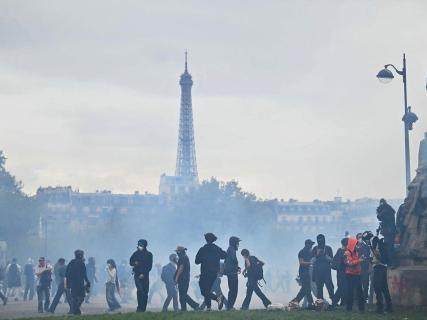

France is experiencing this Saturday a day of protests against the rising cost of living and the deterioration of public services, marked by clashes between protesters and security forces in several cities across the country. The police have used tear gas to disperse gatherings in Paris and Marseille, while in the capital at least 100 arrests have been recorded by noon.
The Paris Police Prefecture has reported that officers had made 100 arrests and 589 preventive checks by 12:00 hours, mainly in the vicinity of train stations. A large part of the arrests are related to the possession of protective objects and prohibited weapons, according to the authorities.
The security forces have intervened to disperse a union gathering of approximately a hundred people near the Gare du Nord and another led by high school students that had begun on Rennes Street. The incidents have spread to different points in the capital, where the authorities had established restrictions on demonstrations.
The French government has deployed more than 10,000 police officers and gendarmes across the territory, of which 5,000 are in Paris. The operation aims to prevent blockades in strategic infrastructures and contain possible disturbances during a day of mobilizations called by different social groups.
Incidents near the CNews and Europe 1 headquarters
The most notable clashes in Paris have occurred in the vicinity of the headquarters of the CNews television channel and the Europe 1 radio station, both belonging to the business group of magnate Vincent Bolloré.
According to police information, around a hundred hooded individuals have attempted to block access to the parking lot of the two media outlets, have thrown objects at the facilities, and have broken several windows. Officers have arrested about twenty people in connection with these incidents.
The authorities had previously prohibited gatherings in certain areas of the capital, including the surroundings of the Élysée Palace, the Prime Minister's residence, parliamentary headquarters, the Champs-Élysées, and several train stations.
The Minister of the Interior, Laurent Nuñez, had conveyed instructions to the territorial representatives of the Government to order the unblocking of roads, stations, and other infrastructures considered strategic when occupied by protesters.
The protests spread to Marseille, Lyon, and Rennes
Tension has also moved to other major French cities. In Marseille, several hundred people participated in a gathering that turned into clashes with the Police, after some protesters burned containers and other elements of urban furniture.
The agents have resorted to tear gas to respond to the throwing of objects and disperse the participants in the riots.
In Lyon, gatherings have been recorded near the Feyzin refinery and at different points in the city. Some of these mobilizations have been dissolved by security forces in response to attempts to disrupt traffic.
Police interventions have also been carried out to clear ring roads in Rennes and streets in Lille, on a day when roadblocks and urban access points have become one of the main forms of protest.
The rising cost of living and education fuel discontent
The mobilizations respond to a set of social demands that encompass the rise in fuel prices, the loss of purchasing power, deficiencies in public services, and the conditions of education.
The current cycle of protests began in September in high schools in the northern suburbs of Paris, where high school students denounced the lack of teachers and the deterioration of educational facilities. The mobilizations expanded their demands to include criticisms of social inequality and the insufficiency of resources allocated to public services.
As the weeks went by, student protests were joined by farmers, climate activists, and former participants of the "yellow vests" movement, which featured significant mobilizations between 2018 and 2019 against fuel taxes and the rising cost of living.
Although the main trade union organizations are not leading the call for this Saturday, some unions, including the General Confederation of Labor (CGT), have expressed their support for the mobilizations.
The unions are also preparing a new day of protests and strikes for the next November 5, focused on the defense of wages and public services.
Macron calls for calm in the face of the risk of new disturbances
The President of France, Emmanuel Macron, has appealed for calm and defended the right to protest, although he has insisted that it must be exercised without resorting to violence, insults, or vandalism.
The government fears that the mobilizations will lead to new confrontations, especially in Paris and the main cities of the country. The magnitude of the protests has rekindled the memory of the "yellow vests," whose demonstrations led to serious disturbances and a prolonged social crisis during Macron's first term.
The police action is also being debated after the injuries suffered by protesters in previous student protests. The government has suspended the use of stun grenades in those mobilizations, although the Interior Ministry maintains the possibility of resorting to other means of intervention in the face of violent situations.
For his part, the Prime Minister, Sébastien Lecornu, has pointed out that more than 900 agents have been injured during the protests, a figure provided by the government in the context of the confrontations recorded in recent weeks.
A new social crisis in a context of political uncertainty
The wave of mobilizations comes at a particularly delicate moment for France, which faces significant budgetary difficulties arising from its high public debt and the political tensions surrounding the necessary measures to contain the deficit.
The social discontent coincides, moreover, with a scenario of parliamentary fragmentation and with the proximity of the presidential elections scheduled for the spring of 2027, in which Emmanuel Macron will not be able to run for a third consecutive term.
La France Insoumise, a radical left formation led by Jean-Luc Mélenchon, has expressed its support for the demands of the protesters. Meanwhile, the far-right of Marine Le Pen maintains a prominent presence in the electoral polls, in a still open scenario for the upcoming elections.
The French authorities remain attentive to the evolution of the concentrations, whose definitive scope is still unknown. The day represents a new test for a protest movement that has managed to gather student, labor, and social demands around the rising cost of living and the functioning of public services.