Why the alarm has sounded today on the mobiles of Valencia and Alicante: what the ES-Alert of the Adam flood says

Emergencies sends two preventive notices due to the torrential rains expected for Sunday and Monday. These are the affected territories and the recommendations from Civil Protection.

es alert valencia lluvias

es alert valencia lluvias

Add DEMÓCRATA to Google

Ask FREN

Published

Last updated

2 minutes

Most read

Elecciones 29N · Encuestas

La media de las encuestas

Media a 13 de noviembre de 2026 · 15 institutos

  • PP31,4 %
  • PSOE26,8 %
  • Vox19,1 %
  • Frente Amplio6,3 %
  • ERC2,4 %
01020304050ene 2024jul 2024ene 2025jul 2025ene 2026jul 2026

Media del último estudio de cada instituto en 30 días y su evolución semanal desde el 23J. Partidos con al menos un 2 %.

Todas las encuestas

Elecciones generales del 29 de noviembre · Demócrata

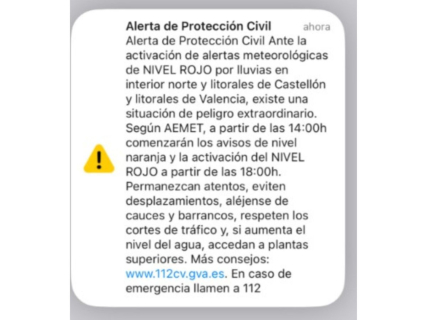
The mobile phones of numerous residents of Valencia and Alicante received an emergency alert this Saturday, October 17, ahead of the arrival of dana Adam, which threatens to bring torrential rains during Sunday and Monday. The alarm sound corresponds to the ES-Alert system, used by Civil Protection to warn the population of risk situations.

The Generalitat Valenciana has sent two preventive notices early in the afternoon, before the most intense precipitation occurs. The Minister of Emergencies, Juan Carlos Valderrama, explained that the goal is to anticipate the meteorological episode and warn of the possibility of flooding in the affected areas.

The areas that have received the ES-Alert

The two messages have been distributed in different territorial areas. The first was directed to the southern coast of Valencia and the northern coast of Alicante, where the State Meteorological Agency (Aemet) has activated the red alert for rain.

The second was sent to the southern interior and northern coast of Valencia, also affected by the risk of intense precipitation.

Although the distribution areas are different, the content of both notices has been the same, with instructions aimed at reducing the risks associated with the rains and possible flooding.

What the Emergency message says

The alert sent to mobile phones recommends avoiding travel, not crossing flood-prone areas, and respecting traffic closures that authorities may establish.

It also asks not to engage in activities in riverbeds or their proximities and advises people in flood-prone areas to seek elevated places or go to upper floors.

The message includes a warning about the danger of approaching promenades and other coastal areas during the storm.

In case of emergency, the Generalitat reminds that one should call 112.

Why the alert has arrived before it starts to rain

The sending has been done preventively, several hours in advance of the period of greatest meteorological risk. The purpose is for the population to know the self-protection recommendations before conditions worsen.

The ES-Alert system uses mobile phone networks to send messages to devices located in a specific area. No application needs to be installed nor prior registration is required to receive these warnings.

The alert can activate an intense sound and a special vibration to attract the user's attention, even if the phone is set to silent, depending on the device.

When the heaviest rains from the Adam DANA are expected

Aemet has activated the red alert from 10:00 hours on Sunday, October 18, to 10:00 hours on Monday, October 19 on the southern coast of Valencia and the north of Alicante.

In these areas, accumulations of 200 liters per square meter in twelve hours are expected, which could reach 300 liters in 24 hours in some points.

Authorities recommend following updates from Aemet and Emergency services, as the distribution and intensity of the precipitation may vary during the episode.

More key points, information and questions with FREN

AI-GENERATED CONTENT

What other emergency alert systems exist in Spain besides ES-Alert?

Besides ES-Alert, Spain uses sirens, loudspeakers, in-person warnings, radio, television, and official digital channels to inform about emergencies. There are also regional applications and preventive weather warnings. These are complementary mechanisms: some warn of an immediate danger while others allow anticipation or monitoring of its evolution; their availability varies by territory.

1. Sirens and on-site warnings

  • Alarm sirens: used in areas exposed to specific risks, such as chemical accidents or floods associated with dams. Catalonia, for example, has sirens linked to its chemical emergency plans PLASEQTA and PLASEQCAT. Not all signals mean the same: it is necessary to know the municipality's instructions.
  • Fixed or mobile loudspeakers: allow transmitting instructions via speakers and emergency service vehicles. Useful for communicating specific measures in a street, neighborhood, or locality.
  • In-person warnings: police, firefighters, Civil Protection, and other teams can inform directly or door-to-door, especially when evacuation is necessary or telecommunications are not working.

The response depends on the risk: a chemical alert may require confinement, while a dam alarm may indicate evacuation. The Generalitat explains this last difference in its Baserca and Llauset plans.

2. Radio and television

Both media broadcast statements, recommendations, and instructions from authorities. Battery or hand-crank radios are especially useful during power or Internet outages. These traditional channels continue to complement mobile alerts, as Demócrata notes in its explanation of the evolution of Civil Protection warnings.

3. Applications, messaging, and official channels

  • Regional applications: Euskadi has had a geolocated alert system integrated into the 112 SOS Deiak app since 2020. The Basque Government calls it "112 Inverso" and states it complements ES-Alert. It allows receiving risk alerts based on the person's location, according to official information.
  • Regional and municipal alerts: some territories use SMS, local apps, or subscription messaging channels. They do not constitute a single national system and may require prior registration.
  • Institutional websites and social networks: emergency services and town halls publish updates, affected areas, and instructions. Traffic agencies add information about closures and restrictions.

4. Preventive weather warnings

AEMET's Meteoalerta and regional meteorological services, such as Meteocat, warn of adverse phenomena. Yellow, orange, and red levels allow anticipating risks and adapting activities. However, a weather warning does not equal an evacuation order: protection instructions correspond to the competent authorities.

5. Tested or developing technologies

Additional alternatives have also been tested. In July 2025, Catalonia announced a pilot test of alerts via Galileo, designed to complement the terrestrial network. Furthermore, the promotion of DAB+ digital radio plans to incorporate the Automatic Safety Alert System. These references should not be confused with a widely available general deployment.

Finally, 112 is primarily a channel to request help, not a mass dissemination system. It should not be used to confirm an alert or request general information. It is advisable to know your municipality's channels, have a radio, and follow official instructions, according to the preparedness recommendations.

What are the legal powers of the Emergency Minister in the Generalitat Valenciana?

The Emergency and Interior Minister of the Generalitat Valenciana has two main responsibilities: to lead their department and exercise the Sole Command of emergencies under the terms of legislation and civil protection plans. This includes deciding actions, resources, and protection measures, but does not mean they concentrate all powers: the Consell, the president, municipalities, and the State retain their own attributions.

1. Legal framework and department scope

The regional basis is article 49.3.14.a of the Statute of Autonomy, which grants the Generalitat powers over civil protection and public safety, without prejudice to state powers. Its main development is in Law 13/2010, on Civil Protection and Emergency Management.

Articles 140 to 148 of Decree 186/2025 place the minister as the hierarchical superior of the department. Under their direction are civil protection, emergency management, forest fire extinguishing, firefighter coordination, public safety, coordination and training of local police, management of the assigned National Police, and matters of shows and public establishments.

In the health field, the organizational text consulted specifies a competence of functional and temporary coordination of health emergencies in emergency or disaster situations; this should not be confused with directing all ordinary health care.

2. Personal powers during an emergency

Article 12.2 of Law 13/2010 expressly grants them "to exercise the Sole Command of the emergency by directing civil protection plans." This includes:

  • Determining the actions and human and material resources to be assigned to each situation.
  • Declaring, when appropriate according to plans, the levels, phases, or emergency situations and their end.
  • Deciding protection measures for people, property, environment, and involved personnel: access controls, warnings, self-protection, confinement, distancing, or evacuation, among others legally provided.
  • Coordinating information to the population during the emergency.
  • Deciding the constitution of the CECOPI, the Integrated Operational Coordination Center, when the emergency's evolution advises it.

Additionally, according to article 12.3, they designate in the plans the command of essential services that will assume technical direction on site, such as director of the Advanced Command Post.

3. Planning, prevention, and coordination

Personally, the minister is responsible for proposing to the Consell the approval of the Territorial Plan, special plans, and necessary general provisions. They also approve operating procedures, operational protocols, and external emergency plans for industrial establishments contemplated in article 12.2.c.

The department, according to article 12.1, is responsible for preparing these instruments; managing the Emergency Coordination Center and the Regional Registry of Self-Protection Plans; having risk maps and preparing resource catalogs; coordinating public and private services and other administrations; promoting prevention and volunteering; extinguishing forest fires; promoting the return to normality; and exercising legally attributed sanctioning powers. These are departmental functions, not actions the minister must personally execute.

4. Limits and distribution of responsibilities

The Consell retains superior direction and regional coordination: it approves main plans and general provisions. The minister proposes that it request the Interior Minister to declare a national interest emergency; they do not declare it themselves.

Finally, article 12.4 allows the president of the Generalitat to declare a catastrophic emergency under the provided conditions and then assume Sole Command. Therefore, to attribute a specific decision, the activated plan and applicable delegations must also be considered.

What legal requirements must be met for Aemet to activate the red warning?

To issue a red warning, AEMET must technically substantiate an extraordinary meteorological hazard, apply the criteria of the Meteoalerta system, specify the affected territory and period, and communicate the information to the competent authorities. This warning should not be confused with an emergency declaration: AEMET informs about the meteorological hazard; Civil Protection decides protection actions.

1. Applicable legal framework

It is necessary to distinguish between legal obligations of information and coordination and the technical criteria that determine the warning color. Law 17/2015 on Civil Protection, especially its article 12, establishes the National Alert Network and obliges public bodies to immediately communicate known situations that may cause an emergency.

Additionally, the Directive on adverse meteorological phenomena, approved on April 21, 2026, effective from April 28, specifies the framework for prediction, monitoring, warnings, and coordination. It is integrated into the planning provided by Law 17/2015 and the Basic Civil Protection Standard, approved by Royal Decree 524/2023.

2. Existence of an extraordinary hazard

The Directive literally defines the red level: "the hazard is extraordinary. Vulnerable goods and population or those in exposed areas could suffer very serious or catastrophic impacts."

The assessment must be based on observations and monitoring, numerical prediction, conceptual models, and knowledge of the situation. The Directive requires timely, reliable, and precise predictions and warnings and states that, as far as possible, they should be impact-oriented, also considering vulnerability.

It is not necessary to wait for damages to exist: the system is preventive and allows warning of forecasted phenomena. A probabilistic prediction should not be confused with a guarantee that the phenomenon will occur exactly as anticipated.

3. Application of the corresponding technical thresholds

The specific values are included in the Meteoalerta Plan and its threshold annex, not in a single figure set by law for all Spain.

Therefore, the criterion applicable to the phenomenon and area must be used: rain, wind, temperature, snow, or coastal phenomena, among others. For precipitation, the accumulation period also matters. An isolated amount of rain, without indicating where and for how long, is not enough to determine the appropriate level.

4. Content, anticipation, and updating

According to the Directive, decision-makers must have detailed and timely information about at least:

  • The type of phenomenon and warning level.
  • The affected geographic area.
  • The temporal extent.
  • The probability of occurrence.
  • The expected evolution for different time horizons.

The goal is to provide sufficient anticipation to adopt preventive measures. Warnings are updated as the situation evolves; the possibility of anticipating them up to 72 hours should not be interpreted as a mandatory legal deadline to issue any red warning.

5. Communication and separation of powers

AEMET must send warnings to Civil Protection authorities and provide them in real time to the National Alert Network. Article 12.3 of Law 17/2015 adds the obligation of immediate communication to the National Emergency Monitoring and Coordination Center in the face of threats that may generate an emergency.

The red does not by itself equate to an order of evacuation, confinement, or closure. These decisions correspond to the competent authorities according to applicable plans and regulations. It also does not automatically generate an ES-Alert message, as Demócrata explains: they are distinct but closely related instruments.

Play

Test your knowledge with FREN!

How much do you know about this topic? Answer the following 3 questions.

What system has been used to send the emergency alert to mobile phones in Valencia and Alicante?

Question 1 of 3

What is the main reason for the alarm sent to the population of Valencia and Alicante on October 17?

Question 2 of 3

What should people in flood-prone areas do according to the alert?

Question 3 of 3