
The Iranian Executive has demanded that the member countries of the United Nations and the Security Council "condemn and reject" the new economic offensive driven by the United States and "refrain from approving or implementing" what it qualifies as "unilateral coercive measures" aimed at "forcing" other States to "modify their relations".
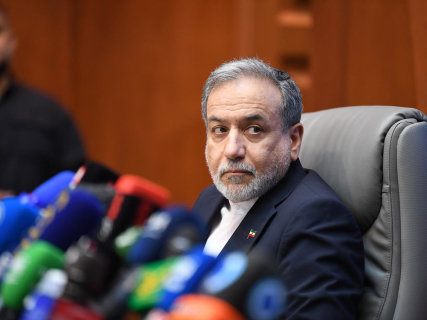
The request appears in a letter from Iran's Foreign Minister, Abbas Araqchi, addressed to the UN Secretary-General, António Guterres, in which the Iranian official repeatedly criticizes the "economic exclusion operation" launched by the Donald Trump Administration against the Islamic Republic, which he labels as a "state terrorism act".
According to Araqchi, these measures "represent an attempt to extend the laws and policies of the United States beyond the limits of its legitimate jurisdiction and to link the sovereign economic decisions of other States to decisions made unilaterally in Washington".
"It deliberately and indiscriminately attacks civilians and is designed to evade the protections granted to them by International Law," the minister has denounced, warning that it "imposes collective punishment by deliberately depriving them of access to food, medicines, medical equipment, energy, and other basic needs".
The head of Iranian diplomacy also maintains that Washington's financial campaign "is a clear deviation from the ruling and order of the International Court of Justice (ICJ)" of October 3, 2018, which urged the U.S. government in Trump's first term to lift sanctions on imports of humanitarian goods and products and on services related to civil aviation security.
Araqchi contrasts two paths for the international community: "Either we must defend the principles of sovereign equality, non-interference, and respect for the sovereign rights of States, enshrined in the United Nations Charter; or we surrender to unilateralism and the intimidation of a rogue State".
In this line, Tehran demands "the Security Council and all members of the United Nations to condemn and reject the use of unilateral coercive measures and secondary sanctions by the United States as tools to force sovereign States to change their legitimate economic interests and trade relations".
Likewise, it urges States to "refrain from recognizing, approving, or implementing such measures that seek to link their sovereign rights to policies unilaterally imposed by the United States."
In the letter, Araqchi also requests Guterres to "assess and report on the humanitarian and human rights consequences of these measures (...) and to ensure that relevant evidence is evaluated, documented, and preserved independently for future accountability and responsibility."
On the strictly internal level, the Islamic Republic, according to the text, "demands that the United States immediately cease its threats and coercive actions aimed at forcing third countries and their nationals to modify their legitimate relations and economic interests."
The minister also warns that "the international unlawful act committed by the United States by carrying out a campaign of economic terrorism through unilateral coercive measures entails international responsibility," which, in his opinion, opens the door to demanding its "obligation to fully compensate for all damages suffered, both material and moral, including the restoration of the previous 'statu quo', the payment of compensation, and satisfaction, in accordance with the demands of International Law."
Tehran ridicules US contacts with Bahrain
So far, only a small number of governments have taken a stance on the economic war waged by Washington against Iran, in which the United States has threatened to sanction those who maintain ties with Tehran.
Among them is China, whose government has promised to adopt "all necessary measures" to "firmly protect its legitimate rights and interests" against any step by the United States against the Asian giant for its economic and trade relations with Iran, a position applauded by the head of the Iranian negotiating team and president of Parliament, Mohamed Baqer Qalibaf.
As part of its global pressure campaign, Washington has intensified diplomatic contacts with other countries. In this context, the Secretary of the Treasury held a conversation with the Minister of Finance of Bahrain, Salman bin Khalifa Al Khalifa, focused on the aforementioned operation.
During the call, Bessent "emphasized the importance of maintaining constant financial pressure on the main economic pillars of Iran and stressed that the United States will hold accountable those who financially support the regime," according to what the Department of the Treasury has published on social media.
The agency added that "both officials agreed on the importance of ongoing coordination between the United States, Bahrain, the partners of the Gulf Cooperation Council (for the Arab States) and the international community in general to combat illicit financing and strengthen economic security."
Tehran has interpreted this approach as a sign of the drift of the U.S. strategy. That exchange has been described as a test of the "authentic parody" that "Washington's policy regarding Iran" has become, according to the spokesman for the Iranian Foreign Ministry, Esmaeil Baqaei.
"It resorts to Bahrain -- a country that practically has no significant economic relations with Iran -- to demonstrate that its 'coalition' works. Then, it 'suspends' sports and academic exchanges with Iran that, in practice, had been inactive for years," Baqaei pointed out in a scathing post on social media, which concludes by emphasizing that the Trump Administration "is sanctioning those who are already sanctioned and calling that void a 'coalition'."