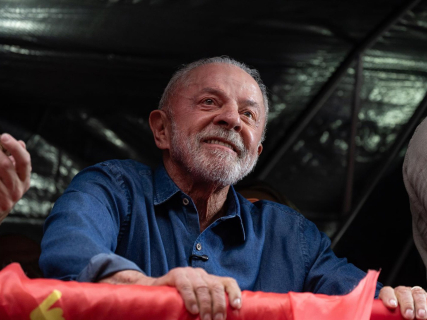

The president of Brazil and candidate for re-election, Luiz Inácio Lula da Silva, has warned that his government is willing to apply the law of commercial reciprocity against the United States if the currently open conversations do not come to a good end. The head of state has emphasized that it is Washington that "should be worried" about the future of the bilateral relationship, stressing that the South American country has resources that Americans need "more than the things I need from them."
Despite the trade clashes of recent months and the clear inclination of the U.S. government towards its electoral opponent, Flávio Bolsonaro, Lula has defended in an interview on the Globo network that his relationship with the president of the United States, Donald Trump, has been "the most civilized" that the Republican leader has maintained with another head of state.
The Brazilian leader has explained that, after a start marked by tension, he appealed to the "judgment" of both parties to navigate conflicts between "the two largest democracies in the West." That change of tone, he has recounted, has been reflected in several meetings and extensive phone conversations, including a last call of "almost an hour and a half" in which he criticized the actions of the United Nations Security Council.
In economic terms, Lula has minimized the relevance of the 9% drop in trade with the United States, which he has contrasted with the results of his policy of opening up to other markets. Thus, he has highlighted that Brazil's exports have increased by 20% with China, 16% with Germany, and 15% with Indonesia, marking historical highs in surplus. "I don't want to make the law of reciprocity, I want to keep negotiating. But if it is necessary to do so, we will do it and I believe they will have a problem with us," he has emphasized.
At the same time, the president has reiterated his firm opposition to Washington's decision to include the main Brazilian criminal factions — such as the First Capital Command (PCC) and the Red Command — on the list of terrorist organizations. Lula has maintained that the United States "does not understand" the nature of these groups, confusing organized crime oriented towards economic benefit with "state terrorism."
As an alternative to what Brasilia perceives as a possible avenue for external interference, the president has confirmed that his Government has already sent Trump a written proposal for bilateral cooperation against drug trafficking, based on the experience accumulated by the Brazilian Federal Police.
These statements from the Brazilian leader occur in the midst of the campaign for the second round of the presidential elections, scheduled for next October 25, in which Lula will face the candidate of the Liberal Party (PL) —and son of former president Jair Bolsonaro—, Flávio Bolsonaro.
In the first round of the elections, Bolsonaro won with 47% of the votes, two points ahead of Lula, who started as the favorite. Looking ahead to the second round, Bolsonaro leads the polls with a margin of just two points, a difference that, in light of the margin of error of the surveys, places both candidates in a technical tie.