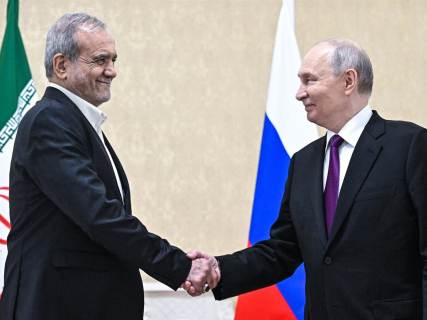

The president of Russia, Vladimir Putin, has reiterated that his country will provide all possible support to his Iranian counterpart, Masud Pezeshkian, in efforts to end the war between Iran and the United States, a confrontation in which, in his view, Tehran has no responsibility.
Both leaders have held a meeting in the city of Avaza, in the republic of Turkmenistan, one day ahead of the initially scheduled date, taking advantage of the meeting of leaders of the Commonwealth of Independent States (CIS) and the Caspian Ecological Summit.
After the meeting, Putin emphasized to the press that Russia's position, an ally of Tehran, is "well known" and that Moscow continues "willing to do everything within its power" to try to resolve the war in Iran, which he has described as "the most serious problem" of the moment.
The Russian leader has insisted on exempting the Iranian government from any implication in the origin of the conflict that began on February 28, after U.S. and Israeli fighter jets carried out a massive attack against Tehran and other key enclaves in the Islamic Republic. This initial offensive resulted in the death of the then supreme leader, Ali Khamenei, and much of his family.
While Washington and Tel Aviv maintain that the war aims to prevent Iran from obtaining a nuclear weapon, a claim that Tehran has repeatedly denied, Putin has highlighted that Iran is making real efforts to stop a war "that has erupted without this country having any blame for it."
In this regard, the Russian president has emphasized that Iran has once again "presented new proposals to resolve the situation by peaceful means," initiatives that, according to him, are being examined by the United States, according to statements collected by the Russian agency Interfax.
Putin's public defense has been received with praise from Pezeshkian, who sees Moscow as the main counterbalance to the United States in international forums, where Tehran claims to face constant blockages from Washington.
"I would like to thank you for your position in the region, as well as at the United Nations. Thanks to your help, they have not been able to impose a unilateral approach on us, and for that, we will always be grateful to you," said the Iranian president.
Pezeshkian has reiterated that the way out of the war requires a "multilateral" approach, since, in his opinion, "the United States is trying to impose its point of view on all the countries of the world from a dictatorial model directed against the internal politics of others."
"We are trying to end the war as soon as possible. And it is essential that everyone respects our rights. But if they rely on a unilateral approach, peace will not happen soon," Pezeshkian has concluded.