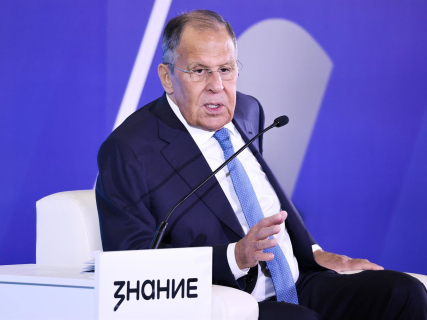

The Russian Foreign Minister, Sergei Lavrov, has communicated that Russia will proceed to close the three delegations of the Goethe Institute in the country, the public body responsible for promoting German culture abroad. The decision is made in reaction to Germany's announcement to close the Russian consulate general in Bonn starting September 18 and to terminate the contract of the House of Russia in Berlin.
"Of course, they will be closed," Lavrov pointed out, who during a conference within the framework of the XI Eastern Economic Forum presented this measure as a response "after our cultural center has been expelled" by the German government, according to the Russian agency Interfax.
The head of Russian diplomacy added that the authorities in Berlin "are deliberately taking a step that, they can only understand, clearly means the end of their cultural presence in the Russian Federation, which had been maintained despite all these twists and turns related to Ukraine in our relations with the West."
In the same intervention, Lavrov reported that the German authorities "found a crashed drone at an airport in Leipzig, Germany, and decided that it was similar --they cannot confirm it, but it is a definitive conclusion-- to those used by the Russian Federation." "Based on this assumption, this hypothesis, this conjecture, they decided to close the last consulate general we had in Bonn and our House of Russia in Berlin," he criticized.
With this move, Moscow responds to the measures announced this week by the German ministers of the Interior, Alexander Dobrindt, and of Foreign Affairs, Johann Wadephul. In a joint appearance, Dobrindt emphasized that Berlin "does not consider Leipzig an isolated incident," but frames it "together with other hybrid actions."
Wadephul detailed on his part that the German Executive will close the Russian consulate general in Bonn starting September 18, will terminate the agreement with the House of Russia in Berlin, and will summon the Russian ambassador to express its protest. He also indicated that the government will propose to the European Union a new 'blacklist' of Russian citizens linked to hybrid attacks and will tighten entry controls for people coming from Russia.
The background of this measure crossover is situated in the frustrated attack last month with drones loaded with explosives at Leipzig airport, in eastern Germany, where authorities located several devices in the vicinity of Ukrainian aircraft.
This airport has consolidated itself as a strategic point for the transit of armament, also linked to the conflict in Ukraine. Since the beginning of the Russian invasion, sightings and reconnaissance operations with drones over critical infrastructure and military targets have multiplied in Germany.