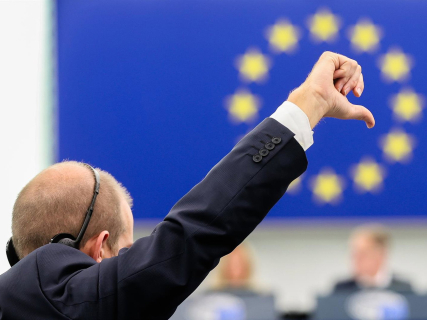

The European Parliament decided this Thursday not to recognize the legitimacy of the Russian Duma after the legislative elections held between September 18 and 20, elections that it has described as "fraudulent" and a "complete simulation," understanding that they took place in a context of political repression and absence of democratic guarantees.
In a resolution approved during the plenary session in Strasbourg (France) with 482 votes in favor, 41 against, and 39 abstentions, the MEPs denounced the irregularities recorded during the voting and accused the regime of Russian President Vladimir Putin of carrying out a "prolonged and deliberate destruction of any remnants of democracy in Russia."
The document states that the elections were "neither free nor fair," as they were held without "real alternative" candidates, without independent media, without credible observers, or political freedoms, in a scenario where opponents of the Kremlin have been imprisoned, murdered, or pushed into exile.
Furthermore, the Eurochamber condemned the organization of voting in the Ukrainian territories occupied by Russia of Donetsk, Kherson, Luhansk, and Zaporizhia, as well as in the Moldovan region of Transnistria and in the Georgian regions of Abkhazia and South Ossetia, considering that they violate the sovereignty and territorial integrity of these States.
Calls on the Twenty-Seven not to recognize the Russian Duma
In this context, the European Parliament has chosen not to recognize the new State Duma as a legitimate representative or as a legislative body of the Russian Federation, a stance it has urged the member States of the European Union to adopt as well.
Specifically, the MEPs have demanded that the Twenty-Seven refrain from maintaining official contacts with the newly formed Duma and its members, and that they block its participation in international interparliamentary assemblies.
The resolution also rejects any legal or political effect derived from the holding of elections in the territories occupied by Moscow and positions itself against normalizing Russia's presence in international sporting and cultural events.
At the same time, the Eurochamber has requested the EU to strengthen and expand sanctions against individuals and entities involved in political persecution within Russia and in the war of aggression against Ukraine.
Among the possible recipients of these sanctions, the MEPs have pointed out judges, prosecutors, officials of the Russian federal financial supervision service, agents linked to repression inside and outside the country, members of the Central Electoral Commission, and those responsible for organizing electoral processes in the occupied territories of Ukraine, Georgia, and Moldova.