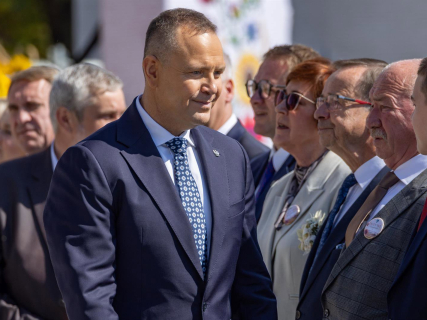

The Minister of Foreign Affairs of Poland, Radoslaw Sikorski, denounced this Monday that the president of the Constitutional Tribunal, Karol Nawrocki, is encouraging Polish ambassadors stationed abroad to tender their resignation. These accusations come amid a political crisis over control of the high court, which has led to the removal of its president amid a large police deployment and protests in front of the institution’s headquarters.
In a message disseminated on social media, Sikorski has assured that "Nawrocki encourages ambassadors to abandon their missions and, for their supposed heroic feats, they will surely be generously rewarded", a comment he made after, in the framework of this crisis, Poland’s ambassador to China, Jakub Kumoch, has left his post.
The head of Foreign Affairs has resorted to a historical parallel with pro-Soviet Poland in 1981, when two diplomats, Zdzislaw Rurarz and Romuald Spasowski, resigned from their posts and requested asylum in the United States and Japan, respectively. As he recalled, that gesture was made "in protest against martial law" and they paid for it by "suffering the reprisals of communist power".
Nevertheless, Sikorski has qualified that the current situation is not comparable to that crisis, underscoring that the institutional situation the country is experiencing today is different, and he has ironized by pointing out that "history rhymes: first as tragedy and the second time as farce".
The origin of the current institutional clash dates back to months of blockage in the swearing-in of the new judges of the Constitutional Tribunal. Nawrocki has only agreed to swear in two of the six magistrates proposed by the Government of Donald Tusk, which has strained to the maximum the relationship between the Executive and the leadership of the tribunal.
The conflict has intensified after the decision to suspend unilaterally, and for a period of one month, the president of the Constitutional Court, Bogdan Swieczkowski, and his vice president, Bartlomiej Sochanski. This measure was adopted while the tribunal’s headquarters remained surrounded by a strong police deployment under orders from Prime Minister Tusk, a circumstance that has generated scenes of great confusion. The opposition party Law and Justice has gone so far as to describe what happened as an attempt at a coup d’état.