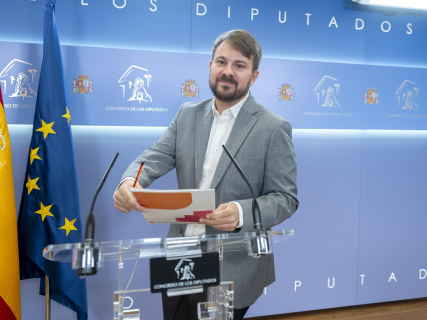

The deputy spokesperson of Sumar in Congress and deputy of Compromís, Alberto Ibáñez, has criticized this Friday that the President of the Government, Pedro Sánchez, "continues on vacation" at the official residence in Lanzarote while a "humanitarian drama and the attack" on Spanish sovereignty in Ceuta by Morocco is taking place.
Ibáñez has pointed out that next week parliamentary committees will be held in which the ministers "who have more weight in the management" of the Ceuta crisis must account for their actions. "But it is evident that it makes no sense for the President of the Government to continue on vacation," he stated on the program 'Al rojo vivo' of 'La Sexta', in statements collected by Europa Press.
In his view, the situation in the autonomous city after the massive arrival of immigrants at the end of July is "very serious" and the head of the Executive "should provide explanations, first of all to the entire Parliament, and then convey calm to the people of Ceuta."
Ceuta, overwhelmed by the arrival of immigrants
"We cannot demand more responsibility and solidarity from the people of Ceuta," the deputy insisted, emphasizing that the Ceuta citizenry is overwhelmed and that the response must be assumed by the entire peninsula, its autonomous communities, and the rest of Europe, given that "it is a southern border of all Europe." "The reception and inclusion of all these people coming in very complex conditions must be shared," he stressed.
In line with what was expressed by the leader of IU, Antonio Maíllo, and the parliamentary spokesperson of the formation, Enrique Santiago, Ibáñez has demanded that the Executive "should have had a permanent and more coordinated presence" in Ceuta. In his opinion, "it is unacceptable how they are treating the girls and boys, the migrant people, but also the Civil Guard, which is in completely unacceptable conditions."
In this context, the deputy of Sumar has criticized the Government of Ceuta and the PP because "they refuse to receive" migrant girls who "flee from misery and war," and has denounced that in Spain it has been possible to "host 350,000 Ukrainian people for fifteen days without any debate, perhaps because they were white and blonde," while now there are obstacles to attend to "500 girls" who entered Ceuta from Morocco.
Morocco, the 2030 World Cup and the "blackmail"
On the other hand, Sumar has reiterated its opposition to Morocco being part of the organization of the 2030 World Cup alongside Spain and Portugal as long as it does not guarantee respect for human rights, and has emphasized that any potential "blackmail" from the Alaouite kingdom is "never tolerable".
In an interview on 'Mañaneros' (TVE) reported by Europa Press, Ibáñez has assured that "right now there is an unprecedented hybrid attack from Morocco against Spain", referring to the massive entry of thousands of immigrants into Ceuta at the end of July, which, in his opinion, has been "orchestrated" based on this country's alliances with the presidents of the United States and Israel, Donald Trump and Benjamin Netanyahu.
In this context, the parliamentarian has defended the need to promote a "different" policy that places respect for human rights "at the center", something that, he has indicated, can be addressed in the debate about football but also in other areas of the bilateral relationship.
In his view, if action is not taken in this way, there is a risk that Vox will use these issues to "instill fear and racism" in Spain, despite being, as he has stated, "friends of the Moroccan regime".
Relationship with Morocco and defense of sovereignty
Regarding the possibility that Morocco may adopt reprisals affecting commercial ties with Spain, Ibáñez has defended that the neighborhood between both countries "is positive as long as the sovereignty and democracy of all countries are respected".
In this line, he has reiterated that "blackmail is never tolerable", whether it comes from the kingdom of Morocco or any other state, and has pointed out that if Rabat aspires to maintain good neighborliness with Spain, it must "return to the consensuses", respect international legality, and accept that Spain "has its own sovereignty".
The Valencian deputy has also maintained that Spain has the right to "defend itself when there is an attack" as well as to preserve "its own foreign policy". And he considers that "what happened in Ceuta cannot be separated" from the Spanish position on Palestine or from the Sahrawi nationality law that is being processed in Congress.