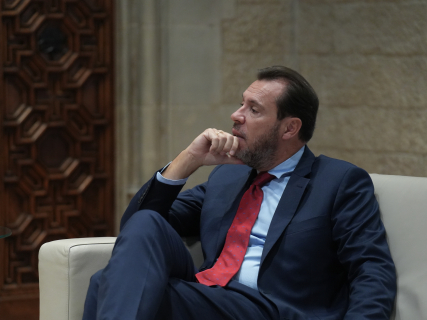
All against Puente or how the left and the right coincide in demanding the resignation of the Minister of Transport

PP, Vox, Frente Amplio, Junts and Adelante Andalucía demand the resignation of the Minister of Transport, while the PNV is considering his dismissal and Podemos strongly questions his explanations. Sánchez, however, has refused to replace him

EuropaPress 7861180 ministro transportes movilidad sostenible oscar puente reunion palau

EuropaPress 7861180 ministro transportes movilidad sostenible oscar puente reunion palau

Add DEMÓCRATA to Google

Ask FREN

Published

Last updated

7 minutes

Most read

Elecciones 29N · Encuestas

La media de las encuestas

Media a 27 de octubre de 2026 · 15 institutos

  • PP31,0 %
  • PSOE27,3 %
  • Vox18,9 %
  • Frente Amplio6,3 %
  • Podemos2,9 %
  • ERC2,3 %
010203040ene 2024jul 2024ene 2025jul 2025ene 2026jul 2026

Media del último estudio de cada instituto en 30 días y su evolución semanal desde el 23J. Partidos con al menos un 2 %.

Todas las encuestas

Elecciones generales del 29 de noviembre · Demócrata

The continuity of Óscar Puente at the head of the Ministry of Transport has caused an unusual political coincidence after the Urda (Toledo) railway accident, which has left at least 69 dead. From Alberto Núñez Feijóo’s PP and Vox to the Frente Amplio of Ada Colau, Junts and Adelante Andalucía, leaders of formations with very different positions have demanded that the minister leave the Government.

The pressure has increased this Friday, when investigations into the railway collision that has caused at least 69 dead are still ongoing and which comes nine months after the Adamuz (Córdoba) accident, where another 46 people died. The two tragedies total at least 115 deaths in 2026, a figure that has reopened the debate about the safety of the railway network and the political responsibility of those who manage it, although the causes of both disasters must be clarified separately.

The President of the Government himself, Pedro Sánchez, has acknowledged that the succession of accidents has broken citizens’ trust in high speed. However, his response has not been to replace the minister. Puente has explained that he put his position at the president’s disposal and that he rejected his departure.

The PP wants Puente to leave before appearing in Congress

The Popular Party is not willing to wait until next Tuesday, when Puente is scheduled to appear before the Permanent Deputation of Congress to offer explanations about the accident. Its parliamentary spokesperson, Ester Muñoz, has this Friday demanded that the minister resign or be dismissed before that appointment, considering that his continuity is incompatible with the seriousness of what happened.

"Puente should not make it to Tuesday", she stated during an interview on Las Mañanas de RNE, in which she reproached the Executive for the management of railway incidents and defended that political responsibilities cannot be postponed until the investigations conclude.

The PP’s demand is no longer limited, moreover, to the head of Transport. Alberto Núñez Feijóo has also called for Pedro Sánchez’s resignation, whom he holds responsible for having appointed the minister and for keeping him in office despite the second serious railway tragedy of the year.

"Whoever has failed in their duty to manage the Ministry safely has to resign, and also whoever put him there," the popular president has said, warning that, if both continue, the PP will try to remove them from Government in the 29N elections.

Vox demands resignations and calls for Puente to be brought before Justice

The Santiago Abascal party has accompanied its resignation demands with a judicial initiative. Vox has announced a complaint against Puente before the Supreme Court for alleged offenses of homicide and injuries through gross negligence, an accusation that must be examined by the Justice system and that does not imply that there is proven criminal liability.

Abascal had already demanded on Thursday, during an event in Ávila, that both the minister and Sánchez leave their posts. This Friday, the deputy José María Figaredo reiterated that position from Barcelona, although he assured that Puente’s resignation would be insufficient if possible criminal responsibilities are not also investigated.

Figaredo has even stated that the minister "should be brought before the courts" and has pointed out that, in his view, the real problem is the alleged "criminal responsibility of this Government".

Colau calls for resignation "as soon as possible" and increases pressure from the left

Ada Colau’s request introduces an important difference with respect to the demands of PP and Vox. The Broad Front candidate for the 29N general elections also believes that Puente must leave Transport, but bases her position on the need to assume political responsibilities and restore travelers’ trust, without attributing direct involvement in the accident to the minister.

"I will not go so far as to say whether this resignation should take place today, tomorrow or the day after, but we believe it should happen as soon as possible, and we hope that it will be so", she said this Friday in Barcelona.

Colau has confirmed that her formation has conveyed this request to Moncloa, convinced that the succession of two serious accidents requires a response that goes beyond technical explanations. For Frente Amplio, the deterioration of public trust obliges political decisions to be adopted, although the specific causes of the tragedy must still be determined.

The pressure on Puente no longer comes solely from his opponents on the right, but also from a candidacy situated to the left of the socialists.

The coordinator of Izquierda Unida, Antonio Maíllo, has also backed the demand for political responsibilities defended by Frente Amplio, which considers the minister's departure necessary to rebuild trust in the railway system.

Junts considers the minister's departure "unpostponable"

For Miriam Nogueras, spokesperson for Junts in the Congress, Puente's resignation cannot wait either. The independence leader has described his departure as "unpostponable" and has called for Sánchez to appear to explain what has happened and what measures he intends to adopt to guarantee railway safety.

"It is unacceptable that today people are afraid to get on a train", she stated from Girona, where she recalled that the President of the Government appeared last February 11, after the Adamuz accident, and committed to preventing a similar tragedy from happening again.

Nogueras has questioned whether railway infrastructure currently offers the necessary guarantees and has rejected the Executive continuing to resort to explanations that, in his view, do not solve the problem.

His request, however, distinguishes between the two political leaders. He demands Puente’s resignation; Sánchez, an appearance to render accounts. The Junts spokesperson has also called for respect for the investigation and has criticized the leak of the conversations between the drivers and the Adif control center.

Adelante Andalucía is clear about it

The demands for resignation from the left are not limited to Frente Amplio. The spokesperson for Adelante Andalucía, José Ignacio García, has also called for the minister’s departure after the Urda accident, considering that a tragedy of this kind forces political responsibilities to be assumed.

García made her request on Thursday, before Colau made public the position of Frente Amplio, and defended that demanding Puente’s resignation is not an exclusive demand of the conservative parties.

Podemos attacks Puente, but does not go so far as to ask for his resignation

Podemos has hardened its criticism against the minister, although, unlike Frente Amplio, it has not expressly called for him to leave the Government.

The party’s candidate for the Presidency, Irene Montero, has questioned the explanations that point to a possible human error at the Adif control center and has rejected that the debate over the accident’s responsibilities end up focusing on a worker.

"Do they really want us to believe that all the responsibility lies with a worker?", Montero has asked, who has also denounced the leak of the conversations prior to the crash and has warned of the risk of singling out employees before the investigation concludes.

Their criticisms are directed both at the initial interpretation of what happened and at the structural problems of the railway system. We may consider it necessary to examine the investments, the incidents and the safety mechanisms, and he has called for urgent explanations from Puente before Congress.

The PNV contemplates dismissal, while ERC and Bildu call for clarifying what happened

Among those who have questioned the Government's response is also the PNV, although its position is more cautious than that of the parties calling for an immediate resignation.

Its spokesperson in Congress, Maribel Vaquero, has argued that political responsibilities must be demanded "at the highest level" and has pointed out that these could lead to the resignation or dismissal of the minister. However, she considers it necessary first to know the causes of the accident in order to determine which decisions are appropriate.

"If it is untenable, he will have to take measures", Vaquero warned, in reference to Sánchez's statements about the seriousness of two railway tragedies having occurred in the same year.

ERC has also called for explanations. Its president, Oriol Junqueras, has demanded that Puente and Adif "show their faces" for the resources allocated to the maintenance of the infrastructure and has questioned the investments in maintenance, although he has not made an explicit request for resignation.

EH Bildu, for its part, has preferred to wait for the investigations to progress before pronouncing itself on possible political responsibilities.

Puente rules out leaving and Sánchez assumes the cost of backing him

Despite the calls for resignation, Puente has no intention of leaving Transportes. The minister explained this Friday that he made his position available to Sánchez and that the president rejected his resignation, considering it unfair for him to personally assume the consequences of an accident whose causes are still under investigation.

"I respect the calls for resignation but my mission is to clarify what happened", he stated during his appearance, in which he defended the need to clarify the failures that may have occurred at the Adif control center and in the safety systems.

Puente has also rejected assigning individual responsibility before having definitive conclusions. "I am not going to use any worker as a shield", he assured, while promising to adopt measures if the investigation uncovers organizational deficiencies or breaches of the protocols.

On Tuesday, the minister must appear before the Permanent Committee of Congress, unless there is some change in his situation. Until then, the pressure will continue to be directed both at him and at the president who has decided to support him. The investigation will determine what happened in Urda and what responsibilities may arise from the accident.

More key points, information and questions with FREN

AI-GENERATED CONTENT

What is the parliamentary process to dismiss a minister in Spain and what procedures would be necessary in this case?

There is no parliamentary procedure to directly dismiss a minister in Spain. The individual dismissal formally corresponds to the king, at the proposal of the president of the Government. The Congress and the Senate can demand explanations and approve a censure, but that vote does not legally oblige the minister to leave office.

1. Individual dismissal: a decision of the president

The fundamental distinction is between demanding political responsibility and formalizing the dismissal. Parliament can reproach a minister's actions and request their departure; the decision to replace them corresponds to the president of the Government, without the need for parliamentary authorization.

To execute it, the dismissal is formalized by royal decree, with the intervention of the king and countersignature of the president, and published in the Official State Gazette (BOE). The appointment of the replacement is formalized separately. A voluntary resignation also does not require a vote of acceptance in the chambers.

2. Censure: how it would be processed

If the intention is for the Congress to express its rejection of a specific minister, a non-legislative motion can be used, that is, a proposal for a political resolution that has no force of law. According to articles 193 to 195 of the Congress Rules, the steps would be:

  • A parliamentary group submits in writing a proposal that states the reasons for the censure and, if desired, requests the dismissal.
  • The Board decides on its admission, orders its publication, and agrees on its processing before the Plenary or the competent committee.
  • It is incorporated into the agenda. Groups can submit amendments up to six hours before the session begins.
  • The debate is held and the text is voted on, with amendments accepted by the proposer. A simple majority applies: more favorable votes than opposing.

Another route is a motion following an interpellation: after a debate on the department's policy, the group presents the motion the next day. Admitted by the Board, it is included in the next plenary session. In both cases, even if the censure is approved, the minister can continue if the president maintains their confidence.

3. Instruments to clarify the facts

Before or simultaneously, questions can be asked, documentation requested, and a ministerial appearance promoted. Committees can summon the minister to report on their department. These actions allow contrasting explanations but do not produce automatic dismissal.

A commission of inquiry can also be created. In the Congress, its creation corresponds to the Plenary, at the proposal of the Government, the Board, two groups, or one fifth of the deputies. Its conclusions are debated in the Plenary and communicated to the Government; they do not replace a dismissal decision nor bind the courts.

4. Motion of no confidence: affects the entire Government

The motion of no confidence is not directed against an isolated minister. It requires the signature of one tenth of the Congress and an alternative candidate for president who accepts the candidacy. The Board verifies the requirements; alternatives can be presented during the following two days and it cannot be voted on before five days from its presentation.

It requires an absolute majority. If it succeeds, the candidate obtains the confidence of the Congress and the Government is replaced, not only the questioned minister. The Senate does not participate in this decision.

5. Application to the case presented

Since you do not indicate which minister nor what facts would motivate the request, the conclusion is procedural: to request their departure, censure; to effectively dismiss them, a presidential decision formalized by royal decree. It is not mandatory to previously hold appearances, an investigation, or a censure. The confidence question also does not allow individual dismissal: it can only be raised by the president and affects the continuity of the Government.

What are the specific powers and functions of the Minister of Transport according to current legislation?

The Minister of Transport and Sustainable Mobility directs the state policy on infrastructure, transport, and mobility, and is responsible for managing their department. Their powers combine the general functions of any minister with the sectoral competencies of the Ministry; not all operational decisions correspond personally to them.

1. Legal framework and political leadership

The main regulations are article 4 of the Law 50/1997, of the Government, articles 60 and 61 of Law 40/2015, and Royal Decree 253/2024, on ministerial structure, modified by Royal Decree 690/2025.

As the senior head of the department, they develop governmental action following the president's guidelines and the Council of Ministers' agreements. They set objectives, approve action plans, allocate budgetary resources, issue instructions, and evaluate results. They also countersign, when appropriate, the acts of the King related to their competencies.

2. Specific areas of Transport

Article 1 of Royal Decree 253/2024 assigns the Ministry the proposal and execution of the following policies, under the minister's direction:

  • State infrastructures: planning and programming investments in land, air, and maritime transport infrastructures.
  • Transport services: control, organization, and administrative regulation of the corresponding state-competent services.
  • Sustainable mobility: promotion of its social, economic, and environmental dimension, including active mobility and the combination of different transport modes, with safety and social justice criteria.
  • Postal services: normative regulation of the sector.
  • Geographic and scientific information: promotion and direction of state services of astronomy, geodesy, geophysics, and cartography.

Among the decisions specifically elevated to the Ministry's head are authorization for the establishment and classification of civil airports and proposals for master plans of airports of general interest and air navigation.

3. Regulations, budget, and administrative management
  • Regulatory power: issues ministerial orders in matters belonging to the department and promotes normative proposals. They do not alone approve draft laws or royal decrees: their approval corresponds to the Council of Ministers.
  • Budget: approves the Ministry's expenditure proposals and budgets of its public bodies to submit them to the Treasury. Administers credits, authorizes and commits expenses, recognizes obligations, proposes payments, and approves the budget modifications that correspond to them.
  • Contracts and aid: enters into contracts and agreements within their competence and grants subsidies, respecting the required authorizations and the powers of other bodies.
  • Organization and personnel: determines or proposes internal organization; makes appointments and dismissals when not reserved to another body; proposes those reserved to the Council of Ministers and exercises legal powers over employment, job positions, and separation from service.
  • Administrative control: resolves appeals, reviews acts ex officio, declares their harmfulness —to challenge them judicially— and resolves conflicts of powers when it corresponds. Also provides the necessary documentation for the State General Account.
4. Coordination, supervision, and limits

Maintains relations with autonomous communities and convenes sectoral conferences. International coordination, especially with the European Union, has a subdirectorate directly dependent on the minister, in collaboration with Foreign Affairs.

Execution is distributed among the State Secretariat, the Undersecretariat, and specialized bodies. For example, the strategic direction and evaluation of Ports of the State, Adif, Adif-High Speed, Renfe-Operator, and Enaire are assigned to the State Secretariat. The 2025 reform also places crisis preventive coordination and victim assistance at that level. Therefore, ministerial direction does not equate to personal management of each file, nor does it allow invading autonomous or other ministries' competencies.

What results did the Popular Party obtain in the last general elections compared to Vox and Frente Amplio?

The Popular Party obtained 137 seats and 33.05% of the votes in the last general elections held, those of July 23, 2023. Vox obtained 33 deputies and 12.39%, while Sumar, the previous electoral reference to the current Frente Amplio, achieved 31 seats and 12.31%. Precision is important: Frente Amplio did not run under that name, so it is not appropriate to directly attribute Sumar's result to it (23J results).

The results of the three candidacies
Candidacy in 2023National voteSeats
Popular Party33.05%137
Vox12.39%33
Sumar12.31%31

These figures correspond to electoral results, not voting intention estimates. The PP was the most voted candidacy; Vox and Sumar were much closer to each other, both in vote percentage and parliamentary representation (electoral results).

The PP's advantage over Vox

The PP obtained 104 more deputies than Vox: 137 versus 33. In vote percentage, the difference was 20.66 percentage points, comparing the 33.05% of the Populars with the 12.39% of Vox. In terms of representation, the PP obtained slightly more than four times Vox's seats; in vote percentage, its result was approximately 2.7 times greater (23J results).

It is advisable to distinguish both measures. Percentage points express the distance between their vote percentages, while the 104 additional deputies express the difference in Congress. They are not two interchangeable ways to describe the result: one compares electoral support and the other parliamentary representation.

Comparison with Sumar and Frente Amplio

Compared to Sumar, the PP obtained 106 more seats: 137 versus 31. The vote gap was 20.74 percentage points, resulting from subtracting Sumar's 12.31% from the PP's 33.05%. Therefore, the Populars' advantage over Sumar was slightly greater than over Vox, both in votes and deputies (23J results).

However, those 31 seats belong to the 2023 Sumar candidacy, in which Podemos and other forces participated. They serve as a precedent to compare the electoral space of the later Frente Amplio, but not as a result obtained by an identical candidacy. Information about the new electoral offer reflects that difference in composition and denomination (Frente Amplio in Demócrata).

Vox and Sumar were very close

Between Vox and Sumar there was only 0.08 percentage points difference: 12.39% versus 12.31%. Vox obtained two more deputies, 33 versus 31. That proximity contrasts with the distance that separated both candidacies from the PP, which surpassed each by more than twenty percentage points and more than one hundred seats (comparison of results).

In short, the correct comparison of the last polls is PP: 137; Vox: 33; Sumar: 31. The figures published in polls for the November 29, 2026 elections are projections, not results already obtained, and should not be mixed with this 2023 balance (comparison published by Demócrata).

Play

Test your knowledge with FREN!

How much do you know about this topic? Answer the following 3 questions.

Which party has filed a complaint with the Supreme Court against Minister Óscar Puente?

Question 1 of 3

How many fatalities have the Urda and Adamuz railway accidents in 2026 caused?

Question 2 of 3

What has Óscar Puente done regarding his position after political pressure due to the railway accidents?

Question 3 of 3