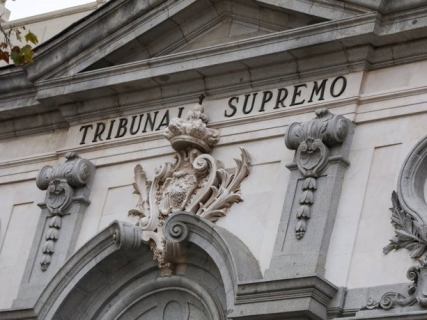
Vox files a complaint against Óscar Puente before the Supreme Court over the Urda accident

Abascal’s party asks that the minister testify as a suspect and demands that his conduct be examined in light of the warnings about railway safety and the fulfillment of the commitments acquired with the unions in February

fotonoticia 20261024111748 1920

fotonoticia 20261024111748 1920

Add DEMÓCRATA to Google

Ask FREN

Published

Last updated

3 minutes

Most read

Elecciones 29N · Encuestas

La media de las encuestas

Media a 27 de octubre de 2026 · 15 institutos

  • PP31,0 %
  • PSOE27,3 %
  • Vox18,9 %
  • Sumar6,3 %
  • Podemos2,9 %
  • ERC2,3 %
010203040ene 2024jul 2024ene 2025jul 2025ene 2026jul 2026

Media del último estudio de cada instituto en 30 días y su evolución semanal desde el 23J. Partidos con al menos un 2 %.

Todas las encuestas

Elecciones generales del 29 de noviembre · Demócrata

Vox has filed a complaint before the Second Chamber of the Supreme Court against the Minister of Transport and Sustainable Mobility, Óscar Puente, for alleged crimes of homicide and injuries through gross negligence, in the form of commission by omission, in relation to the railway accident that occurred this Wednesday in Urda (Toledo). The group considers it necessary to investigate whether the head of the department failed to comply with his duties of management, supervision and control in railway safety matters and requests that he appear before the High Court as a person under investigation.

The judicial initiative focuses on determining what information the minister received about possible deficiencies in the railway network, what actions he promoted to correct them and how he supervised their execution. According to Vox in its filing, the investigation must also clarify whether Puente requested the necessary reports to know the state of railway safety and whether he adopted the measures corresponding to his responsibilities.

The complaint is filed when the causes of the collision have still not been officially determined, a circumstance that the group itself acknowledges in its filing. Vox does not attribute to the minister the specific decision to authorize the resumption of rail traffic, but rather raises a possible criminal liability derived from the omissions that it considers necessary to investigate.

Vox asks to investigate the railway safety commitments acquired in February

Among the background information included in the complaint are the warnings and claims made after the Adamuz and Gelida railway accidents, as well as the agreement reached last February 9 between the Ministry of Transport and the trade union organizations to reinforce the maintenance of the infrastructures, staffing levels, and safety conditions.

The group requests that it be checked to what extent the commitments undertaken had been carried out and that the seven measures that, according to the documentation collected in the filing, were still under processing on October 16 be identified.

With this request, Vox seeks for the judicial investigation to examine both the warnings conveyed to the Ministry officials and the decisions subsequently adopted to address them, with special attention to the monitoring and verification mechanisms of the committed actions.

They request Puente's statement

The complaint includes a series of investigative steps aimed at reconstructing the actions of those responsible for railway safety before the accident. In addition to requesting that Óscar Puente testify as a suspect, Vox asks that the reports, communications and alerts received by the Ministry of Transport and Adif related to possible safety shortcomings be added to the proceedings.

The party also calls for the protocols applicable when failures occur in railway protection systems to be examined, with the aim of determining what procedures were envisaged and what measures should have been adopted in situations of this kind.

Among the requested statements are those of officials from the ministerial department, representatives of trade union organizations and members of the victims' association of the Adamuz accident. Likewise, Vox proposes the preparation of an independent expert report that would make it possible to identify any existing shortcomings and establish what specific actions could have prevented the collision.

Another complaint against Adif officials

The filing submitted to the Supreme Court also refers to another complaint filed by Vox against Adif officials with powers in circulation and railway safety, whose actions it requests be incorporated to facilitate the coordination of both investigations.

The party thus differentiates between the operational decisions directly related to the movement of the trains and the possible oversight responsibilities that it attributes to the minister in the exercise of his functions.

More key points, information and questions with FREN

AI-GENERATED CONTENT

What parliamentary phase is the February 9 agreement to strengthen railway maintenance and safety currently in?

The agreement of February 9, 2026 is not in a parliamentary phase: it is a pact between the Ministry of Transport, Adif, Renfe, and the unions SEMAF, UGT, and CCOO, not a bill pending approval. Its status should be described as execution of administrative, labor, and regulatory commitments, with actions following different paths. There is no record in the consulted sources of legislative processing of the agreement as a single text.

What was agreed and who must apply it

The official Transport communication identifies the pact as the result of negotiations with the unions to call off the strike days. It announced 1.8 billion euros additional in maintenance and 3,650 jobs, as well as organizational and safety changes. This does not equate to the approval of a law nor does it automatically open a procedure in the Congress or Senate.

Implementation is distributed among several instruments:

  • Maintenance funding: it was agreed to process two agreements with the General State Administration, one for Adif and another for Adif AV, for 2026-2030. For Adif, 861 million euros in maintenance were announced for 2026, reaching 1.179 billion in 2030; for Adif AV, a 44% growth between 2025 and 2030.
  • Employment: the commitment includes 2,400 additional positions at Adif during 2026-2030, 1,200 additional contracts at Renfe, and 50 structural positions at the State Railway Safety Agency.
  • Regulatory changes: it was agreed to modify Royal Decree 929/2020 to count as effective driving the stops of train drivers shorter than 45 minutes. There is public information dated April 24, 2026, about a draft modification of that royal decree; this regulatory procedure should not be confused with a law under parliamentary processing.
  • Budgets: it was agreed to include in future budget laws a replacement rate not less than 115% for Adif. This is a future incorporation commitment, not a budget approval made by the pact itself.
What is known about its execution

The agreement foresaw a joint monitoring commission, whose first meeting was to be held within a month, and a safety coordination committee with union participation. It also contemplated working groups on temporary speed limits and weather alerts. These are application and monitoring mechanisms, not parliamentary phases.

According to information published by Demócrata on October 17, Renfe maintained that it had fulfilled its commitments and that, of 24 measures corresponding to other bodies, 17 were executed and seven were still being developed through administrative, technical, and regulatory procedures. That is the operator's version, not a parliamentary certification of full compliance with the agreement.

What happens with related parliamentary initiatives

There are initiatives on railway safety, but they do not constitute the processing of the pact. For example, non-legislative proposals 162/000679 and 161/002923, directed respectively to the Plenary and the Transport Commission, were published or admitted before the agreement, on January 30 and February 3. Both expired on October 6, 2026. The dissolution of the Chambers does not, however, turn the administrative and labor pact into an expired agreement.

In conclusion, it is not pending committee, amendments, Congress vote, or referral to the Senate. What remains is to complete and verify the committed measures, distinguishing those already executed from those requiring funding, administrative decisions, or regulatory development.

What are the legal competencies of the Minister of Transport and Sustainable Mobility according to Spanish law?

The Minister of Transport and Sustainable Mobility has the competence to direct the state policy on transport, infrastructure, and sustainable mobility, within the powers reserved to the State by the legal system. His functions are not gathered in a single law: they result from general government laws and royal decrees that define and organize the department. It is important to distinguish between the minister's personal powers and the functions exercised by the ministry's bodies under his direction.

1. General functions as minister

Article 4 of Law 50/1997, of the Government assigns him the following functions:

  • Develop the Government's action in his department, according to the agreements of the Council of Ministers and the president's guidelines.
  • Exercise the regulatory power, that is, approve general provisions in the ministry's own matters.
  • Exercise the competencies attributed to him by laws and other applicable provisions.
  • Endorse, when appropriate, the king's acts related to his competencies.

Therefore, he has direct responsibility over his management but does not act outside presidential direction or the Government's collegiate decisions.

2. Matters he directs

Article 7 of Royal Decree 829/2023 assigns him the proposal and execution of policies on infrastructure and land transport of state competence, air and maritime, to guarantee fair and sustainable mobility.

Article 1 of Royal Decree 253/2024 specifies that scope:

  • Infrastructure: policy on land, air, and maritime transport infrastructure of state competence, and planning and programming of their investments.
  • Transport services: control, ordering, and administrative regulation of the corresponding services.
  • Sustainable mobility: promotion of its social, economic, and environmental dimensions, including active mobility.
  • Postal services: normative regulation of the sector.
  • Geographic information: promotion and direction of state services of astronomy, geodesy, geophysics, and cartography.
3. Planning and execution through the department

The minister directs an organization whose tasks are legally distributed. Article 2 of Royal Decree 253/2024 assigns to the State Secretariat, under his direction, the definition and proposal of infrastructure, transport, and mobility policies.

Among those functions are strategic planning; investment programming; execution of infrastructure, directly or through attached entities; coordination of different transport modes; and monitoring of dependent bodies. It also includes cooperation with territorial administrations in sustainable urban mobility and promotion of aids and economic instruments.

This means that not every ministry decision corresponds personally to the minister: some belong to the State Secretariat or other bodies by normative attribution.

4. What norms he can approve and which he must propose

According to articles 5 and 24 of the Government Law, the minister can issue ministerial orders within his competence. These have a rank below royal decrees.

He can promote normative proposals from his department, but the approval of bills and royal decrees corresponding to the Government belongs to the Council of Ministers. He also cannot approve a royal decree-law alone.

5. Limits regarding other competencies

The attribution over transport does not equate to directing any matter related to mobility. Royal Decree 253/2024 requires coordination and respect for other ministries' competencies. For example, Royal Decree 829/2023 assigns traffic and road safety to the Interior Ministry, and housing, land, and Urban Agenda to the Ministry of Housing. Additionally, the described scope is limited by state competence, not by a general authority over all transport.

What is Óscar Puente's political and professional background and which party does he belong to?

Óscar Puente Santiago belongs to the Spanish Socialist Workers' Party (PSOE), in which he has been a member since 1990. A lawyer by profession, he was mayor of Valladolid between 2015 and 2023 and has been Minister of Transport and Sustainable Mobility since November 2023. His career combines twenty years of professional practice with municipal responsibilities, internal PSOE positions, and national political activity.

Education and professional background

He was born in Valladolid on November 15, 1968. He holds a law degree from the University of Valladolid and a master's degree in Political Management from the Jaime Vera Foundation, according to his official biography.

He practiced law from 1995 until June 2015, when he assumed the Mayorship of Valladolid. Therefore, during his first years as a councilor, he combined law practice with political activity. His professional experience prior to municipal government was focused on law, not on a technical career linked to transport or infrastructure.

Early responsibilities in the PSOE

Although his affiliation dates back to 1990, he began holding organizational responsibilities in 2004, as deputy secretary general of the Provincial Executive of the PSOE of Valladolid. In 2009 he became secretary general of the municipal group, a responsibility he held until December 2021, when he assumed the provincial Secretary General. These positions correspond to party organization and are distinct from his public institution posts.

His first national leap within the PSOE came in June 2017, after Pedro Sánchez's victory in the socialist primaries. He was appointed spokesperson of the Federal Executive Commission and held that role until October 2021. During that stage, he combined the Mayorship with public communication of the party's positions, as noted in this Demócrata profile.

Municipal stage in Valladolid

He was elected councilor of the Valladolid City Council in 2007 and became head of the socialist municipal group in 2008. He remained eight years in opposition before accessing the Mayorship in June 2015. Although the PP had been the most voted force, Puente gathered an alternative majority that allowed his election.

He continued as mayor after the 2019 municipal elections, in which the PSOE was the leading force. His term ended in June 2023: the socialists were again the most voted candidacy, but the sum of PP and Vox allowed Jesús Julio Carnero to obtain the Mayorship. Puente thus completed two terms and eight years at the head of the City Council.

He also had municipal representation responsibilities: he presided over the Spanish Network of Healthy Cities between 2015 and 2019 and was part of the Governing Board of the Spanish Federation of Municipalities and Provinces until 2023.

Congress and Ministry of Transport

In the July 2023 general elections, he obtained a seat for Valladolid. In September, he spoke on behalf of the PSOE during Alberto Núñez Feijóo's investiture debate, an action that expanded his national projection. In November of that year, he was appointed Minister of Transport and Sustainable Mobility of Pedro Sánchez's Government, succeeding Raquel Sánchez.

At the head of the department, his scope of responsibility covers railways, roads, ports, airports, and mobility policies. He also maintains his political ties with Valladolid and is listed as the socialist lead candidate for that province for the November 29, 2026 elections, according to the candidacies published by Demócrata.

Play

Test your knowledge with FREN!

How much do you know about this topic? Answer the following 3 questions.

What does Vox request in its complaint against Óscar Puente following the Urda accident?

Question 1 of 3

What agreement did the Ministry of Transport reach on February 9, mentioned in the complaint?

Question 2 of 3

What element does Vox highlight in the investigation into the Urda railway accident?

Question 3 of 3