Live, the Congress validates two royal decree-laws

The Permanent Deputation will vote this Friday on the decrees regarding the dana and the aid for the crisis in the Middle East, while a new session remains pending to ratify the housing measures.

https://www.youtube.com/embed/4NmITqMQ8MM

Add DEMÓCRATA to Google

Ask FREN

Published

1 minute

Most read

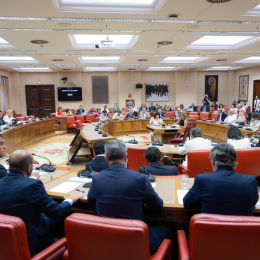
Activity returns to the Congress, for the first time, after the dissolution of the Cortes, and it does so with the help of the Permanent Deputation. The governing body will decide this Friday starting at 11:00 hours on the validation or repeal of two royal decree-laws. The first, which establishes immediate response measures and reconstruction of the municipalities affected by the flood in October 2024; and the second, extending aid to address the crisis in the Middle East.

In the coming weeks, it will be necessary to convene another session to address the two recently approved royal decree-laws on housing by the Council of Ministers and that the Executive, now yes, hopes to push forward thanks to the arithmetic of the body.
More key points, information and questions with FREN

AI-GENERATED CONTENT

What are the competencies and functions of the Permanent Deputation of the Congress according to the Chamber's Regulations?

The Permanent Deputation of the Congress guarantees the continuity of the Chamber when it is not in session. According to the Regulations, its general mission is to "ensure the powers of the Chamber," but its specific powers vary between periods without sessions and situations of dissolution or expiration of the mandate: it does not generally replace the Plenary.

1. Guarantee and continuity function

Article 57 establishes this mission of protecting the powers of the Congress. During ordinary session periods, it is not attributed a general alternative competence to that of the Plenary: the special functions it lists correspond precisely to situations in which the Chamber is not convened or its mandate has ended.

Furthermore, article 22.3 keeps its members, both titular and substitutes, in office until the constitution of the new Chamber. This avoids a gap in parliamentary continuity between legislatures.

2. Between session periods

Articles 57.2 and 61 allow the Permanent Deputation to request extraordinary sessions of the Congress. Ordinary periods run from September to December and from February to June; outside these, sessions can also be requested by the Government or the absolute majority of the members of the Congress.

The request must include the proposed agenda. The Presidency convenes the session according to that request and the Chamber remains convened until the agenda is exhausted. Therefore, in this case, the Permanent Deputation promotes the meeting of the Congress, instead of automatically assuming all its legislative and control functions.

3. After dissolution or expiration of the mandate

Article 57.1 attributes two especially relevant blocks of competencies:

  • Decree-laws: it assumes all the powers that article 86 of the Constitution assigns to the Congress regarding these Government provisions.
  • States of alarm, exception, and siege: it exercises the powers that article 116 of the Constitution assigns to the Chamber. Article 165 of the Regulations confirms that the powers of the Plenary provided in that chapter pass to the Permanent Deputation.

Therefore, it is not an unlimited authorization to continue all parliamentary activity. Article 207 excepts from the expiration of pending matters those that constitutionally must be known by the Permanent Deputation.

4. Powers over decree-laws

Article 151 specifies that the debate and vote on the validation or repeal of a royal decree-law must be held before thirty days have passed since its promulgation, in the Plenary or in the Permanent Deputation, as appropriate.

Additionally, its section 5 allows the Permanent Deputation to process decree-laws issued by the Government during inter-legislature periods as bills, through the urgent procedure. Its intervention is therefore not limited to deciding whether to maintain or repeal the decree-law.

5. Organization, other functions, and accountability

According to article 56, it is chaired by the Presidency of the Congress and has a minimum of twenty-one members, proportionally distributed among parliamentary groups. It is convened by the Presidency on its own initiative or at the request of two groups or one-fifth of its members.

Article 58 applies the rules of the Plenary to its sessions and functioning. The Regulations also provide that the Ombudsman presents before it, when appropriate, a summary of their reports, followed by interventions from the groups.

Finally, article 59 requires that, once the new Congress is constituted, it reports to the Plenary on the matters addressed and decisions made.

Reference: Congress Regulations.

What legal requirements must be met for the validation of a royal decree-law in the Congress of Deputies?

The validation of a royal decree-law requires an express pronouncement by the Congress within thirty days following its promulgation, through a debate and a vote on its maintenance or repeal. It is approved by a simple majority, not by an absolute majority. Additionally, the decree-law must respect the constitutional requirements that allow the Government to use this exceptional figure.

1. Constitutional basis and material limits

Article 86 of the Constitution allows the Government to issue provisional legislative provisions when there is an extraordinary and urgent need. Validation does not replace this requirement: the Government must justify why it is necessary to act through a decree-law instead of waiting for the approval of a parliamentary law.

The Constitution also prevents decree-laws from affecting the organization of the basic State institutions, the rights, duties, and freedoms of citizens regulated in Title I, the regime of autonomous communities, or general electoral law. These are constitutional limits, distinct from parliamentary rules for approving validation.

2. Deadline and competent body

Article 151.1 of the Congress Regulations establishes that the debate and vote must be held before thirty days have passed since promulgation. It is not enough to send the decree-law or announce its debate within that period: the parliamentary decision must take place.

Its inclusion in the agenda can be made from the moment it is published in the Official State Gazette. If the Congress is not convened, it must be called for this purpose. When the Chamber is dissolved or its mandate has expired, the Permanent Deputation acts, assuming the Congress's powers regarding decree-laws.

3. Debate and voting requirements

According to article 151.2 of the Regulations, a Government member must present to the Chamber the reasons that led to the promulgation of the decree-law. Then a debate is held subject to the rules of totality debates.

  • Decision on the whole: the vote is to maintain or repeal the decree-law, not to modify its articles through amendments during this process.
  • Vote meaning: affirmative votes favor validation; negative votes favor repeal.
  • Quorum: to validly adopt the agreement, the majority of the members of the deciding body must be present.
  • Simple majority: more votes in favor than against are needed. Abstentions are not added to either block.

The Senate does not intervene in this decision. Neither is a reinforced majority required due to the political or economic importance of the measures: what matters is that their content respects constitutional limits.

4. Result and possible legislative processing

Validation maintains the decree-law's validity but does not automatically convert it into a parliamentary law nor eliminate the possibility of controlling its constitutionality. If repeal is agreed, it ceases to be in force; this does not automatically erase all effects produced during its provisional validity.

Once validated, the Presidency asks if any parliamentary group requests to process it as a bill. If there is a request, the Chamber makes a second decision. When approved, the urgent procedure is followed, allowing modifications, although total return amendments are not admitted.

Finally, article 151.6 requires publishing the validation or repeal agreement in the Official State Gazette. The procedure is included in the Congress Regulations.

What have been the results of the latest general elections and how is the Permanent Deputation of the Congress currently composed?

The latest general elections held in Spain were on July 23, 2023. The PP obtained the highest number of seats, 137, but no candidacy reached the 176 that mark the absolute majority of the Congress. Currently, as of October 16, 2026, the Permanent Deputation has 69 titular members: the president of the Congress and 68 representatives appointed by the parliamentary groups.

Results of the July 23 elections

The final distribution of the 350 seats of the Congress was as follows. It is important to distinguish these results from polls published afterward: the former come from a held vote; the latter are estimates, not a new composition of the Chamber.

  • People's Party: 137 deputies.
  • PSOE: 121 deputies.
  • Vox: 33 deputies.
  • Sumar: 31 deputies.
  • Esquerra Republicana de Catalunya: 7 deputies.
  • Junts per Catalunya: 7 deputies.
  • EH Bildu: 6 deputies.
  • EAJ-PNV: 5 deputies.
  • Galician Nationalist Bloc: 1 deputy.
  • Canarian Coalition: 1 deputy.
  • Navarrese People's Union: 1 deputy.

PP and Vox combined 170 deputies, six less than the absolute majority. PSOE and Sumar gathered 152. These sums only describe the arithmetic of the electoral result, not an automatic investiture majority or an agreement between parties. The distribution of the first four is recorded in the comparison published by Demócrata; official electoral data can be found through the electoral results catalog.

Current composition of the Permanent Deputation

The distribution of its 68 seats appointed by the groups is as follows. Added to them is Francina Armengol, who chairs the body as president of the Congress:

  • Popular Group: 27 titular and 27 substitutes.
  • Socialist Group: 24 titular and 24 substitutes.
  • Vox Group: 6 titular and 6 substitutes.
  • Plurinational Sumar Group: 6 titular and 6 substitutes.
  • Republican Group: 1 titular and 1 substitute.
  • Junts Group: 1 titular and 1 substitute.
  • EH Bildu Group: 1 titular and 1 substitute.
  • Basque Group, EAJ-PNV: 1 titular and 1 substitute.
  • Mixed Group: 1 titular and 1 substitute.

Therefore, there are 69 titular and 68 substitutes; substitutes do not add as many votes to the body. It is also important not to confuse the 24 seats appointed by the Socialist Group with Armengol's presidency, which is counted separately. The composition can be consulted on the official Congress portal and in the Demócrata explanation.

Who leads the body
  • President: Francina Armengol Socias.
  • First Vice President: Alfonso Rodríguez Gómez de Celis, from the Socialist Group.
  • Second Vice President: José Antonio Bermúdez de Castro Fernández, from the Popular Group.
  • First Secretary: Esther Gil de Reboleño Lastortres, from Sumar.
  • Second Secretary: Marta González Vázquez, from the Popular Group.

Among the titular representatives of the groups with a seat are Gabriel Rufián for the Republican, Míriam Nogueras for Junts, Mertxe Aizpurua for EH Bildu, and Ione Belarra for the Mixed. The list of members allows for more nominal detail. The essential difference is that the electoral result is expressed by candidacies, while the Permanent Deputation is organized by parliamentary groups.

Play

Test your knowledge with FREN!

How much do you know about this topic? Answer the following 3 questions.

Which body of Congress has met to vote on the validation or repeal of two royal decree-laws?

Question 1 of 3

What measure is included in the first royal decree-law submitted for voting?

Question 2 of 3

What topic will be addressed in future sessions according to the Government?

Question 3 of 3