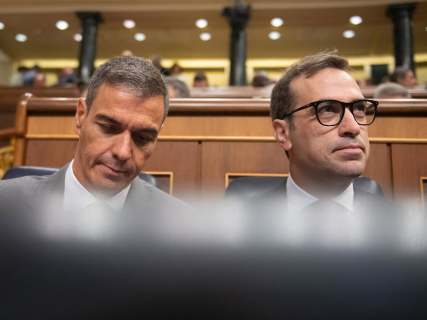

The Permanent Deputation of the Congress, the only body of the Chamber that remains operational after the dissolution of the Cortes, will submit for voting this Friday, October 16, the decree laws that include the aid for fuels derived from the war in Iran and the one that introduces a waiver of the repayment of the advances linked to the aid granted by the flood of 2024.
This will be the first session of the Permanent Deputation after the call for general elections. This body will have to meet again, at least on one more occasion, to discuss the validation of the two decree laws on housing that the Government re-approved, with changes, after their previous texts lapsed in the Plenary of the Congress on October 2, a circumstance that prompted the electoral advance.
The two decree laws that will be examined this Friday were approved by the Council of Ministers on September 29, that is, before the President of the Government, Pedro Sánchez, announced the call for the elections.
As happens with any decree law, the texts must be sent to Congress within a maximum period of 30 days for it to decide whether to validate or repeal them. Since the Cortes are now dissolved due to the electoral advance, the debate and voting will fall to the Permanent Deputation, which assumes the powers of the Chamber when it is dissolved.
The Deputation is made up of 69 deputies, distributed as follows: 27 representatives of the PP, 25 of the PSOE (including the vote of the President of Congress, Francina Armengol), six from Vox and six from Sumar. ERC, Junts, Bildu, and Podemos, which in this body acts on behalf of the entire Mixed Group, each have one vote.
Aid against the energy crisis
The Deputation must pronounce on the new package of measures, which includes support to alleviate the price increase resulting from the war in Iran, among them the extension until December 31 of the tax reductions on gasoline and diesel, as well as the cap on the regulated gas tariff and the price of the butane cylinder.
The decree establishes that if the CPI of gasoline or diesel increases by more than 15% compared to the same month of the previous year, the subsidy will be 20 cents per liter. The INE has confirmed that in September the CPI exceeded that threshold, so the aid for fuel will continue at 20 cents per liter during the month of November.
Along with the reduction in fuel, the text recovers two measures that were already in effect during the most intense phase of the war in Ukraine: the weight of the gas quotation in the calculation formula of the Last Resort Tariff (TUR) for natural gas is limited, and a maximum price of 19.55 euros is established for the butane cylinder.
The regulation determines that the weight of the gas quotation can only increase by 35% compared to the current value, so that the final increase of the TUR is around 15%. This intervention, coinciding with the arrival of winter and the expected increase in consumption due to heating, will continue over time. Thus, in the following quarterly revisions of the TUR, the maximum increase of the gas quotation will be limited to 15% until the accumulated deficit is compensated and equilibrium is restored.
Regarding the butane cylinder, although the calculation formula for the maximum selling price of packaged LPG already contemplates a maximum variation of 2% upwards or downwards in each bimonthly revision, a cap price of 19.55 euros is set until June 30, 2027, guaranteeing consumers' access to this basic supply, whose current maximum price is 18.84 euros. Any possible deficit generated will be recovered through the usual mechanism.
Reduction of VAT if electricity prices rise
The decree also maintains the safeguard clause that allows for a reduction in VAT and the special tax on electricity. If the CPI for September 2026 is 15% higher than that of the same month of the previous year, the VAT on electricity and gas will drop from 21% to 10%, and the Electricity Tax will be reduced from 5.1% to 0.5%.
This tax reduction on the electricity bill will apply to consumers with contracted powers below 10kW and to beneficiaries of the social bonus, while the VAT reduction will also reach natural gas, briquettes, and pellets, and wood intended for firewood.
At the same time, the reserves of liquefied natural gas for the winter period are expanded, and the system of energy savings certificates is strengthened, in addition to extending the measures that were already in effect until the end of the year.
Extension of aid for transport and agricultural diesel
In the most affected sectors, aid for agriculture and professional road transport is extended.
Specifically, the aids for land transport are extended throughout 2026, with a partial refund of the hydrocarbon tax of 5 cents per liter in October, 12 in November, and 19 in December, in addition to supports for maritime and rail transport.
Likewise, the aid for agricultural diesel is maintained until December 31 with a bonus of 20 cents per liter and the compensatory aid for fishing vessel owners.
As a novelty, a specific line is created for freight rail, with 15,000 euros of aid for each diesel locomotive, a demand from the sector itself. Social measures are also preserved, such as the obligation for companies receiving aid not to carry out layoffs.
New assignments to the CNMC on energy and food
The decree incorporates two additional requests to the CNMC. The first consists of the preparation of a study on price formation in wholesale and retail markets, analyzing the functioning of the distribution and marketing of energy throughout the entire value chain.
The second assignment focuses on the functioning of the food value chain and asks the CNMC for recommendations to ensure the proper functioning of the market and the effectiveness of the measures being applied.
Partial forgiveness of the refund of aid due to the dana
In the same Council of Ministers, another decree law was approved to modify several sections of the regulation that governed the aid for the damages caused by the dana recorded between October and November 2024.
In particular, the text establishes a forgiveness of the reimbursement of the advances on account of the aid provided for in article three of the law, in order to prevent the return of those amounts from causing "a new harm to people who still bear the consequences of the disaster".
The Executive estimates that about 44.35 million euros will be forgiven and that the number of people initially required to return all or part of the advance amounts to 2,771.
The forgiveness will not be universal. Thus, the beneficiaries who will have to return the advance will only be those with an income exceeding 42,000 euros per year in 2025, or with a wealth exceeding 300,000 euros, excluding the primary residence.